HOT NEWS !
Stay informed on the old and most recent significant or spectacular
nautical news and shipwreck discoveries

-
Treasure hunters suspected to have looted 1915 shipwreck
- On 06/12/2017
- In Illegal Recoveries
By Joseph Brean - The Province
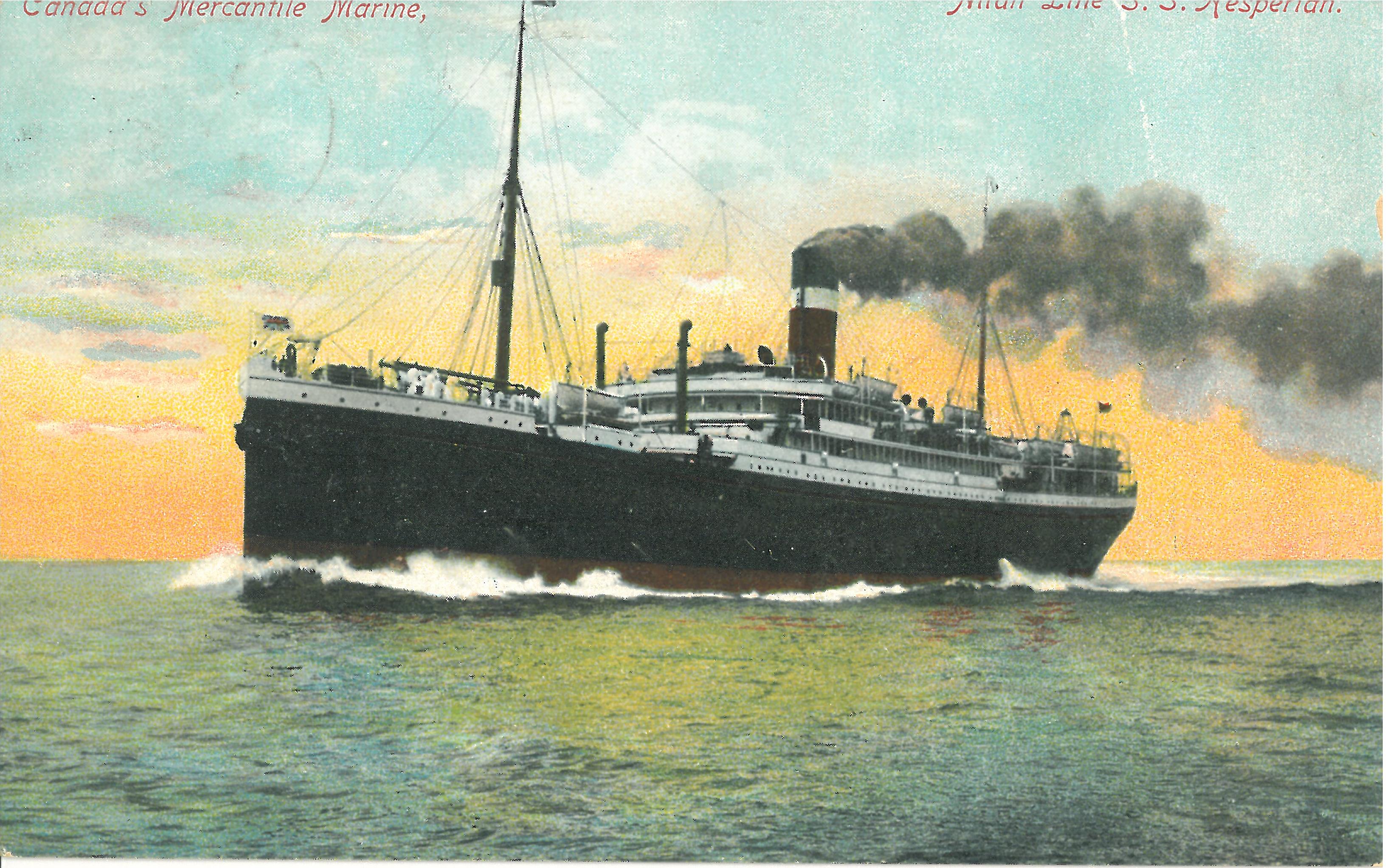
Scuba-diving pirates have ransacked a 1915 shipwreck that contains the embalmed body of a Montreal socialite philanthropist, along with stores of gold and treasure that were being shipped to Canada for safety as Europe fell into war, according to an Irish marine biologist.
Blood-stained canvas hammocks that were used by wounded Canadian soldiers on board the ocean liner Hesperian have surfaced over the past few weeks in the waters off Ireland’s southern coast, suggesting the century-old wreck has been recently disturbed.
This follows the discovery by fishermen in their nets of brass taps and water pipes, which have been reported to Ireland’s heritage ministry, and are being preserved by Kevin Flannery of the Dingle Oceanworld Aquarium in Ireland.
“There is obviously interference with the wreck because all that stuff would have been washed away in the last 100 years never mind one bad storm,” he told The Times of London. “These are pirate treasure hunters with no respect for the dead.”
A mysterious ship, which refused to make radio contact and did not have an automatic identification system, has been seen near the wreck site, with no clear reason for being there, he said.
“I think they obviously blew the ship to get at the safes or whatever they were looking for,” he said. “It’s grave robbing.”
-
Ancient Roman shipwrecks
- On 23/11/2017
- In Underwater Archeology
By Jack Moore - Yahoo News
The Egyptian government announced Tuesday that archaeologists have uncovered three sunken, millennia-old shipwrecks off the country's north coast. The wrecks, filled with ancient artifacts, are Roman and date back when the empire spread over Europe and North Africa.Inside the wrecks, archaeologists discovered three gold coins that date to the time of ancient Rome’s first emperor, Augustus, also known as Augustus Caesar Octavian.
They also found a head sculpture carved into crystal, remains of pottery and large pieces of wood, potentially from the ship itself. The discoveries were made off the coast of the northern city of Alexandria, specifically in its Abu Qir Bay.
Augustus succeeded his infamous great-uncle Julius Caesar following the latter's assassination and brought peace and stability to the Greco-Roman world in a lengthy rule of 40 years.
-
The Titanic shipwreck killed 1,500 people
- On 17/11/2017
- In Famous Wrecks

By Stephanie Merry - Washington Post
Here’s a lesson in how to avoid being a popular teenager in 1997: Tell all your friends that the swoony romantic drama they’re giddy over is actually a garbage movie; that, really, a 1958 black-and-white film called “A Night to Remember” is more worth their time; that the whole romance between Leo and Kate is insipid compared with what really happened.I was 16 when “Titanic” came out and became a colossal hit, and sometimes I felt like the only naysayer. I was right in the bull’s eye of the target demographic: What adolescent girl didn’t want to see a tear-jerker starring Romeo himself, with a plucky heroine and sweaty love scenes? So I saw it in the theater 20 years ago, like everyone else.
But unlike just about all of my female classmates, I wasn’t impressed. Or maybe I should say I wasn’t impressed with the story — you can’t deny that the movie had some seriously special effects. The problem was that, knowing the real tales of some of the survivors put me at a disadvantage for appreciating the manufactured love story the mass tragedy revolved around.
The sinking itself on April 15, 1912, was dramatic enough.
What was the point of inserting a bunch of made-up melodrama into an event that was already so harrowing? Even before I knew I had a distant relative on the Titanic, I was instantly and deeply fascinated by the disaster.
I must have been 6 or 7 when I stumbled upon a couple of old National Geographic magazines in my childhood basement about the recent discovery of the ship’s wreckage.
(In the days before Marie Kondo, my parents, like every parent I knew, hung on to every last issue, neatly lining up the yellow spines in a bookcase in chronological order.) I found myself paging through a worn copy from December 1985 with a story by Robert Ballard, the explorer who discovered the ruins that year.
The article was accompanied by underwater photos like I’d never seen of the rusted hull of a sunken ship that had been sitting on the ocean floor, undisturbed, for decades.
I can’t say what could possibly draw a little girl to such a nightmare — shouldn’t I have been playing with my Pound Puppy or something? — but I was transfixed and immediately took the magazine to my dad, who I presumed had never heard of this massive historical event. That’s when he told me we had a family connection, albeit a distant one.
-
Diving archaeologists find unique lion helmet
- On 17/11/2017
- In Underwater Archeology

By Philippe Bohstrom - Haaretz
A unique bronze helmet discovered in the deep by marine archaeologists off the Sicilian coast, which they have dated to a sea battle of 241 B.C.E. may have been a precursor of the lion-themed helmets used by Rome's Praetorian Guards, the personal bodyguards of the Roman emperors.The corps of the Praetorian Guards were established more than two centuries after that battle, by Emperor Augustus. Praetorian helmets also sported a lion-shaped relief, and were sometimes adorned with real lion skin.
The helmet's dating is based, among other things, on pottery jars and other debris discovered on the sea floor at the site. Recovered from the site of the Battle of the Egadi Islands (Aegadian islands), northwest of Sicily, the helmet is a Montefortino, a Celtic style-helmet that had been worn across Europe, also popularly known as a "Roman helmet".
These are easily identified: they look like half a watermelon with a knob on top and cheek flaps down the sides that tie at the chin. But this one had a difference: the lion decoration.
"Montefortinos spread from central Europe, down through Italy then across into Western Europe. Variations were worn by the Roman and mercenaries on both sides of the conflict,” explains Dr. Jeffrey Royal. And indeed, say the archaeologists, all the helmets discovered thus far on the Egadi seabed were of Montefortino type.
However, the newly discovered helmet has a unique feature: what appears to be a relief of a lion's skin embracing the central cone adorning its peak. Only one Montefortino helmet is known to have a relief on top, that appears to show a stylized bird.
-
Polish explorers find long-lost WW2 submarine HMS Narwhal
- On 17/11/2017
- In World War Wrecks

By Conrad Landin - iNews
The discovery of a Second World War submarine found at the bottom of the North Sea could mean that 58 mariners are finally buried.Polish explorers believe they have discovered the wreck of HMS Narwhal. It is thought the mine-laying sub was sunk by the Luftwaffe in 1940.
The explorers said 3D radar scans show a vessel matching Narwhal’s profile 140 miles east of the Scottish coast. She appears intact below 308 feet of water.
Diver Thomas Stachura, a member of the Santi Diving group which found the sub, said: “We are very interested in any contact with HMS Narwhal staff relatives as it would be good to hear their stories.” The Poland-based band of deep-sea divers was searching for another sub, the ORP Orzel – meaning Eagle.
This was a Polish navy vessel which joined the British fleet after a legendary escape from Tallinn. She had been held there by the Estonian military at the instruction of the Nazis. But she was lost after a number of successful re-deployments in the North Sea.
The Poles have sought to recover her wreck for the past decade.
-
The race to save up to 50 shipwrecks from looters in SE Asia
- On 16/11/2017
- In Illegal Recoveries

By Natali Pearson - ABC.net
This figure is an astonishing escalation from the handful of wrecks already known to have been damaged or destroyed.Japan has lost the most wrecks. Other nations affected include Australia, America, the Netherlands, Britain, Germany and Sweden. However, sources close to the issue suggest that the figure may be much higher still, with one Chinese company claiming to have salvaged over 1,000 wrecks in the South China Sea.
It is now a race against time to protect these wrecks and preserve the histories they embody. Museums can play a key role.
For instance, exhibitions such as the Australian National Maritime Museum's current Guardians of Sunda Strait testify to the continuing resonance of these ships' stories even as the sites themselves are destroyed.
This exhibition, which looks at the WWII loss of HMAS Perth and USS Houston, is made more poignant by the fact that HMAS Perth, in particular, has been heavily salvaged in recent years.
The emotional echo of the stories of courage and sacrifice told here — such as that of HMAS Perth veteran Arthur Bancroft, who was shipwrecked not once but twice, and USS Houston's Chaplain Rentz, who insisted a young signalman take his lifejacket after the ship sank — is amplified, not diminished, by the accompanying contemporary tragedy.
-
San Francisco shipwreck: Divers find 'cannonball clue'
- On 14/11/2017
- In Underwater Archeology
From BBC
The San Francisco was travelling from the Philippines to Mexico when it sank.The galleon was believed to be carrying valuable trade goods which could be worth millions today, researchers say.
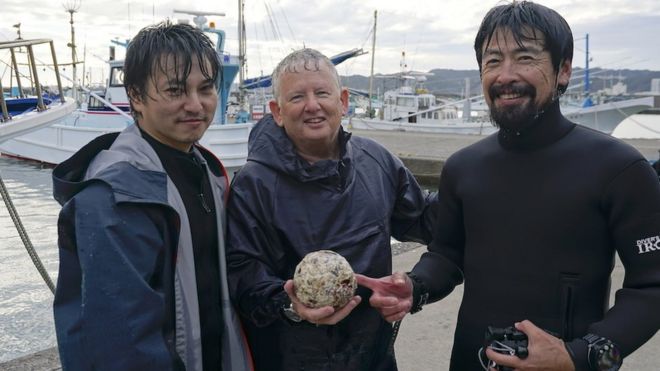
Its location has been a mystery - but the suspected cannonball, thought to be the first artefact ever found from the ship, offers clues about where it sank. Dr Jun Kimura from Tokai University has been leading a team of maritime archaeologists, who have been searching for the San Francisco in waters off Iwawada in Chiba prefecture.
The cannonball was discovered by Ian McCann, an Australian researcher at the University of New England, during a deep dive nearly 40m (131 ft) below the surface.
"We were in dark, murky waters," Dr Kimura told the BBC. "Ian just saw an unusual shape on the sandy bed - he recovered it but then we had to go back to the surface as our air had nearly run out."
He said the team, and archaeological experts they had consulted, were "almost certain" it was a cannonball from the San Francisco, as it was similar to cannonballs found in other Spanish trading ships in the Philippines.
However, they will be carrying out a chemical analysis to confirm this.
-
Le naufrage du premier sous-marin militaire de l'histoire élucidé
- On 11/11/2017
- In Conservation / Preservation

De Francois Savatier - Pour La Science
Un blast pulmonaire, c’est-à-dire la destruction des poumons par une onde de choc, a-t-il tué les huit premiers sous-mariniers de l’histoire ?C’est en tout cas ce que suggère l’essai qu’a mené l’équipe d’ingénieurs de Rachel Lance, du Centre pour la recherche militaire navale de Panama City, en Floride.
Bien qu'Horace Lawson Hunley (1823-1863), son inventeur, soit mort noyé au cours d’essais de routine, le sous-marin confédéré CSS HL. Hunley, un bâtiment d’une douzaine de mètres de long pour 1,2 mètre de large, fut remis à flot et remis en service.
Construit à partir de la chaudière d’un navire à vapeur, le petit sous-matin était dirigé depuis une tourelle de commande par un membre de l’équipage, pendant que sept autres le propulsaient en actionnant à la main un vilebrequin faisant tourner l’hélice.
Des lests de quille pouvaient être libérés manuellement tandis que, comme dans les sous-marins modernes, des ballasts se remplissaient d’eau afin d'avancer à demi immergé vers la cible.
Le haut de l’étrave était prolongé par un système de poutres de sept mètres de long au bout duquel était suspendu un baril de poudre à canon.
