HOT NEWS !
Stay informed on the old and most recent significant or spectacular
nautical news and shipwreck discoveries

-
Shipwreck treasure off Goa coast
- On 31/05/2010
- In Parks & Protected Sites
By Mayabhushan - Panaji
Next time you are headed for Goa, it makes sense to pack in your scuba gear along with swimming trunks.
With more than three shipwrecks discovered and explored off the State’s coast in the last seven years, marine scientists at the National Institute of Oceanography (NIO) here believe that Goa might be the next big thing as far as underwater shipwreck exploration is concerned.
“We have begun explorations since 1988 but regular, organised explorations began in 1997. We had found two ships earlier, but this is the first time we found a steel-hulled steamship,” NIO marine researcher Dr Sila Tripathi told The Pioneer, adding that the recent find was a century-old merchant ship.
Over time, however, some of the underwater relics have been stripped bare of their merchandise by local divers.
“Boilers, furnace bricks, flanges, broken copper pipes and tubes were found scattered over a wide area. The engine, which appears to be a triple-expansion type, is reasonably well preserved, though local divers have despoiled the wreck in the recent past. They have removed copper alloys, and other attractive or saleable items,” Dr Tripathi said.
In the last few years, three wrecks — including a 17th century merchant ship (oldest wreck found in Indian waters to date) — were found at the Sunchi Reef (between Mormugao harbour and the promontories of Cabo headland), a Basel Mission Company shipwreck at St George reef (eastern side of Grande Island to the south of Mormugao port) and the recently-explored merchant ship at Amee shoals (a sand bank that divides the Mormugao bay from the Arabian Sea).
The Sunchi shipwreck, found in 2006, fetched a unique brass barrel of a handgun, iron guns, an anchor, Chinese ceramics, Martaban pottery (stoneware), assorted bases of glass bottles, elephant tusks, hippopotamus teeth, lead pipe fragments, a copper vessel and strip, stone bricks and dressed granite blocks — all sitting pretty at one location.
According to the NIO, the wrecks have offered rare glimpses and vital clues to the Portuguese and British maritime trade.
“The stamps on the flanges and the name on the firebricks of the wreck suggest a British origin, and the three scotch boilers indicate that it was a large merchant ship (naval vessels used water-tube boilers),” Tripathi said.
The scientist further said that in the 1880s, steel from Sheffield (England) was imported by Portugal for the laying of a railway line from Mormugao to Castle Rock, a railway station in Karnataka near the border with Goa.“The vessel could be from that period. However, lack of datable finds means that it is difficult to identify the date and origin of this wreck,” Tripathi rued.
With Goa being a major trading post for the Portuguese, it is suspected that a large number of ships sunk off its shores.“The Portuguese records housed in the Goa State Archives, Panaji, and India House, Lisbon, hint at the wrecking of numerous Portuguese shipwrecks in shallow waters off Goa, with its treacherous reefs and sand-bars, in prevailing storms or due to enemy fire,” Dr KH Vora, a marine archaeology project leader at the NIO said.
The Portuguese had established several shipyards in Bassein (Maharashtra), Cochin (Kerala), Goa and Daman on the western coast of India. -
Keith Jessop: salvage diver
- On 30/05/2010
- In People or Company of Interest

From Times Online
On May 2, 1942, after three days of attacks by German submarines, destroyers and aircraft in the Barents Sea, the mortally wounded cruiser HMS Edinburgh was given her coup de grâce by a torpedo fired from one of her escorting destroyers, and slid from sight beneath the waves.
About 840 of her crew of nearly 900 who had not been killed in the attacks on her had been safely transferred to other British warships of the convoy escort.
The sailors had been saved, but a cargo of bullion, 4½ long tons (4,572kg) of gold bars, carried in the cruiser’s bomb room, went to the bottom with her.
The 465 gold ingots were part of Stalin’s payment to Britain for the supplies and military aid that the Allies were shipping to the Soviet Union along the perilous Murmansk convoy route.
In the years following the end of the war they were to become the focus of an intensive effort to recover them by successive British governments.
Finally, in the early 1980s, after several abortive efforts to retrieve the gold, the self-made diver Keith Jessop achieved the remarkable feat that had eluded a number of long-established, well-financed salvage companies.
It was the culmination of a government effort that had been a stop-start affair since 1954 when a contract had been awarded to the UK-based company Risdon Beazley, but work had been aborted by strained relations between the British and Soviet governments.
The designation of the Edinburgh site as a war grave in 1957 only complicated matters, putting a further stop to intrusive exploration of the wreck.But in the late 1970s, with a Labour Government increasingly anxious to recover the gold to swell the Exchequer’s coffers, efforts were renewed, and a number of companies made bids for the contract.
In 1981 Jessop Marine, which under its founder had developed complex cutting machinery and the saturation diving techniques that enabled divers to avoid the deadly effects of the “bends”, permitting them to work at depth for long periods, won the argument about sensitivity to a war grave site against other companies which favoured explosives-led methods of entering the wreck.In April 1981 Jessop’s survey ship Dammtor had located the cruiser’s final resting place at a depth of 800ft (245m) in a position approximately 72.35N, 35.00E.
Its detailed filming of the wreck enabled Jessop to plan his operation with military precision. By August 30 that year the dive-support vessel Stephaniturm was at the wreck site and salvage operations began in earnest.
In spite of injury to several of the Jessop marine divers, on September 15 one of them penetrated the armoured room and recovered the first bar of gold. Over the next three weeks, until bad weather forced the suspension of diving on October 7, 431 of the 465 ingots were been recovered, worth an estimated £45 million.It was a triumph for Jessop, an entirely self-made man who had been born into poverty and had no background in either diving or marine salvage. He had been born at Keighley, West Yorkshire, in 1933, the son of a textile mill worker.
Leaving school without any qualifications, he followed his father into the mill, married a local girl, had three children and looked to be set for the life of drudgery that that been the lot of his own parents.
Lent some scuba diving equipment by a friend for recreation at weekends, he began to see the possibilities of making a modest living and began to salvage scrap metal, brass and copper fittings from wrecks in shallow water off the west coast of Scotland.
As time went by he acquired an ex-Fleetwood trawler and began to systematise his operation, working on larger wrecks and retrieving more saleable items.
-
Scientists get look at Queen Anne's artifacts
- On 29/05/2010
- In Underwater Archeology
By Josh Humphries - The Daily Reflector
Scientists from throughout the world are in Greenville this week to get a first-hand look at efforts to preserve artifacts believed to have been aboard the Queen Anne’s Revenge.
About 80 conservators and scientists from 15 countries and 10 U.S. states who preserve wet archaeological artifacts are participating in the Triennial Conference of the International Council of Museums, Conservation Committee, Wet Organic Archaeological Materials Group.
The group visited East Carolina University’s West Research Campus and the Queen Anne’s Revenge (QAR) lab on Wednesday evening as part of the four-day event.
N.C. Department of Cultural Resources Secretary Linda Carlisle spoke to the scientists at the QAR lab.
“We are doing great work here,” Carlisle said. “I think you can see that this is not just a Greenville, North Carolina, project but an international project.”
The QAR lab is the center for protecting and cleaning artifacts researchers have discovered in Beaufort inlet believed to have been aboard the Queen Anne’s Revenge, the one-time flagship of the famous pirate, Blackbeard.
Carlisle and the researches viewed hundreds of artifacts removed from the ship including large cannons and tiny beads and particles of gunshots. The project continues to gather and prepare items from the shipwreck for display in museums.
“We hope you can come back and see these wonderful artifacts in exhibits that tell the story of our state,” Carlisle said.“That is what we are working toward.”
Carlisle said it is an honor for North Carolina to host the conference because it is on held once every three years. -
Shipwreck may conceal 'Maracaibo' treasure
- On 28/05/2010
- In Treasure Hunting / Recoveries

From Eitb
Pedro Terrón, author of Kalitxi: The Lost City made the announcement during a hectic press conference alongside archaeologists and researchers.Pedro Terrón, author of the Kalitxi saga about the shipwreck suffered by the Santo Cristo de Maracaibo boat in 1702, gave a press conference on Thursday in which he confirmed that the remains of a ship discovered in 2004 in the Vigo estuary are, with "99.9%" certainty, those of the Maracaibo wreckage.
The announcement came during a hectic press conference in which the author and his companions became involved in a debate with archaeologists and researchers over the possibility that the ruins were really those of the Santo Cristo de Maracaibo.
Luis Valero, who introduced himself as representative of the US company See Hunt, devoted to the rescue of sunken treasures, confirmed that, though it could only be 100% confirmed that the wreckage found was that of the Santo Cristo de Maracaibo once the authorities had given permission to carry out an evaluation, he was "99.9%" convinced that this was the case.
He confirmed that his company, See Hunt, had the necessary permission from the Ministry of Environment in order to investigate the area around the Cíes islands and stressed that on locating the wreckage, the "coordinates" of the discovery were communicated to the Ministry of Culture.
However, the Ministry of Culture has confirmed that to this day the heritage department still has received no official notification from the company about the discovery. -
The 1770 wreck of the Industry at Kennebunk Beach
- On 27/05/2010
- In Parks & Protected Sites
From Seacost Online
The leonine month of March lived up to its reputation in 1960. Nearly a foot and a half of snow fell on coastal York County on March 4.The following week, gale winds blowing from a southeasterly direction scoured Kennebunk Beach in an unusual way, exposing the remains of a shipwreck that few remembered.
Bill Calder and Charles Robinson were the first to see crudely constructed ribs projecting 18 inches out of the sand on March 11, and they called George Stevens, photographer for the Kennebunk Star.Some of the ribs were 2 feet wide and a foot thick, giving the wreck an ancient appearance. A 6-inch trenail (a wood fastening peg) removed from the planking had an unusual, diamond-shaped wedge hammered into the end of it.
Sandy Brook, editor of the Star, contacted marine expert and author Edward Rowe Snow at his home in Marshfield, Mass., and invited him up to examine the unusual wreck.By the time Snow arrived with marine architect Bror Tamm, the timbers were almost entirely covered again by the shifting sand. Kennebunk Fire Chief Harrison Coleman was persuaded to dispatch a fire truck from the Washington Hose Company and volunteers removed enough sand with a high pressure fire hose to give the experts a good look at the 65-foot wreck, where she lay some 70 feet from the seawall on Mother's Beach.
Snow, who was perhaps best known as "The Flying Santa Claus" for his annual delivery of Christmas presents to the families of New England lighthouse keepers, returned to Massachusetts to write an article for the Patriot Ledger.In his column, Snow theorized that the Kennebunk Beach wreck was the remains of a coasting packet, called the Industry, built in 1770 by Irish shipbuilders in St. George, Maine.
"A colony of ship builders from Northern Ireland settled in St. George. They were the only ones to use a diamond-shaped wedge at a convex angle in the end of their trenails," explained the maritime historian. Wreckage of the Industry superstructure had also been found in this area after she was lost on her maiden voyage.
Fascinated by the story, Dick Bedard, who now lives in Columbia Falls, Maine, and three of his friends, dug down 4 feet in an effort to reach the keel of the vessel.
"I have a trenail that I carefully removed from one of the rib stumps, and often show it to people," Bedard said recently. The young men also found some broken pottery, pieces of leather punched with small triangular holes,unidentifiable chunks of a heavy, hard, black substance and half a pulley carved from lignum vitae — a wood species only found in South America and the West Indies. Remains of an old leather boot, a bone and a china plate were also uncovered and turned over to the Kennebunkport Historical Society.
-
My secret museum !
- On 26/05/2010
- In People or Company of Interest
By Julie Weiss - Boston, Massachusetts
To end the day, with excitement, intrigue and beauty, please check out Pascal's real life of underwater treasure discoveries.
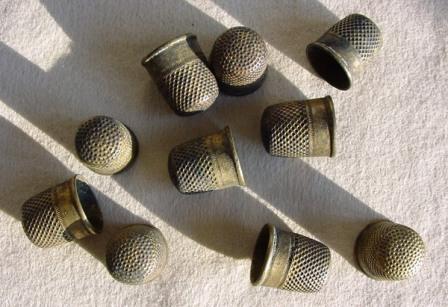
It is my secret museum, and history book that I sneak in to every night and think for hours upon hours about everything from what was being sewn with all the brass thimbles. Was it, Flags, Clothing, Sails ?
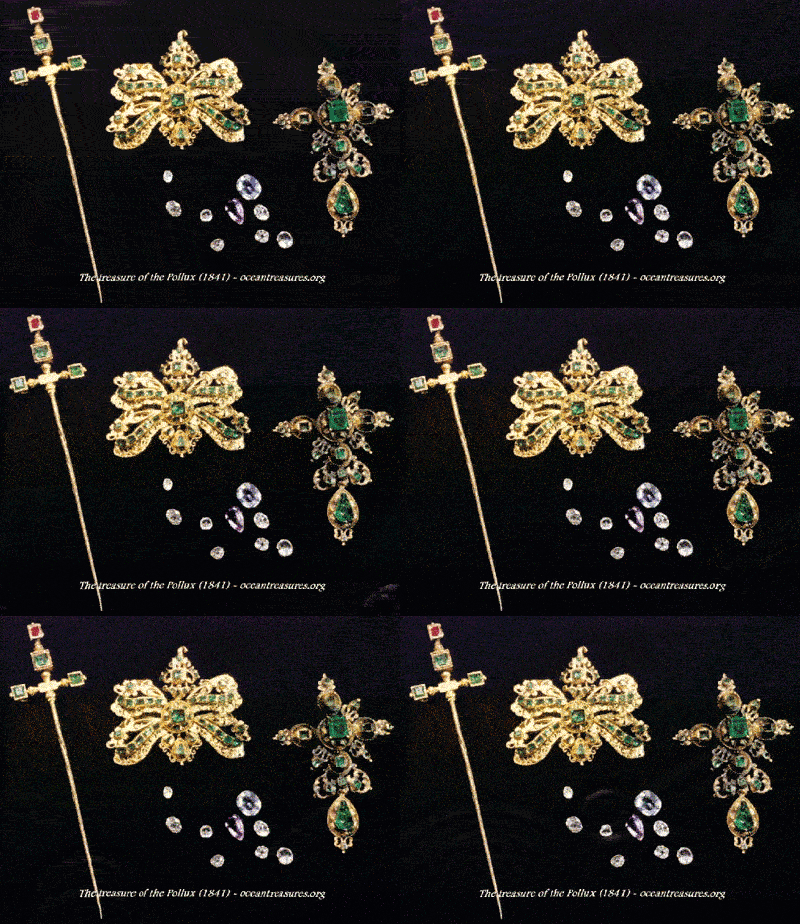
Who did the jewel's belong to ?Where they to be worn or being set to be sold ? What food and drink was placed on the beautiful gold leaf plates ?
Followed by a zillion other questions having to do with everything from politics, piracy, lift bags, equipment, cataloging, research, and archeology, and on, and on, and on...
It is no joke that this keeps me up until the light of dawn.It's the secret place my mind and imagination visit so often, and the beauty of all the treasures Pascal and his team have been able to discover. To begin to think of finding a wreck with sunken treasure and every detail that happens all the way until it is placed in a museum or sold at auction is fascinating to me.
Very different than the items many of my friends have brought up from all the wrecks lying in the North East. For me, it has nothing to do with diving. The Ocean holds so very many secrets and mysteries. To have the talent, skill and knowledge to actually and tangibly uncover these secretes, completely blows my mind.
It is not just about the "treasures" found. For me, the fascination is about, when all is collected, researched and a theory has been either proved to be true or false is the biggest hook. The story that is told, when all the pieces of the puzzle are put together, is the book I want to read.
How does one find a needle in a haystack, which so many others know is out there somewhere and have been searching for as well ? I better stop, as my mind is already starting to wander off... Maybe some night, I will see you in this museum. which seems like it comes out of my own fantasy or creativity, but is in fact all very real.
Blessings Pascal ! For me, the real treasure is the history and stories of these ships and all those who lost their lives at sea. For me these “treasures” are about their artistic beauty and historical significance. Everything from the rare coins and jewelry and the handmade artistic art, as well as the old bottles left half full and stories that were shared while passing it, forever untold...
It is man and trade that puts a value on things that I believe to be priceless. Even something as simple as a brass thimble. -
Rapture of the deep
- On 25/05/2010
- In People or Company of Interest
From Beta Lep
From searching for mines planted on Allied boats during World War II to spying on Russian warships, Sydney Knowles had a colourful life at sea.Jenny Simpson speaks to the Prestonian about his new memoir, A Diver in the Dark.
Sydney Knowles braced himself as he plunged into the choppy waters and made his descent into their pitch-black depths.
Kitted out with nothing but swimming trunks, lead-weighted plimsolls and primitive breathing equipment, Sydney was carrying out another perilious search for mines planted by enemy Italian frogmen on the hulls of Allied ships anchored in ports during World War Two.
Working in total darkness, the divers would try to cut the mines loose or call for help from their commanding officer, Lionel ‘Buster’ Crabb.
“We had no diving equipment at all,” explains Sydney, now 88.
“We just took a deep breath and tried to see what we could.”
Sydney, who grew up in New Hall Lane, Preston, had joined the Royal Navy in 1939 at the age of 18.
He served in the North Atlantic aboard HMS Zulu during the hunt for the Bismarck and later in Operation Pedestal, the naval convoy which broke the Siege of Malta in 1942.
It was on his return to Gibraltar following Pedestal that he spotted an intriguing notice, pinned to a board: ‘Volunteers required for hazardous duties ashore.’
Sydney recalls: “I wondered what could be more hazardous than the hell I had experienced on the Malta convoys – surely nothing ashore could equal that?
“I was soon to discover, however, that it was a case of out of the frying pan and into the fire.
“I was asked if I could swim, and if I would be interested in learning to become a diver.”
After an interview with Crabb and Lt Bailey, the bomb and mine disposal experts, Sydney joined the Underwater Working Party and began the dangerous task of hunting for underwater explosives.
Crabb’s expertise at rendering mines safe were second to none and earned him a George Medal, as well as the unwavering loyalty of his men, including Sydney.A film, The Silent Enemy, was later made about their underwater exploits, which also included searching for the body of the commander-in-chief of the Polish armed forces following a plane crash off Gibraltar.
-
Warplane, M.I.A. For 60 Years, Comes Home to WNY
- On 25/05/2010
- In Airplane Stories

By Pete Gallivan - WGRZ.com
It was a journey that began christmas morning, 1943 in Wheatfield. A P-39 Airacobra, one of the 30,000 planes produced here in Western New York for the war effort, rolls from the hanger and takes off, headed west.
She was one of 10,000 planes, many from here in Western New York, that were sent to Russia. It was also a bit of WNY technology turned the tide against the Nazi's.
The P-39 was known as the "flying cannon". She was a force in the air. It was equipped with 2 machine guns in the wings, two more in the nose, a 37 mm cannon in the nose and a state of the art radio system.
But on a mission in 1944, this plane disappeared
Fast forward 60 years to July 2004. A fisherman on Lake Mart-Yavr in arctic Russia spotted something under the water. A British warbird recovery team was called in and what they found was absolutely astounding.
The plane was recovered intact. The pilots remains, and medals were still in the cockpit, so was the plane's logbook.