HOT NEWS !
Stay informed on the old and most recent significant or spectacular
nautical news and shipwreck discoveries

-
Heritage designation sought for Royston breakwater wrecks
- On 09/04/2011
- In Parks & Protected Sites
By T.W. Paterson - The Canada
This graveyard of ships has been described as "world-class."
According to the press there's a movement afoot to attain "heritage wreck" status for 14 ships scuttled at the old Royston breakwater by the Comox Logging & Railway Co. and its successor, Crown Zellerbach, from the mid-1930s through the early '60s.
Based upon a review just concluded by the Underwater Archaeological Society of B.C. and the Institute of Nautical Archaeology, these hulks cover an area just 500 metres long by 100 metres wide.The all-but-submerged wrecks include three Cape Horn windjammers, a barkentine, an auxiliary schooner, three frigates, two destroyers, a US Navy deep-sea rescue tug, two steam tugs and a Norwegian-built whaler.
The site has already been recognized as the Royston Heritage Wrecks by the provincial government. What is now proposed is that each ship be given its own heritage status with an archaeological catalogue number. "This is almost a world-class heritage site, the way we see it," said a UASBC member. "I mean, it's just incredible."
What a shame that any form of heritage designation is so long after the fact, after seven decades of storms and extensions of the rock-fill breakwater have broken up, ground down and buried most of these seagoing ladies.
The day when you could literally step from ship to ship has long gone. Happily for me, when it was still possible to board most of these wrecks, I spent many an enchanted hour climbing in and out of them with my notebook, camera and toolkit (the latter for salvaging what few -- very few -- bits 'n' bites that had escaped countless previous visitors.
All this was done, I point out, with the consent of Crown Zellerbach which had commissioned me in the '70s to write a history of the breakwater for their company newsletter.
-
Saluting memory of shipwreck dead
- On 09/04/2011
- In Miscellaneous

By Vesela Todorov - The National
Half a century ago today, the UAE witnessed the Gulf's worst peacetime maritime disaster as an explosion tore through the MV Dara, killing at least 236 people.
Two days later, the ship sank off the shores of Umm al Qaiwain, where it remains to this day, 20 metres below the surface.
The story of the MV Dara made headlines around the world at the time, but today, few are aware of the accident.
Yesterday, divers from the British Sub Aqua Clubs in Sharjah, Dubai and Abu Dhabi paid a dignified tribute to those lost in the sinking.
Dropping to a depth of 11 metres, they dodged the underwater currents, for which the area is renowned, and erected the Red Ensign, the flag of the merchant naval fleet, at the stern of the shipwreck.
The gesture of respect was the idea of Ian Hussey, a Sharjah-based civil engineer and honorary chairman of the Sharjah Wanderers Dive Club.
Mr Hussey said he had dived the site more times than he could remember. The abundance of fish can make some visitors forget the wreck's sombre history.
"It is a very nice dive," he said. "You tend to forget that aspect of it."
Determined to remind the diving community about the history, Mr Hussley contacted fellow divers from his club as well as divers from Dubai and the capital. About 60 people dived the site yesterday.It was up to four of them to attach the 1.5-by-2.4-metre flag to the wreck. One was Dr Steven Winstanley, the diving officer at the Abu Dhabi Sub Aqua Club.
-
Pirate shipwreck find by Bowtech
- On 08/04/2011
- In High Tech. Research/Salvage
From Hydro International
Bowtech’s latest Surveyor-HD (high definition) and Surveyor—SD (standard definition) cameras coupled with LED lighting and portable splash proof HD, SD and sound recording system may have uncovered a lost piece of American/British history in the Irish Sea off the Welsh coast, a shipwreck thought to have belonged to a fleet of American sea raiders.Deep Trek are a team of experienced subsea specialists in diving, submersibles, and deep water Remote Operated Vehicles (ROV) for the offshore industries.
They have applied these technologies in the search for history for the first time.DeepTrek filmed their search of the coastline near Holyhead, Wales, UK, for remnants of a shipwreck thought to have been a privateer ship on a mission from Benjamin Franklin to capture British sailors to exchange for American prisoners.
-
Local Utah company discovers Caribbean shipwreck
- On 06/04/2011
- In Treasure Hunting / Recoveries

By Matt Hopkins - KSL
A Midvale, Utah based underwater exploration and recovery company, Deep Blue Marine, Inc., has discovered what they believe to be the oldest colonial shipwreck in the Caribbean.
"We have found a shipwreck that we can definitively date back to 1535," Deep Blue Marine CEO Wilf Blum said. "We have also found artifacts that are still in the Dominican Republic that date back to the pre-Columbian era. When you think about that, this is significant.
This shipwreck is just a few years after Columbus and it is the single oldest shipwreck ever found in the Caribbean. We think this is something noteworthy."Deep Blue Marine, Inc. has built a relationship with the government of the Dominican Republic and has secured a contract with the sub-aquatic ministry.
This specific discovery has been named after the captain of the ship, Capt. William Rawson. Rawson's wreck is one of many sites the company is currently exploring.
"We have a contract which includes, I think, about 42 miles of coastline," Rawson said. Our contract allows us to keep 50 percent of all artifacts recovered, and right now we have 13 wrecks that we are currently working."
-
Texas State researcher helps find pirate cannons
- On 06/04/2011
- In Underwater Archeology
By Roy Bragg - My San Antonio
Six deteriorating pirate cannons, discovered by a team that included a Texas State University researcher, will help Panamanian antiquities experts tell the history of that nation.
The cannons, found in September in the muck at the mouth of the Chagres River, are thought to be from the deck of ships led by legendary pirate-for-hire Capt. Henry Morgan, who was en route to raid Panama Viejo — now called Panama City — in 1671.
Instead, says Frederick Hanselmann, Morgan's flagship ran into a reef. Then, like a nautical rumba line gone bad, three of his other ships either ran into the same reef or into each other trying to avoid it. All of them sank, depositing the cannons and everything else on the ocean floor.
Undaunted, Morgan took his remaining ships to the city and sacked it.
The discovery of the 340-year-old weapons, which are now in Panama's possession and being preserved, is an important find, says Hanselmann, the school's chief underwater archaeologist.
“It was an important event in the development of the country,” he said. “It's a major find for the country. It's a major find for the people.”
William B. Lees, president of the Society for Historical Archaeology, agreed: “It's part of a bigger story,” he said. “It's part of a nation's view of itself.”
The ultimate goal of archaeology, Lees said, isn't to find interesting stuff, but rather to find tangible proof of historical events.
-
Caribbean Meeting on the Protection of the Underwater Cultural Heritage
- On 06/04/2011
- In Maritime News
By Kelly Dunst - Vadvert
The Caribbean Meeting on the Protection of Underwater Cultural Heritage takes place on 10 and 11 June 2011 in Kingston.
During the Meeting participants will present and discuss the importance and pertinence of the 2001 Convention with the help of legal and archaeological experts.
The Meeting is essential to promote ratification and create awareness of the existence of this heritage and of the urgent need to create legal frameworks for its protection.This Meeting is jointly organized by the UNESCO Offices in Havana and Kingston, the Jamaican National Commission and with the support of the Secretariat of the 2001 Convention.
In spite of its vast underwater cultural heritage due to its maritime history, the majority of Latin American and Caribbean countries lack experts and national systems for its safeguarding.
Thanks to the diving industry and technical developments in devices for detection and exploration of the seabed, this heritage, that was for centuries protected by its own environment, is now easily accessible to sport divers, fishermen and treasure hunting companies. -
Fishmonger and friends are guardians of historic shipwreck
- On 06/04/2011
- In Underwater Archeology
From Echo News
A fishmonger will be swapping filleting fish for swimming with them after winning the right to dive for treasure on a historic wreck in the Thames.
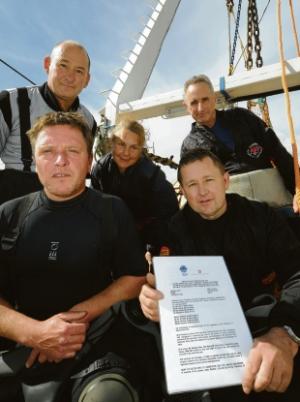
Steve Ellis, 46, who runs Mattacks, in Leigh, was granted a year-long licence to explore HMS London after a chance meeting on a flight to the Maldives.
Mr Ellis, of Park Drive, Westcliff, bumped into an English Heritage expert who was searching for someone who could keep an eye on the ship, which sank after an accidental explosion in 1665.
Now Mr Ellis, his wife Carol, 44, and four friends have been placed in charge of diving to the wreck regularly and helping to bring its relics to the surface.
He said: “It was completely by chance, but there’s not many people who dive in the Thames, so I think English Heritage thought it was a bit of good luck as well.
“We’ve been told to watch over the wreck and let them know if there’s any changes to it.
“They’ve also asked us to let them know about anything we find, because they might want to bring it up and put it in local museums.
“We dived for the first time last week and we already think we’ve found a cannon.”
HMS London was discovered in 2008 during a salvage operation by professional archaeology company Wessex Archaeology and the Port of London Authority.
It was considered of such importance that the Thames shipping lane was re-routed to avoid disturbing its resting place, off the Southend coast. -
Mysterious shipwreck unearthed at bottom Gulf
- On 06/04/2011
- In Underwater Archeology

Photo Texas A&M University
By John Pope - Nola
Nearly 200 years ago, a ship sank in the Gulf of Mexico, about 35 miles off Louisiana's coast. It stayed, undiscovered, on the seabed, about 4,000 feet below the surface, until 2002, when a crew happened upon the wreckage while checking out a pipeline.
An expedition led by Texas A&M University found no skeletal remains and nothing to indicate the vessel's name, where it came from or how it sank.
But underwater sleuths discovered plenty of artifacts, including a telescope, pottery, French bottles, swords, English mustard jars, hourglasses, a cast-iron stove and a Scottish cannon, Louisiana State Museum spokesman Arthur Smith said.
About 500 of those pieces are to be transferred today to the Louisiana State Museum and the state Division of Archaeology.
Archaeologists will study the pieces, Smith said, and eventually the museum will display them.
In addition to receiving the artifacts, the state will assume the responsibility of solving this mystery of the deep.
"It's a tantalizing mystery," Smith said. "Who knows who was on that ship and what they were up to ?"