HOT NEWS !
Stay informed on the old and most recent significant or spectacular
nautical news and shipwreck discoveries

-
Sunken slave ship found off South Africa
- On 10/06/2015
- In Underwater Archeology

By Helene Cooper - The New York Times
On Dec. 3, 1794, a Portuguese slave ship left Mozambique, on the east coast of Africa, for what was to be a 7,000-mile voyage to Maranhão, Brazil, and the sugar plantations that awaited its cargo of black men and women.
Shackled in the ship’s hold were between 400 and 500 slaves, pressed flesh to flesh with their backs on the floor. With the exception of daily breaks to exercise, the slaves were to spend the bulk of the estimated four-month journey from the Indian Ocean across the vast South Atlantic in the dark of the hold.
In the end, their journey lasted only 24 days. Buffeted by strong winds, the ship, the São José Paquete Africa, rounded the treacherous Cape of Good Hope and came apart violently on two reefs not far from Cape Town and only 100 yards from shore, but in deep, turbulent water.
The Portuguese captain, crew and half of the slaves survived. An estimated 212 slaves did not, and perished in the sea.
On Tuesday, the Smithsonian’s National Museum of African-American History and Culture, along with the Iziko Museums of South Africa, the Slave Wrecks Project, and other partners, will announce in Cape Town that the remnants of the São José have been found, right where the ship went down, in full view of Lion’s Head Mountain.
It is the first time, researchers involved in the project say, that the wreckage of a slaving ship that went down with slaves aboard has been recovered.
The story of the São José, like the slave trade itself, spanned continents and oceans, from fishing villages in Africa to sheikhdoms where powerful chiefs plotted with European traders to traffic in human beings to work on plantations in the New World. Fittingly, the discovery of the São José also encompassed continents and oceans.
Divers from the United States joined divers in South Africa, while museum curators in Africa, Europe and the Americas pored through old ship manifests looking for clues. In the end, the breakthrough that the shipwreck was of a vessel that had been carrying slaves came from something unexpected, the iron blocks of ballasts that were used to offset the weight of slaves in the hold. -
The quest to reproduce the world’s oldest shipwreck beer
- On 26/05/2015
- In Treasure Hunting / Recoveries

By Mckenna Stayner - The New Yorker
In the summer of 2010, Christian Ekström, a diver from the Åland Islands, an autonomous region of around sixty-five hundred isles off of Finland’s west coast, began searching for a shipwreck in the Baltic Sea, based on a tip he’d received from a fisherman.
The Baltic’s temperature is unusually consistent (between about thirty-nine and forty-three degrees Fahrenheit on its seabed), and it hasa salinity level that is less than a fifth that of oceans.
Its coastal waters are also treacherously shallow. All of this makes it particularly well suited to sinking ships, and then, once they’ve sunk, to preserving them for centuries.
(Creatures commonly known to erode wrecks, like shipworms, can’t survive in such brackish waters.)
As a result, the Baltic has an estimated hundred thousand shipwrecks, only a fraction of which have been explored. Ekström and his dive partners soon found a small, wooden schooner, a hundred and fifty-five feet underwater, coated in sand and algae.
Its hull had ruptured and there were no name signs or ship bells by which to identify it. Shining his headlamp into the large gash in the ship, Ekström saw some dark-green bottles, lying corked among broken planks of mossy wood. He reached in and pulled one free. As he rose to the surface with the bottle, the cork began to work its way out.
He pushed it in with his thumb. Back on the boat, it poppedout completely.
“All this aroma came through,” he told me recently. “It was phenomenal. And we tasted it without any knowledge of what we were drinking.” -
Shipwreck found in sea bed off Wan Chai
- On 26/05/2015
- In Famous Wrecks

By Fanny W. Y. Fung - South China Morning Post
The mystery is nearly over: the government has all but confirmed that wreckage found during harbour dredging in Wan Chai last year is the remains of HMS Tamar, Hong Kong's most famous military ship that was scuttled by the British navy in 1941 to prevent her from falling into Japanese hands.
The Civil Engineering and Development Department said yesterday that the large metal object, about 40 metres long, two to 11 metres wide and two metres high, "may be part of the bottom of the wreck" and "could be the remains of HMS Tamar".
But it stopped short of confirming the historic find, "as the ship's bell, name plate or any other unique features have not been found".The government's statement came a day after the South China Morning Post confronted it with findings by the founding chief of the Hong Kong Maritime Museum, Dr Stephen Davies, that identified the wreck as HMS Tamar, and asked it to respond to the marine historian's claim that he had been removed from the investigation team after presenting evidence to officials.
-
Navy divers to help raise confederate warship artifacts
- On 26/05/2015
- In Famous Wrecks

From Newschannel9
The Navy is preparing to send one if its premier diving teams to Georgia to help salvage a Confederate warship from the depths of the Savannah River.
Before it ever fired a shot, the 1,200 ton ironclad CSS Georgia was scuttled by its own crew to prevent its capture by Gen. William T. Sherman when his Union army took Savannah in December 1864. Today, it's considered a captured enemy vessel and is property of the U.S. Navy.
The shipwreck is being removed as part of a $703 million project to deepen the river channel so larger cargo ships can reach the Port of Savannah. Before the harbor can be deepened, the CSS Georgia has to be raised.
After years of planning, archaeologists began tagging and recording the locations of thousands of pieces from the shipwreck in January. They've been able to bring smaller artifacts to the surface, but the Navy is being called in to raise the 120-foot-long ship's larger sections and weapons. Navy divers are scheduled to arrive at the site near downtown Savannah about 100 yards from the shore on June 1.
The Navy divers assigned to the project are from the same unit that's had some of the military's highest profile salvage operations. That includes the Civil War ironclad USS Monitor, TWA Flight 800, Swiss Air Flight 111, as well as the space shuttles Challenger and Columbia.
Divers from the Virginia Beach-based Mobile Diving Salvage Unit 2 also provided damage assessments and repairs on the USS Cole following the terrorist attack on it in Yemen in 2000 and pulled up wreckage from an F-16 that crashed off the eastern shore of Virginia in 2013.
In Georgia, Navy divers will pull up parts of the ship's armor systems, steam engine components and small structure pieces. They'll eventually be sent to one of the U.S. Naval History and Heritage Command's repositories and Conservation Research Laboratory at Texas A&M University in College Station, Texas. -
1681 Spanish shipwreck holds intrigue for Texas researchers
- On 13/05/2015
- In Underwater Archeology
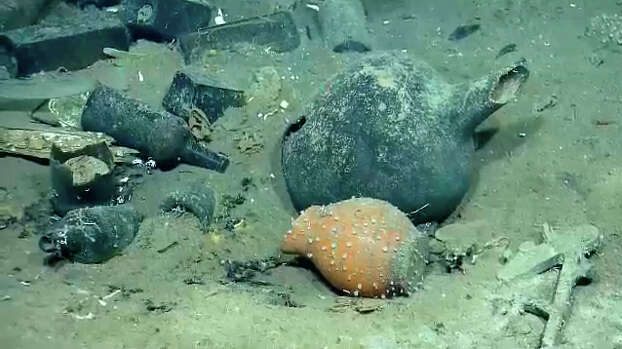
By Carol Christian - ChronSword blades, scissors and mule shoes are a few of the myriad artifacts from a colonial Spanish shipwreck being studied by Texas researchers.
The Spanish merchant ship, which sank in 1681 off the Caribbean coast of Panama, is a rare find, according to underwater archaeologists at the Meadows Center for Water and the Environment at Texas State University in San Marcos.
Dug out of sand in July 2011, the ship, known as a nao, has recently been identified through painstaking analysis as Nuestra Senora de Encarnacion, which was built in Veracruz, Mexico, for Spain. The identification was accomplished partly through archival research in Seville, Spain, by project historian Jose Espinosa of the Universidad del Norte.
The 334-year-old wreck is extremely well preserved because it was buried in up to 3 feet of muddy sand and silt, said Fritz Hanselmann, head of the research team.
"The amount of hull that's still there is really unique for the Caribbean and any warm saltwater locale," he said. "Very few Spanish merchant naos have ever been found, making this one an extraordinarily significant find because it is so well preserved."
The entire lower portion of the ship's hull is still there, along with the cargo in the hold, including wooden barrels, more than 100 wooden boxes with sword blades, scissors, mule shoes, nails, ceramics and other items.
About 20 artifacts have been removed from the ship, in dives during 2012 and 2014, Hanselmann said. Among them are lead seals, devices that looked like coins and were attached to strings around items such as bales of cloth, to mark ownership. While the cloth has long since disintegrated, the lead seals remain. -
Ship that could have changed Latin America history to be salvaged
- On 12/05/2015
- In Treasure Hunting / Recoveries

From Latin American Herald Tribune
The 60-gun British privateer Lord Clive, sunk in combat off the coast of Uruguay in 1763 during a raid that might have changed the history of Latin America, will be brought up from the floor of the River Plate.
If that ship had not failed in the attempt to take the city of Colonia, nowadays we might all be speaking English in Latin America,” said Argentine treasure-hunter Ruben Collado, who found the wreck.
The ship lies just 350 meters (380 yards) off Colonia del Sacramento.
Spain and Britain were on opposite sides in the Seven Years War, a multifaceted European conflict that extended to the Americas, West Africa, India and the Philippines.
British merchants desperate to break Madrid’s monopoly on trade with Spanish colonies in the New World saw in the war a chance to force their way into the South American market.
The Lord Clive – launched in 1697 as the Royal Navy vessel HMS Kingston – was sold in 1762 to privateers linked to the British East India Company.
The Clive arrived in the River Plate in 1763, carrying guns intended for would-be rebels in Spanish bastions such as Buenos Aires, Lima and Santiago.
When the British raiders found Spanish defenders on the alert in Buenos Aires and Montevideo, they headed to Colonia del Sacramento, a Portuguese stronghold 180 kilometers (111 miles) west of Montevideo.
Under the command of Capt. Robert McNamara, the small British force intended to take on supplies at the Portuguese post.
What the British didn’t know was that their Portuguese allies had lost Colonia to Spanish troops two months earlier.
At noon on Jan. 6, 1763, the Lord Clive’s 32 port-side cannons opened fire but the squat buildings and huts of Colonia remained untouched because of McNamara’s faulty ballistic calculations: with the ship so close to the coast, the shells sailed harmlessly over the targets. -
Xisha underwater survey
- On 12/05/2015
- In Underwater Archeology

From CCTV
Now some progress on China's large-scale underwater archaeological mission. A team of archaeologists set off last month to excavate a shipwreck in the Xisha archipelago in the South China Sea. And they've already made some remarkable discovery.
A team of Chinese archaeologists embarked on one of the country's largest underwater surveys in mid-April, in the Xisha Islands in the South China Sea. The 25 underwater archaeologists are equipped with a 900-ton archaeological vessel and four auxiliary vessels.The survey is focused on Yongle Atoll, which is located to the west of Xisha Islands. And the crew has found a substantial amount of stone building material and carvings at the site.
These artifacts contain a wealth of historical information and valuable proof of the ancient Maritime Silk Route. This was a maritime route that connected China with other regions of the world for trade and cultural exchanges.
-
Pirate Captain Kidd's 'treasure' found in Madagascar
- On 09/05/2015
- In Treasure Hunting / Recoveries
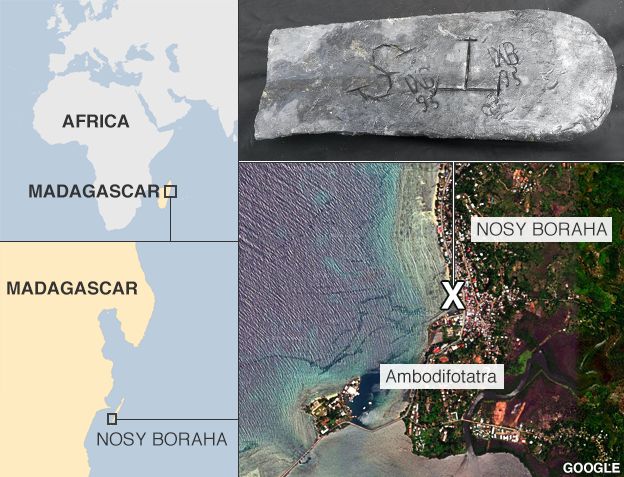
From BBC NewsA 50kg (7st 9lb) silver bar was brought to shore on Thursday on the island of Sainte Marie, from what is thought to be the wreck of the Adventure Galley.
The bar was presented to Madagascar's president at a special ceremony. US explorer Barry Clifford says he believes there are many more such bars still in the wreck.
Capt Kidd was first appointed by the British authorities to tackle piracy but later became a ruthless criminal and was executed in 1701.
"Captain's Kidd's treasure is the stuff of legends. People have been looking for it for 300 years. To literally have it hit me on the head - I thought what the heck just happened to me.
I really didn't expect this," Mr Clifford said. "There's more down there.
I know the whole bottom of the cavity where I found the silver bar is filled with metal. It's too murky down there to see what metal, but my metal detector tells me there is metal on all sides."
The BBC's Martin Vogl tweets that there is much excitement in Madagascar about the discovery and Mr Clifford's team has no doubt that the discovery is genuine.The team believes the bar, marked with what appears to be a letter S and a letter T, has its origins in 17th-Century Bolivia.
It believes the ship it has found was built in England, however there is bound to be scepticism and calls for more proof that the bar was linked to Capt Kidd, our reporter says.