HOT NEWS !
Stay informed on the old and most recent significant or spectacular
nautical news and shipwreck discoveries

-
Underwater archaeology a new field of exploration
- On 09/08/2008
- In Underwater Archeology
By Bradley T. Lepper
Archaeologists in the UK are exploring a vast expanse of sea floor between southeastern England and the Netherlands that, between 8,000 and 10,000 years ago, was a rich landscape inhabited by Mesolithic hunters and gatherers.
The team named this sunken world "Doggerland", which Laura Spinney describes in the July 10 issue of Nature as having once been a paradise of marshes, lakes and rivers.
Using seismic survey data, these archaeologists have created a map of Doggerland that is providing crucial context for artifacts that occasionally are scooped up in fishing nets.
James Adovasio, director of the Mercyhurst Archaeological Institute in Erie, Pa., and C. Andrew Hemmings, an archaeologist with the University of Texas at Austin, are leading an expedition that is surveying the seabed along the Gulf Coast of Florida.
Having mapped the submerged landscape, they will send a diving robot to explore likely locations for archaeological sites.
Ohio has its own lost world beneath Lake Erie. With the advance and retreat of glaciers, Lake Erie has risen and fallen dramatically over the millennia. About 4,000 years ago, the level of the lake was about 30 feet below modern levels.
Read more... -
Scuba divers' paradise
- On 04/08/2008
- In Wreck Diving
By Shaila Dewan
Pirate lore has it that in the late 17th century, horses bearing lanterns were led along the barrier islands near Beaufort, luring ships to be pillaged and sunk. But that was only one of many perils by which the North Carolina coast earned the nickname Graveyard of the Atlantic.
From the Queen Anne's Revenge, Blackbeard's hijacked French slaver, to the Monitor, the ironclad Civil War vessel, many a ship has been doomed by converging currents, rocky shoals, treacherous storms and, in World War II, lurking U-boats.In 1921, the schooner Carroll A. Deering was stranded in a storm on Diamond Shoals; rescuers found it abandoned, making the fate of the crew one of the enduring mysteries of maritime history.
But the seascape that for centuries menaced sailors is, it turns out, a Xanadu for scuba divers. The water is clear, warmed by the Gulf Stream and populated by tropical marine life against the operatic backdrop of the mammoth, ghostly shipwrecks.Unlike reef diving, wreck diving offers both natural splendor and human narrative -- lionfish and octopus, rust and cannon.
-
Shipwreck hunters still searching for 'ultimate Grail' of the Great Lakes
- On 04/08/2008
- In Treasure Hunting / Recoveries

From The Canadian Press
The recent discovery of a British warship that foundered in Lake Ontario during the American Revolution has many marine history buffs likening the find to the Holy Grail of the Great Lakes.
But shipwreck hunters believe the "ultimate Grail" of the Lakes is still entombed in the cold, murky depths.
Last spring, U.S. wreck enthusiasts Jim Kennard and Dan Scoville located HMS Ontario below the waves of Lake Ontario, not far from the New York shoreline.
Kennard's quest to find the watery grave of the Ontario, which was lost with 130 people on board during a powerful gale in 1780, had spanned 35 years.
The 64-year-old is one of many to call the 22-gun sloop of war the "Holy Grail of the Lakes," but even he acknowledges the most treasured wreck is still out there.
"I think the boat that would top it would be the Griffon," he told The Canadian Press in an interview from his home outside Rochester, N.Y.
"That would maybe be the ultimate Grail."
The Griffon was the vessel of noted French explorer Rene-Robert Cavelier, Sieur de La Salle. It is believed to be the first ship to sail the upper Great Lakes. -
Looters plunder wrecks in the 'graveyard' of the Atlantic
- On 03/08/2008
- In Illegal Recoveries

By Jasper Copping
Divers are plundering the wrecks of British vessels sunk during the Second World War in an area known as the "Graveyard of the Atlantic".
Merchant ships and Royal Navy vessels are among the wrecks lying off the coast of America which were sunk by German U-boats during the Battle of the Atlantic.
The stretch of seabed off North Carolina and Virginia contains up to 90 wrecks, most lying at relatively shallow depths, offering divers and maritime historians unique opportunities for exploration.
However, experts have warned that the wrecks are increasingly being disturbed by divers, some of whom are removing items to keep as souvenirs.
Weapons and other artefacts have been looted and divers are even said to have removed the skeleton of a German sailor from a sunken U-boat in the area.
On one British wreck, the remains of a sailor who went down with his ship have recently been exposed by the seabed's shifting sands and historians are concerned they could be targeted by souvenir hunters.
Read more... -
Captains' logs yield climate clues
- On 03/08/2008
- In General Maritime History
By Jonathan Leake
Britain's great seafaring tradition is to provide a unique insight into modern climate change, thanks to thousands of Royal Navy logbooks that have survived from the 17th century onwards.
The logbooks kept by every naval ship, ranging from Nelson’s Victory and Cook’s Endeavour down to the humblest frigate, are emerging as one of the world’s best sources for long-term weather data.The discovery has been made by a group of British academics and Met Office scientists who are seeking new ways to plot historic changes in climate.
This is a treasure trove,” said Dr Sam Willis, a maritime historian and author who is affiliated with Exeter University’s Centre for Maritime Historical Studies.
“Ships’ officers recorded air pressure, wind strength, air and sea temperature and other weather conditions. From those records scientists can build a detailed picture of past weather and climate.
Read more... -
1956 shipwreck claims life of Houston diver
- On 02/08/2008
- In Maritime News
By Neil Stratton
To get a true picture of what Houston diver Terry DeWolf was trying to do when he lost his life exploring the wreck of the Andrea Doria this week, think of touring a museum at least 230 feet from the nearest breathable oxygen and at least 50 miles by water from the nearest hospital.
The site, deep in the Atlantic Ocean south of Nantucket, Mass., is the grave of 51 people who lost their lives when the luxury liner collided with another ship and went down more than 50 years ago.
It is also considered the Mount Everest of diving, a perilous plunge of more than 200 feet to the seabed that now, with DeWolf's death, has claimed the lives of 15 divers.
"It's a pretty dangerous dive," said Capt. Ed Ecker of the East Hampton Town Police Department. "I don't want to speculate, but what generally happens is that they either get the bends or something goes wrong with the equipment."
On Monday, the dive boat John Jack sailed out of Sportsman's Dock in Montauk, N.Y., ferrying DeWolf and nine other divers to the site of the wreck as part of the 2008 Andrea Doria Expedition, a charter led by Richard Kohler, a famous diver and television personality who gained fame on The History Channel's Deep Sea Detectives program. -
Paddling through history
- On 02/08/2008
- In Underwater Archeology
From The Gazette
Archaeologists hope tests will determine age of Amerindian dugout canoe found at bottom of Quebec lake in 1986.
Since its discovery on the bottom of a lake north of Montreal more than 20 years ago, an amazingly well-preserved and possibly prehistoric dugout canoe has sparked debate among archaeologists.
The debate has focused on whether the vessel was hollowed out of a massive white pine by Amerindians using stone tools and fire in the 1400s, making it a rare example of dugout technology in the St. Lawrence River valley before the European conquest.
Or whether the five-metre-long vessel was made later, in the 1500s to 1600s by Amerindians, perhaps using technology and metal tools belonging to French colonists who had a history with dugouts in Europe.
Read more... -
Sailing into eternity
- On 02/08/2008
- In Ancien Maritime History
By Nevine El-Aref
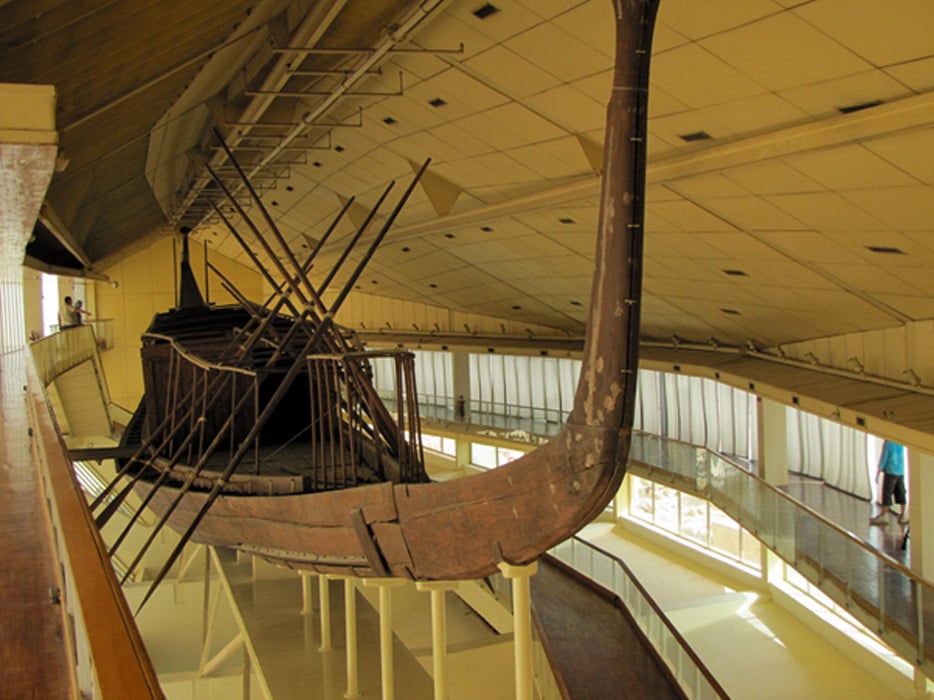
Visitors to the Giza Plateau will be able to view Khufu's second solar boat through a tiny camera 4,500 years after it was buried to ferry the king to eternity.
On the southern side of Khufu's Great Pyramid, a hundred journalists, photographers, cameramen and television presenters gathered inside a five-metre-long metal hanger padded with black fabric.Inside the hanger were 10 leather chairs and an LCD screen showing scenes of Khufu's solar boat in situ.
From last Saturday, Khufu's second solar boat is on show to the public for the first time since its discovery by Egyptian architect and archaeologist Kamal El-Mallakh with Zaki Nour in 1954.
At that time El-Mallakh and Nour found two boat pits during routine cleaning at the southern side of the Great Pyramid.The first pit was found under a roof of 41 limestone slabs, each weighing almost 20 tonnes, with the three westernmost of the slabs being much smaller than the others leading them to be interpreted as keystones.
On removing one of the slabs El-Mallakh and Nour saw a cedar boat, completely dismantled but arranged in the semblance of its finished form.Also inside the pit were layers of mats, ropes, instruments made of flint and some small pieces of white plaster along with 12 oars, 58 poles, three cylindrical columns and five doors.