HOT NEWS !
Stay informed on the old and most recent significant or spectacular
nautical news and shipwreck discoveries

-
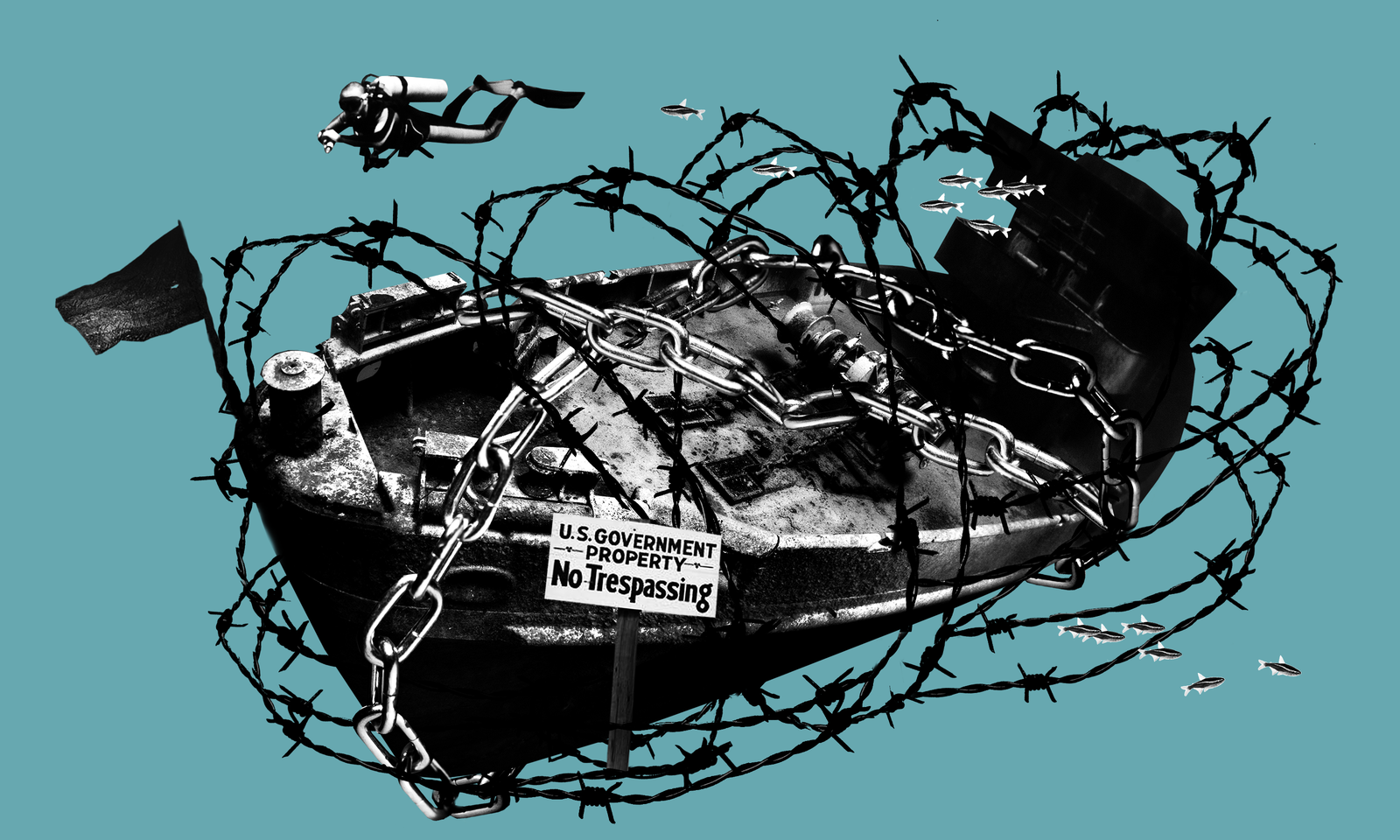
Here's what protects shipwrecks from looters and hacks
- On 03/04/2018
- In Famous Wrecks
By George Dvorsky - Gizmodo
On May 25, 1798, the HMS DeBraak was entering Delaware Bay when a squall struck without warning. The British ship that originally belonged to the Dutch capsized and sank, taking 34 sailors and a dozen Spanish prisoners down with it.
Rumored to contain a hoard of gold and jewelry, the DeBraak became a popular target for treasure hunters in the years that followed. The wreck was finally discovered in 1986, lying under 80 feet of water at the mouth of the Delaware River.
The team who found the ship attempted to raise it from its watery grave, resulting in one of the worst archaeological disasters in modern history. The event precipitated the passing of long-overdue laws designed to prevent something like this from ever happening again.Soon after the wreck of the DeBraak was found, treasure hunters speculated that it contained riches to the tune of $500 million, even though no evidence existed to support the claim.
The team who made the discovery formed a company called Sub-Sal Incorporated to conduct a salvage operation. Its divers eagerly scoured the wreck, pulling up a gold ring belonging to the ship’s captain, belt buckles, a cannon, a long-barreled pistol, two bottles of rum, scabbards, toothbrushes (sans bristles), a pewter spoon, and hundreds of other items.
The divers also recovered more than a hundred gold and silver coins, which they used as collateral for an $85,000 loan to keep the project afloat. -
Montenegro turns blind eye to deep-sea treasure hunters
- On 09/02/2018
- In Illegal Recoveries
By Sinisa Lukovic - Balkan Insight
When the Austro-Hungarian cruiser Zenta, the first ship sunk in the First World War, plunged to the bottom of the Adriatic Sea near Petrovac, more than half of the ship’s crew went down with it.
When it set out from the port of Tivat, accompanying the destroyer Ulan on a mission to blockade the Montenegrin port of Bar, the cruiser was already a veteran vessel, pulled out of the reserves. Obsolete, slow and poorly armed, it was an antique among modern ships.
Zenta sank during a battle with the more powerful fleets of France and Britain on August 16, 1914 – and the site of the shipwreck lay undisturbed until divers discovered it in 2001.
Treasure hunters followed soon enough.
Dragan Gacevic, a well-known diver from Herceg Novi and author of the book and documentary TV series Montenegrin Undersea [Podmorje Crne Gore], told CIN-CG/BIRN that thieves soon got to work.
“It is unbelievable that in the meantime someone tried to steal the main compass from the command bridge of the Zenta. That wreck is 73 meters down, and a special gas mixture, the so called trimix, is needed to dive to such depths – which goes to show that these thieves are up for anything,” he said.
-
Never too deep to dive
- On 07/12/2017
- In Miscellaneous
By Aditya Sudarshan - The Hindu
With many thousand kilometres of coastline, an ocean named after it, and maritime activity dating back to the Harappan era, there’s no question that a lot of India’s history lies underwater.The Archaeological Survey of India (ASI) has had its eye on underwater explorations since the mid-1970s, with an Underwater Archaeology Wing (UAW) officially in existence since 2001.
But the significant findings, such as the discovery of man-made structures off the coast of Dwarka, have tended to originate from autonomous bodies like the National Institute of Oceanography (NIO), where a handful of explorers have always borne a disproportionate workload.
In 1990, S.R. Rao, named the father of marine archaeology in India, who supervised the Dwarka dives, observed that ‘five diving archaeologists is too small a number for a country of the size of India.’
Almost 30 years later, even after the UAW sensibly shifted operations from land-locked Delhi to Goa about a year ago, that number is down to a paltry three.
-
The Halifax Explosion: Ten objects that tell the story
- On 07/12/2017
- In Famous Wrecks

By Michael MacDonald - National Post
Across Halifax, a trove of artifacts tell of what happened one terrible day 100 years ago.Just after 9 a.m. on Dec. 6, 1917, the bustling city was shaken by a thunderous blast that cut a swath of unimaginable destruction through its north end. Two ships, the SS Imo and the SS Mont Blanc, had collided in the harbour.
As the Mont Blanc’s hull was sheared open, a shower of sparks set fire to its volatile cargo of bomb-making chemicals and ammunition. Almost 2,000 people were killed by the Halifax Explosion. Another 9,000 were injured.
Inside two of the city’s museums, new exhibits help commemorate the disaster’s 100th anniversary on Dec. 6, showcasing relics that few have seen before:
No. 1: Handkerchiefs
As bodies were recovered from the blast site, those handling the remains were careful to collect all personal effects to help with identification. Among the many items left unclaimed were the mundane, everyday objects found in people’s pockets. These items included silk handkerchiefs, workingmen’s bandannas and children’s hankies, some of which are on display at the Maritime Museum of the Atlantic.
“They’re pretty much exactly as they were when they were recovered from the rubble in the days after the blast,” says curator Roger Marsters. “They’re crumpled, they’re dirty, they’re rough … Every one of those has a story.” One of the cotton handkerchiefs belonged to a girl, believed to be about 10 years old. She was identified as No. 256, with “light complexion” and “long dark hair.”
She was wearing a dark dress with a red and black striped apron, and a light flannel petticoat.
No. 2: Prosthetic eyes.
As the Mont Blanc burned in Halifax harbour, hundreds of people watched the spectacle, unaware that the vessel was a floating time bomb. When it exploded, the resulting shock wave blew out windows across the city, blinding hundreds of people.
About a dozen ophthalmologists treated 592 people suffering from eye injuries, which included performing 249 eye removals.
As part of its exhibit, the museum is displaying a unnerving collection of hand-painted prosthetic eyes, on loan from the Medical History Society of Nova Scotia.
-
136-year-old shipwreck found in Georgian Bay
- On 06/12/2017
- In Wreck Diving

By Rob Gowan - Calgary Sun
The wreck of a steamship that went down in Georgian Bay during a storm 136 years ago has been found, with what could be human remains onboard.American shipwreck hunters Jared Daniels, Jerry Eliason and Ken Merryman revealed their summer discovery to coincide with the anniversary of the Jane Miller’s sinking Nov. 25, 1881.
The 24-metre package and passenger steamer went down with 25 people aboard, including the crew. The wreck was found in Colpoys Bay, an inlet of Georgian Bay leading to Wiarton on the east side of the Bruce Peninsula north of Owen Sound in Georgian Bay.
The ship mostly is structurally intact with its mast still standing, rising within 23 metres of the surface. The shipwreck hunters also reported spotting what could be remains of bodies.
Merryman, who’s hunted shipwrecks for more than 40 years, said it was exciting to find the missing vessel. “People call these things time capsules and they absolutely are,” he said from his home in Minnesota.
“That ship took on 10 to 20 tonnes of cargo, so now the archeologists have a snapshot of 1880s life on the Bruce Peninsula with what kinds of things are there.”
-
Treasure hunters suspected to have looted 1915 shipwreck
- On 06/12/2017
- In Illegal Recoveries
By Joseph Brean - The Province
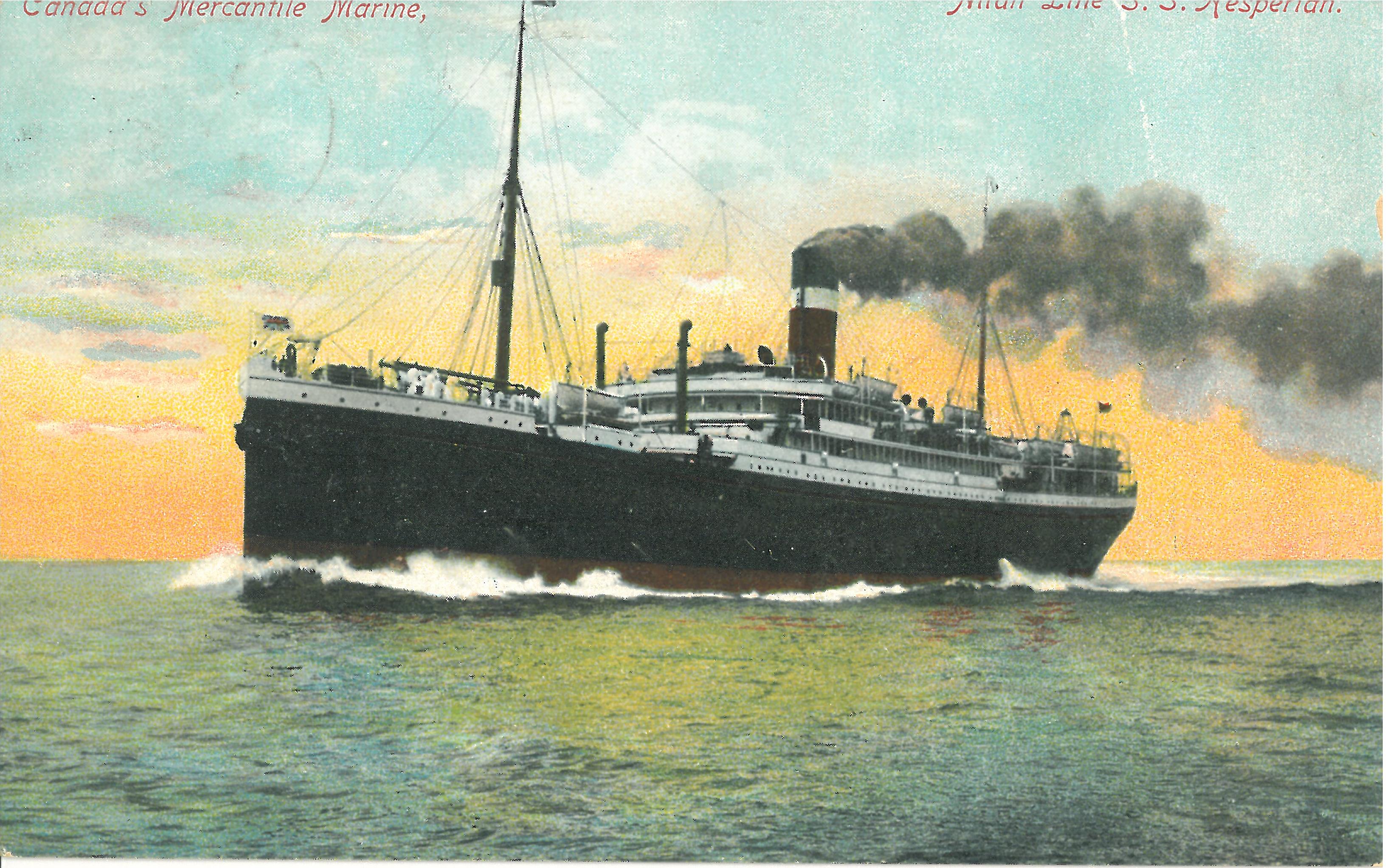
Scuba-diving pirates have ransacked a 1915 shipwreck that contains the embalmed body of a Montreal socialite philanthropist, along with stores of gold and treasure that were being shipped to Canada for safety as Europe fell into war, according to an Irish marine biologist.
Blood-stained canvas hammocks that were used by wounded Canadian soldiers on board the ocean liner Hesperian have surfaced over the past few weeks in the waters off Ireland’s southern coast, suggesting the century-old wreck has been recently disturbed.
This follows the discovery by fishermen in their nets of brass taps and water pipes, which have been reported to Ireland’s heritage ministry, and are being preserved by Kevin Flannery of the Dingle Oceanworld Aquarium in Ireland.
“There is obviously interference with the wreck because all that stuff would have been washed away in the last 100 years never mind one bad storm,” he told The Times of London. “These are pirate treasure hunters with no respect for the dead.”
A mysterious ship, which refused to make radio contact and did not have an automatic identification system, has been seen near the wreck site, with no clear reason for being there, he said.
“I think they obviously blew the ship to get at the safes or whatever they were looking for,” he said. “It’s grave robbing.”
-
Ancient Roman shipwrecks
- On 23/11/2017
- In Underwater Archeology
By Jack Moore - Yahoo News
The Egyptian government announced Tuesday that archaeologists have uncovered three sunken, millennia-old shipwrecks off the country's north coast. The wrecks, filled with ancient artifacts, are Roman and date back when the empire spread over Europe and North Africa.Inside the wrecks, archaeologists discovered three gold coins that date to the time of ancient Rome’s first emperor, Augustus, also known as Augustus Caesar Octavian.
They also found a head sculpture carved into crystal, remains of pottery and large pieces of wood, potentially from the ship itself. The discoveries were made off the coast of the northern city of Alexandria, specifically in its Abu Qir Bay.
Augustus succeeded his infamous great-uncle Julius Caesar following the latter's assassination and brought peace and stability to the Greco-Roman world in a lengthy rule of 40 years.
-
The Titanic shipwreck killed 1,500 people
- On 17/11/2017
- In Famous Wrecks

By Stephanie Merry - Washington Post
Here’s a lesson in how to avoid being a popular teenager in 1997: Tell all your friends that the swoony romantic drama they’re giddy over is actually a garbage movie; that, really, a 1958 black-and-white film called “A Night to Remember” is more worth their time; that the whole romance between Leo and Kate is insipid compared with what really happened.I was 16 when “Titanic” came out and became a colossal hit, and sometimes I felt like the only naysayer. I was right in the bull’s eye of the target demographic: What adolescent girl didn’t want to see a tear-jerker starring Romeo himself, with a plucky heroine and sweaty love scenes? So I saw it in the theater 20 years ago, like everyone else.
But unlike just about all of my female classmates, I wasn’t impressed. Or maybe I should say I wasn’t impressed with the story — you can’t deny that the movie had some seriously special effects. The problem was that, knowing the real tales of some of the survivors put me at a disadvantage for appreciating the manufactured love story the mass tragedy revolved around.
The sinking itself on April 15, 1912, was dramatic enough.
What was the point of inserting a bunch of made-up melodrama into an event that was already so harrowing? Even before I knew I had a distant relative on the Titanic, I was instantly and deeply fascinated by the disaster.
I must have been 6 or 7 when I stumbled upon a couple of old National Geographic magazines in my childhood basement about the recent discovery of the ship’s wreckage.
(In the days before Marie Kondo, my parents, like every parent I knew, hung on to every last issue, neatly lining up the yellow spines in a bookcase in chronological order.) I found myself paging through a worn copy from December 1985 with a story by Robert Ballard, the explorer who discovered the ruins that year.
The article was accompanied by underwater photos like I’d never seen of the rusted hull of a sunken ship that had been sitting on the ocean floor, undisturbed, for decades.
I can’t say what could possibly draw a little girl to such a nightmare — shouldn’t I have been playing with my Pound Puppy or something? — but I was transfixed and immediately took the magazine to my dad, who I presumed had never heard of this massive historical event. That’s when he told me we had a family connection, albeit a distant one.
