HOT NEWS !
Stay informed on the old and most recent significant or spectacular
nautical news and shipwreck discoveries

-
The best way to play Odyssey Marine and Shipwreck Exploration
- On 12/02/2012
- In People or Company of Interest
From Seeking Alpha
A few of you may recall this article, from August of 2008, explaining why "August is the time to buy Odyssey Marine Exploration". First, a few words on what's right with the article. Oddyssey Marine "arrested" some wrecks -- true enough.
This means that some token from the vessel (or ostensibly so) was presented to a court of admiralty in connection with a claim on the vessel - a claim in rem against the vessel itself, rather than a claim against its owner.
An "arrest" doesn't prove either that the vessels at issue are the property of OMEX, or that OMEX even has properly identified the wrecks; it simply brings the supposed wrecks within the jurisdiction of an admiralty court.This means that the fight over the wreck sites can begin.
Let's think back to the famous wreck Atocha, found by Mel Fisher in 1971. Finding the Atocha at a cost of over $2 million didn't immediately enrich the Fishers.
It simply embroiled them in a series of law suits over title to the find and to their share, if any, after taxes (try paying timely quarterly taxes on the appraised value of a trove of antiquities without destroying the market for the antiquities by dumping them).
Among the claims raised by the government in the suit concluded in 1978 were claims that the government owned the wreck as abandoned property and as an assemblage of antiquities - claims supported by statutes the government had passed.
The fact that the Fishers did well in the case decided in 1978 was not based on some immovable pillar of admiralty law, but (if you read the linked case) solely on the language and history of the statutes actually in effect at the time of the suit. The law has changed quite a bit since then.Under the 1902 treaty between the United States and Spain, the United States must afford Spanish warships not only "the same assistance and protection" as United States warships but also "the same immunities which would have been granted to its own vessels in similar cases."
Since modern U.S. law on U.S. warships places the sovereign that launched the warship in absolute control not only of the lost warship but of everything within its debris field, and prohibits courts from determining that they have been abandoned without an express declaratin of abandonment, the happy-go-lucky conclusions offered by some wreck enthusiasts regarding the outlook for acquiring title to a lost Spanish warship full of New World treasures require some serious consideration. -
What lurks beneath ?
- On 11/02/2012
- In Parks & Protected Sites
Bill Gamblin - Santa Rosa Press Gazette
Residents of Santa Rosa County will have the opportunity to learn some of the history that lies beneath the Blackwater River.
What once was known as Hardscrabble before a series of name changes, which included a period where Milton was referred to as Hell, has a rich history resting on the bottom of the Blackwater River.
Saturday night the Blackwater Pyrates are sponsoring a lecture starting at 6 p.m. that will focus on the shipwrecks of the Blackwater River and the lumber mill history.
Dr. Della Scott-Ireton, of West Florida Archaeology Network, will speak on the shipwrecks, while Dr. Brian R. Rucker of Pensacola State College will address the lumber mill history.
Both of these segments work hand in hand.
“The most recognizable wrecks are the four schooners and the steam tug at Sheilds Point,” said Dr. Scott-Ireton, who specializes in maritime archaeology. “The are ones that can be seen at low tide and at times can be seen from the I-10 bridge if you know what you are looking for.
“The biggest thing is there are a lot of vernacular watercraft that are at the bottom of the Blackwater that we do not have much history on since they were not constructed at a shipyard or by a shipwright.”
Ironically one of the biggest mysteries Scott-Ireton will address is a British war sloop – the HMS Mentor. “We recently got a grant to do research on this vessel and try to locate it as well,” Scott-Ireton said.
“This British ship was the only one around and the British were planning on using it to battle the Spanish fleet, but it capsized in 1781 and the crew burned the ship.
“Some of the boats we will talk about has involved a lot of research and thesis work by graduate students here at UWF, while others are not so well researched.”
-
Underwater archaeology in Ibiza
- On 11/02/2012
- In Underwater Archeology

From Ibiza Spotlight
Spotlight has featured many stories of archaeological finds and remnants of ancient civilisations which have been unearthed during building projects.
The plans for the new Parador in Dalt Vila have been modified to accommodate many remains which have been found there and a new school planned on a former car park in the town centre is months behind schedule whilst archaeologists complete investigations on site.
Now, a new find has been made during the dredging process of Botafoch harbour. A 17th century ship was uncovered during the operations and already many relics – including two bronze canons – have been brought to the surface for study and eventual housing in a museum.
The eventual aim is to raise the ship Mary Rose style from the sea bottom and preserve it for future generations. This is such a time consuming and expensive operation that it cannot be done now when it would delay such an important project.
The island authorities have therefore decided to mothball the ship by completely covering it in a thick layer of sediment and then building the already planned car park on top of it.
When the time is right in the future, it will be relatively easy to uncover the ship to raise and eventually display it to the public.
-
Navy researchers to confirm if shipwreck is “Revenge”
- On 11/02/2012
- In High Tech. Research/Salvage
From US navy seals
Researchers from the United States Navy, with the support of the Woods Hole Oceanographic Institution, are seeking to confirm whether the shipwreck resting off the coast of Rhode Island is the Revenge.
The team will make use of high-tech sensor equipment to map the site, which will serve as the first step towards retrieving artifacts.
The Revenge was commanded by Navy hero Oliver Hazard Perry, and was lost on a stormy day in January 1811.
Charlie Buffum, a brewery owner from Stonington, Connecticut, discovered the shipwreck while diving with his friend, Craig Harger.
He shared: “The Revenge was forgotten, it became a footnote… we are very confident this is it.”
The effort may possibly shed light on an important part in the life of one of the greatest naval officers in America. He is best remembered as the Hero of Lake Erie, after emerging victorious against the British navy in the War of 1812.
He is known to have said simply that “we have met the enemy and they are ours” after the Battle of Lake Erie in 1813.
Perry was a 25-year-old commander when the Revenge sailed from Newport, Rhode Island, to New London, Connecticut, in 1811.
The ship, however, hit a reef in heavy fog, as the area is infamous for its rocky, tide-swept surfs. The crew eventually abandoned the Revenge, and no man was lost. He was, however, court-martialed after the incident, although he was exonerated.
David Skaggs, professor emeritus at Bowling Green State University who has written a book on Perry, shared: “He was a rising star…
But then his ship runs aground. Running a ship aground is not a helpful thing for your career.
-
El Supremo de EE.UU. tumba el último recurso de Odyssey
- On 10/02/2012
- In Illegal Recoveries
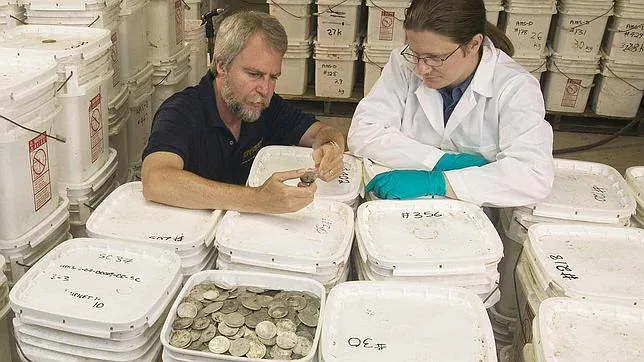
From ABC
Odyssey Marine Exploration ha perdido su última baza para frenar la entrega de las monedas obtenidas en el expolio de la fragata «Mercedes» en mayo de 2007.
El Tribuna Supremo de EE.UU. acaba de tumbar esa oportunidad al rechazar el recurso de emergencia presentado el día 6 de febrero en un intento de que el Alto Tribunal estadounidense concediese una prórroga a la empresa cazatesoros y bloquease la ejecución de la sentencia.
El hecho de que haya tardado apenas tres días en tomar la decisión es interpretado por fuentes de la Administración española como una señal más de lo imparable de la derrota de la empresa con sede en Tampa (Florida).
«Odyssey ha perdido el caso totalmente. Aunque ahora presentara otro recurso ante el Supremo para revisar el caso, la sentencia se cumplirá», afirman las mismas fuentes.
El Tribunal de Apelación de Atlanta falló el día 1 de febrero pasado contra Odyssey en el caso que la propia empresa cazatesoros había iniciado en Tampa en 2007 para exigir los derechos sobre lo que ellos llaman el «tesoro» y que no son más que los restos en metales preciosos de un naufragio acontecido en 1804 frente a las costas del Cabo de Santa María, en el que perecieron casi 250 personas, entre civiles y militares.
En cuanto el Tribunal de Distrito de Tampa reciba la sentencia de Atlanta y el auto del Supremo convocará a las partes y fijará un plazo para la devolución de las monedas y los otros efectos expoliados.
Hay que recordar que Odyssey los custodia mientras la Justicia dirimía sus derechos. Finalmente, con todas las sentencias en contra y sus recursos rechazados, la Justicia de EE.UU. se inhibe ante la capacidad de los cazatesoros de reivindicar derechos de hallazgo sobre los restos de buques de Estado en aguas internacionales. -
Sunken WWII treasure found ? Port Nicholson
- On 08/02/2012
- In Treasure Hunting / Recoveries
From Fox News - The interview news
Treasure hunter claims discovery of $3 billion wreck... True story or hoax !?? -
Ancient Greek pills found in Greek shipwreck
- On 06/02/2012
- In Underwater Archeology

By Fani Toli - Greek Reporter
In 130 BC, a ship fashioned from the wood of walnut trees, bulging with medicines and Syrian glassware, sank off the coast of Tuscany, Italy.
Archaeologists found its precious load 20 years ago and now, for the first time, archaeobotanists have been able to examine and analyse pills that were prepared by the physicians of ancient Greece.
DNA analyses show that each millennia-old tablet is a mixture of more than 10 different plant extracts, from hibiscus to celery.
“Medicinal plants have been identified before, but not a compound medicine, so this is really something new,” says Alain Touwaide, director of the Institute for the Preservation of Medical Traditions, which has the world’s largest digital database of medical manuscripts.
The pills, which researchers believe were diluted with vinegar or water to make them easier to ingest, were preserved inside tin boxes and were the size of coins.
“What is remarkable is that we have written evidence [from the ancient Greeks] of what plants were used for which disorders,” says Alisa Machalek, a science writer for the National Institute of Health, one of the world’s leading research centres.
“This research is interesting, especially for medical historians, because it confirms that what we eat affects our bodies.”
The shift toward synthetic chemical medicines occurred in the 20th Century, but according to Mark Blumenthal, the founder and executive director of the American Botanical Council, there is renewed interest in the medicinal benefits of natural foods – including those found in the pills. -
Blackbeard artifacts to be opened to public
- On 06/02/2012
- In Museum News

From Popular Archaeology
A newly restored cannon recovered from the 1718 shipwreck of Blackbeard's flagship, Queen Anne's Revenge (QAR), will be on display for the public in late February at the N.C. Maritime Museum in Beaufort.
Other artifacts will include a pewter decorated wooden knife handle, cannon wadding, and a hand grenade.
Blackbeard, otherwise known as Edward Thatcher (or "Teach" in some circles), was perhaps the most notorious pirate along the eastern seaboard of North America during the heyday of ocean-going piracy between the late 17th and first quarter of the 18th centuries.
In June of 1718 his fleet attempted to enter Old Topsail Inlet, NC, now known as Beaufort Inlet. His flagship, Queen Anne’s Revenge and the Adventure ran aground at the Inlet and was subsequently abandoned by Blackbeard and many of his crew, fleeing to the north.
He and some of his fellow crew members were eventually killed by an expedition of the Royal Navy the following November.
In 1996 a shipwreck was discovered in the Beaufort Inlet by the Florida-based research firm Intersal, Inc., and gradual recovery and analysis of the artifacts since then have strongly suggested that the shipwreck is indeed that of the Queen Anne’s Revenge.
Says archaeologist David Moore of the N.C. Maritime Museum , "The 19-inch bronze cannon possibly was used as a signal gun to warn victims of the pirate ship's presence or as part of combat.
In fact, there is evidence that the cannon was well-used, as the vent had been worn from explosions and was replaced by the crew."
Speaking of the decorated wooden knife handle, QAR Chief Conservator Sarah Watkins-Kenney said that "it is remarkable that a wooden object has survived nearly 300 years on the ocean floor."
The knife blade itself did not survive.