HOT NEWS !
Stay informed on the old and most recent significant or spectacular
nautical news and shipwreck discoveries

-
Divers locate wreck of battleship sunk on way to Malta
- On 02/07/2012
- In Wreck Diving

From The Times of MaltaDivers have located the wreck of an Italian battleship which was sunk by German bombs while it was on its way to Malta to surrender in the Second World War.
The Roma, which was the flagship of the Italian fleet, was sunk on September 9, 1943 by two 'glider' bombs. The wreckage was located off Sardinia after a search lasting several years, the Italian Navy said.
It is in a depth of some 1,000 metres about 16 miles off the coast of Sardinia.
Admiral Carlo Bergamini and 1,352 crewmen died when the battleship was sunk. It was the Italian Navy's most modern battleship having been launched in June 1942.
The ship formed part of the Vittorio Veneto class, heavily armed with nine 15 inch calibre guns.
-
Bulgaria archaeologists discover ancient settlement underwater at Cape Arkin
- On 01/07/2012
- In Underwater Archeology
From Focus
Bozhidar Dimitrov, Director of the National Museum of History, comments on the latest archaeological discovery in Bulgaria - an underwater settlement during excavations at Akin Cape in an interview with FOCUS News Agency.FOCUS: Mr Dimitrov, what are the latest archaeological discoveries during the excavations at Cape Akin close to the coastal town of Chernomorets ?
Bozhidar Dimitrov: During the excavations under the Via Pontica government programme at Cape Akin, one of the three capes of the town of Chernomorets, apart from the massive fortified wall with two battle towers at the peninsula itself, archaeologist Dr Ivan Hristov [Associate Professor Dr Ivan Hristov, Deputy Director of the National Museum of History] also discovered a continuation of the fortified wall into the sea.
The continuation of the wall surrounds a big mud-bank Southwest of the cape.The fortified wall is preserved to some big height and the team has seen the outlines of a big battle tower of five meters height and three and a half meters width.
The archaeologists have already ascertained that this is the early Byzantine fortress Krimna, which was situated there.Due to some circumstances, since the beginning of the WWI until a couple of years ago the fortress was within the area of a military unit and it was impossible for the archaeologists to study it.
The part of the fortress on dry land covers nearly 40 decares. The fortified wall is bigger even than the one in Sozopol – of around 2.6 metres width.
The coins found by the archaeologists prove that the wall was built by Anastasius I in around 513, then reinforced by Justinian I over the next decades and probably the settlement was destroyed during the big Avarian invasion in 583-586.
-
Diver tells of sunken treasure in Malacca
- On 01/07/2012
- In Underwater Archeology

By R.S.N. Murali - The Star OnlineAn archaeologist diver claims to have discovered the remains of a sunken Dutch merchant vessel containing RM500mil worth of cultural relics, about three nautical miles off Pulau Besar here.
The Kuala Lumpur-based archaeologist, who wanted to be known only as David so he could remain anonymous, believes the vessel could have escaped the roving eyes of underwater relic hunters as it was buried by undersea sand.
The wooden galleon is said to have sunk with the loads of treasures about 400 years ago. It may have a number of well-preserved relics like ceramics, old coins, beads, glass and gold ingots.
David believes the find is the first intact wreck related to the Dutch occupation of Malacca.
He and his team found the near complete hull structure about 1m under the seabed, and 27m beneath the ocean's surface off the Straits of Malacca in May.
“The discovery is so monumental because much of the hull has remained intact and the vessel appears to be well preserved due to the sand,” he said.
David said there were also six other shipwrecks at the same site.
Malacca Museum Authority's general manager Datuk Khamis Abas said the wooden vessel had been detected during an underwater survey conducted by several maritime agencies a few years ago.
-
A tour of Cape Cod shipwrecks
- On 30/06/2012
- In Dangerous Places for Shipping
By Jack Sheedy - The Barnstable Patriot
The waters and sands around Cape Cod form the final resting place for hundreds of shipwrecks that occurred here over the past four centuries.
Dangerous shoals and bars along the backside of the peninsula snagged so many of these hapless vessels that 13 lifesaving stations were built to aid shipwrecked mariners. Eventually, the opening of the Cape Cod Canal in 1914 allowed vessels to avoid the treacherous Atlantic coastline and significantly reduced the number of disasters.
In fact, it is said that if all the vessels that came to woe here were lined up bow to stern they would form an unbroken chain from Monomoy to Provincetown. Many of these wrecks have become lost over time beneath the unceasing rhythms of sea and sand.
Others were picked over so thoroughly by Cape Codders of old that they no longer exist intact, but rather in pieces – perhaps as a door in a house or as boards forming an old barn.
A shipwreck along the shore in those days was a bounty from the sea to be scavenged by the locals. Nothing was left to waste. Yet, some memorable Cape wrecks, or pieces left behind from those wrecks, can still be viewed today – if you know where to look. And you won’t even need scuba gear.
To commence any tour of Cape Cod shipwrecks, one should start at the very beginning with the Cape’s first recorded shipwreck – the Sparrow-Hawk, which grounded off Nauset Beach in 1626.
Not only are her English elm keel and oak ribs viewable today, but these timbers are in remarkably good condition given their antiquity and the fact that they were exposed to the elements for more than 200 years.
The story of the Sparrow-Hawk mirrors that of the Mayflower – a voyage across the Atlantic Ocean in search of a new life in a new world.
Like the Mayflower, the Sparrow-Hawk arrived at Cape Cod, north of her intended destination at Virginia, and like the Mayflower, headed south along the coastline.
Unlike Captain Christopher Jones of the Mayflower, though, who realized the dangers of the shoals along the outer Cape and promptly turned his vessel around for the safety of Provincetown Harbor, the captain of the Sparrow-Hawk eventually wrecked his vessel.
All hands survived, spending the winter with the Pilgrims in Plymouth.
As for the wreck, it was said to be burned to the waterline by Natives and her remains became sanded in until they were discovered in the 1860s and exhumed to go on display around New England.
The ship’s skeletal timbers later landed at Pilgrim Hall in Plymouth, and are now on loan to the Cape Cod Maritime Museum in Hyannis, where they can be viewed.
Another museum in Barnstable that holds a remnant of an impressive shipwreck is the Centerville Historical Museum. On exhibit is the ship’s wheel from the 291-foot paddlewheel steamer, Portland, which sank during a terrible storm in November 1898 with some 175 people on board.
Wreckage from this disaster washed up all along the Lower Cape coastline, ending up in private homes and, eventually, in museums around the Cape, such as at the Jericho House Barn Museum in Dennis, where a Portland deck post is on display.
Provincetown’s Macmillan Wharf is home to the Expedition Whydah Sea Lab & Learning Center, where artifacts can be seen from the wreck of the pirate ship, Whydah, which foundered off Wellfleet in 1717.
The vessel was under the command of legendary pirate “Black” Sam Bellamy, who, as lore suggests, romanced an Eastham woman named Maria Hallett before setting off to make his fortune through piracy. During his return voyage to the area, Bellamy ran into a storm and his prize Whydah wrecked just off his former lover’s coast.
-
Swedish archaeologists push for shipwreck excavation
- On 29/06/2012
- In Underwater Archeology
Swedish archaeologists are keen to secure funding to excavate an 800-year-old shipwreck that was discovered off the country’s south coast.
The long, narrow vessel, which was found close to Sturkö, is almost completely buried, meaning excavation will be difficult.
“When the divers recovered fragments for dating, they were literally ‘looking’ with their hands,” underwater archaeologist for the Kalmar County Museum, Lars Einarsson, told The Local.
“The sediment is so easily disturbed that it makes it almost impossible to see what you’re doing. In some ways, it would be easier if the ship was 10 times deeper.”
“This is an extraordinary medieval wreck. We’ve found that the wood was cut down between 1250 and 1300,” Einarsson said, adding that the 14 by two metre vessel would have been very fast and therefore probably used for looting.
The Kalmar County Council must now decide whether or not to fund the enormous task of excavating the ship, but Einarsson feels the investment could be very worthwhile.
“We really want to determine why the ship was abandoned. We want to know if it was dramatic, or whether it was just left because the ship became too old-fashioned,” he told The Local.
“If it was left under dramatic circumstances, who knows what treasures the insides of the ship may hold ?
The contents would be tremendously helpful in making a connection to the cultural and historical context of the ship.” -
Robots join hunt for wreckage of Amelia Earhart's plane
- On 28/06/2012
- In Airplane Stories

By Jeremy Hsu - Today MSNBCU.S. Navy warships and aircraft failed to find Amelia Earhart when the pioneering female aviator vanished in the South Pacific during her second attempt to fly around the world in 1937.
This summer, aviation archaeologists have enlisted the help of underwater robots to find the wreckage of Earhart's aircraft.
The International Group for Historic Aircraft Recovery (or TIGHAR) suspects that Earhart's Lockheed Electra landed on a reef of the uninhabited coral atoll formerly known as Gardner Island and stayed there for several days before waves washed the aircraft over the reef's edge — perhaps enough time for the aviator and her navigator to have sent out radio distress calls.The expedition plans to deploy ship sonar and two robot submersibles to search the slope of the underwater reef for any aircraft parts.
"We will not be recovering anything on this trip," said Richard Gillespie, executive director of TIGHAR. "The objective is to get imagery and photographs of what's there."
The expedition is scheduled to set out aboard the Hawaiian research vessel "Ka'Imikai-o-Kanaloa" from Honolulu on July 2 — the 75th anniversary of Earhart's disappearance.
Its underwater robots are capable of searching with sonar and taking black-and-white photos down to a depth of almost 5,000 feet (1,500 meters), as well as checking out sonar targets with high-definition video down to a depth of 3,300 feet (1,000 meters).
-
Divers claim 'Baltic UFO' shuts down all electronics within 200m
- On 28/06/2012
- In Miscellaneous

From RTA strangely-shaped object at the bottom of the Baltic Sea has been interfering with the electrical devices of the Swedish diving team that is trying to film it. But critics are growing more skeptical about the long-running mystery.
The Swedish Ocean X treasure-hunting team first discovered a mystery object reminiscent of the Star Wars spaceship Millennium Falcon last year.
But they didn’t have the resources to investigate. Now, they have returned with top-of-the-range 3D seabed scanners and a submersible – all funded by a secret sponsor.They are trying to film it but as soon as they get close, they are foiled.
“Anything electric out there – and the satellite phone as well – stopped working when we were above the object,” Stefan Hogerborn, the expedition’s lead diver, told Swedish channel NDTV.
“And then we got away about 200 meters and it turned on again, and when we got back over the object it didn’t work.”
The discovery itself is described as a round object resembling a “huge mushroom.” On top of it is an “egg-shaped” portal. The team said that a 300-meter trail that “can be described as a runway” stretches out from the site of the “spaceship.”
The team has not been shy to speculate about what they have seen.
“It's a meteorite or an asteroid or a volcano or a base from, say, a U-boat from the Cold War which has manufactured and placed there – or it is a UFO.Well honestly, it has to be something," says Dennis Asberg, one of the Ocean X team.
The electric interference seems to confirm that the object is by no means ordinary. -
Thrilling memories of Mary Rose treasure
- On 25/06/2012
- In Famous Wrecks
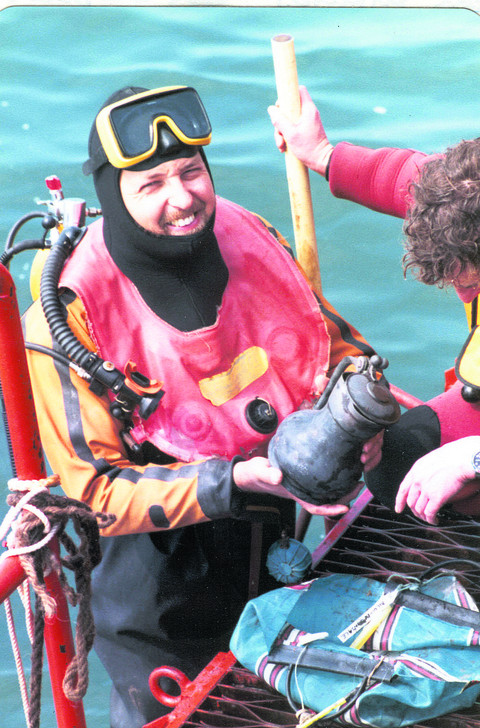
By Laura Jones - Herald SeriesThirty years after the stricken Mary Rose was brought ashore, Wantage recreational diver Colin Fox recalls his role in salvaging its treasures.
The retired oil company worker helped to explore the ship in his spare time and even came face to face with a skeleton in the depths of the wreck.
Mr Fox made 240 trips down to the Mary Rose, spending a total of 173 hours underwater and bringing weapons, pewter pots and other artifacts back to the surface over a period of five years.
The Mary Rose sank in 1545 and lay undiscovered in The Solent until 1967, when the project to excavate and raise the wreck began.
She sank as she prepared to fight the French in the Battle of Spithead and took 660 sailors to their death.
Mr Fox approached the team in 1978 and offered to work on the project for free during his holidays.
The 68-year-old said: “I wrote and asked if I could help, never expecting to dive on the project. I thought I could carry bottles for them.
“They invited me to come and dive.
“We used a thing called an airlift – a four inch plastic pipe which acts as a huge vacuum cleaner.”
The team placed a scaffold grid over the area to stop finds being carried off in the current while they made a painstaking search of the wreck.
Mr Fox, from Ormond Road, said: “We were briefed over what to do while we were down there.
“There were fantastic finds: long bows, a pair of bellows and lots of small things like shoes and pewter pots.
“It was amazing. One didn’t know what one was going to find; it was unbelievably exciting.
“I couldn’t wait to get in and was really fed up when it was time to come up.