HOT NEWS !
Stay informed on the old and most recent significant or spectacular
nautical news and shipwreck discoveries

Gold recovered from shipwreck in Atlantic Ocean

By Liezel Hill - WAtoday
A marine salvager specialising in extracting cargoes from sunken ships has recovered its first gold from a 19th-century vessel lying more than a kilometre beneath the Atlantic Ocean.
Odyssey Marine Exploration recovered almost 1000 ounces (28 kilograms) on April 15 during its first reconnaissance dive to the wreck of the SS Central America.
The precious metal included five gold ingots and two $US20 Double Eagle coins, the Tampa, Florida-based Odyssey said on Monday.
"Gold ingots and other artefacts were clearly visible on the surface of the site during the dive and no excavation was required for their removal," it said.
The Central America, a sidewheel steamer, sank in 1857, more than 250 kilometres off the coast of South Carolina, with the loss of 425 lives.
Previous recovery efforts in 1989 through to 1991 netted more than two tonnes of gold. Odyssey has said that, based on certain assumptions, including that the remaining items are in the form of Double Eagle coins, there may still be $US 86 million ($ 92 million) of gold at the site.

By Sandun Jayawardana - The Nation
Sri Lanka’s strategic importance in the India Ocean attracted seafarers here for thousands of years.
Many shipwrecks from various ages that are found in the sea around the island have served as testament as to how the country was an important meeting point for cultures from across the world throughout history.
These wrecks serve as veritable ‘time capsules’ for archeologists, as they provide fascinating insights to bygone eras.
The Maritime Archaeology Unit (MAU) in Galle, managed by the Central Cultural Fund, and functioning under the Department of Archeology, is Sri Lanka’s first specific unit dedicated to exploring these underwater treasures.
The unit had its initial beginnings in 1992, when exploration work was undertaken with foreign assistance as part of the Galle Harbor Project.
The project was initiated with the aim of training a core group of maritime archeologists. These efforts were overseen by Professor Jeremy Green of the Western Australian Maritime Museum.
While work was suspended from 1994 to 1995 due to lack of funds, exploration work was undertaken after funding resumed led to extensive surveying of the seabed in the Galle harbor from 1996 to 1998, with 26 sites of archeological interest being identified by 1998.
Ten of these sites were confirmed shipwrecks.
When the project began in 1992, there were no trained divers among maritime archeologists in Sri Lanka.
The initial work on the Sri Lankan side was undertaken by amateur divers attached to the ‘Sub Aqua’ diving club and a team from the navy.
However, later on during the project, some undergraduates who were doing honors degrees in Archeology at Sri Lankan universities started training in maritime archeology.
Thus, by 1996, a permanent core group of maritime archeologists had been trained in Sri Lanka. Maritime archeology in the country finally became more institutionalized with the forming of the Maritime Archeology Unit and conservation laboratory in 2001, explained Research Officer and Maritime Archeologist at MAU, Rasika Muthukumarana, detailing how the unit first came into being.
The MAU has been responsible for locating, identifying and documenting dozens of shipwrecks throughout the island since the unit’s inception.
Some of the vessels that archeologists at the unit helped locate and identify include several ships belonging to the Dutch East India Company (VOC), including the Avondster which was wrecked on July 2, 1659 while anchored in the Galle harbor and Hercules, which sank in 1661.
The SS Conch, one of the world’s first oil transporting ships and wrecked in 1903 near Akurala on the southern coast, was also identified by the MAU.
The steamer SS John Jackson, which sank off the coast of Batticaloa in 1908, was also identified by a team from the unit recently. The John Jackson has been identified as being the largest such shipwreck discovered off Sri Lankan waters.
Some these projects, such as the Avondster exploration, were funded by the Netherlands government.
Perfectly preserved Nazi plane found 70 years after

From Nigerian Tribune
The Luftwaffe plane was found at the bottom of the Black Sea by a team of divers nearly 70 years after it vanished mid-flight.
The fate of the aircraft and its nine crew members had remained a mystery since it was reported missing in 1942.
Underwater photographer Andrey Nekrasov, 42, was part of the team which found the wreckage 23 metres beneath the surface off the Ukrainian coast, near Odessa.
The divers made the discovery while searching for a different plane.
Instead of finding the JU 88 they were expecting, they found a JU 52 ‘Iron Annie’, a type used extensively as a transporter aircraft by the Luftwaffe during the war.
Since the discovery, researchers have attempted to piece together the fate of the plane and its crew.
Mr Nekrasov said: ‘There were no records of a crashed plane of this type in this area.
‘The wreckage was very deep down so visibility was poor. We could only see three metres in front of us at any time.
‘A plane on the seabed always looks very strange. It turned out the story behind this one was even stranger.’
Using these items, Mr Nekrasov and his team determined the wreck was a transport flight carrying nine passengers which had been reported missing in early 1942, at a time when the Soviet Army had been on the offensive on the Eastern Front.
Mr Nekrasov said: ‘We have tried to recreate the whole picture of the events using just a couple of artefacts which were 70 years old and found at the bottom of the sea.’
Records from the time showed that the plane was carrying a flight engineer called Johann Wichert - the owner of the thermos and belt.
A signaller called Karl Kroch was also on board, returning to the Russian front after a period of leave
Also aboard was an observer, Oberstleutnant Baron Axel Freiherr von Jena, a veteran of the Spanish Civil War and a possible owner of the cap.
Flight records found inside the cockpit reveal the JU 52 was en-route to Nikolaev in Ukraine, having flown from Romania.
‘No way!’ Clock found in shipwreck debris off Galveston
By Doug Miller - KHOU
An underwater archeology project coordinated from a high-tech command center in Galveston has discovered a centuries-old clock amid the debris of a shipwreck found in the Gulf of Mexico.
Deep in the briny waters of the gulf, the timepiece’s round face marked with Roman numerals -- spotted in live images transmitted by a robotic vehicle – delighted scientists spending much of this week remotely exploring a debris field from what apparently was a disaster at sea in the early 1800s.
As the darkened control room at Texas A&M Galveston echoed with scientists’ voices crying out “That’s a chronometer !” and “No way !,” a computer monitor showed what looked like the hand of a clock pointing toward numbers that ringed the round rim of the clock’s face.
“Now, that’s cool!” said Kim Faulk, a marine archeologist working on the project.
The distinctive timepiece deepened archeologists’ suspicions that nobody escaped the lost vessel alive. Under anything but an extreme emergency, they suspect, sailors leaving the ship during that era would almost certainly have taken the clock, a valuable piece of nautical equipment.
The clock is only one of the latest discoveries from a debris field found about 175 miles off the coast of Galveston in 2011.
Images beamed back from the site show the ghostly remains of three ships that marine archeologists believe sank about two centuries ago.
“This, we believe, is a telescope,” said Dr. Steve Gittings of National Marine Sanctuaries with NOAA, pointing toward a picture transmitted from the shipwreck.
“Right here, with the glass lenses broken out of it, probably because of pressure when the ship sank.”
U.S. ships sunk During D-Day preparations
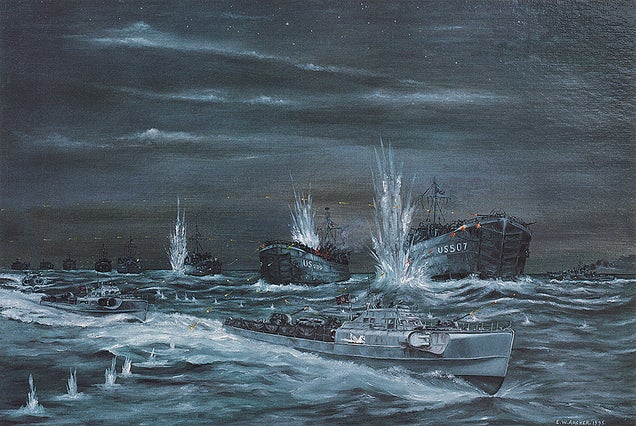
By George Devorsky - io9
On April 28, 1944, a German E-boat sank two U.S. ships participating in training exercises for the Normandy invasion — a largely unknown incident that claimed the lives of 749 American soldiers and sailors. A robotic sub recently captured the most detailed images yet taken of the wrecks.
It was called Exercise Tiger, a training exercise involving some 30,000 American troops consisting of infantry, artillery, engineers, medical personnel, tank battalions and support staff.
The drills took place on the South Devon coast at Slapton Sands, an area chosen for its resemblance to Utah Beach.
In the early hours of April 28, eight tank landing ships (LSTs) were making their way in when they came under attack by a flotilla of nine German E-boats. By the time it was over, two ships had been sunk (LST531 and LST507), while two other ships damaged by torpedos limped back to port.
But the survivors were sworn to secrecy. The Allies feared that if any information leaked to the Germans, plans for the D-Day Landings would be jeopardized.
The public did not know about the incident until 1974 when the details were declassified. To this day, the incident remains largely obscure.
Nazi chemical weapons leaking into the Baltic Sea

By Johnny Duggan - Riot News
Next May marks the 70th anniversary of V-E day and the end of the second World War. During the post-war Potsdam Conference, it was mutually agreed upon by the Allies that the remaining 65 tonnes of Nazi chemical weapons would be disposed of in the Baltic Sea.
While their intentions were certainly good, it was clearly a decision made without a complete consideration of the long-term ramifications of such a method.
Now, those sunken stockpiles may be stirring up huge problems from their watery resting place.
Here’s what we know about them, what we don’t, and what kind of problems we could be facing.
65,000 tonnes roughly measures out to about 143 million pounds. To put that in perspective, it’s like having nearly 1,800 big-rig 18 wheelers just lying on the ocean floor.
But instead of hauling some type of consumer cargo, those trucks are filled with deadly chemicals and explosives.
The agreement reached during the Potsdam Conference stipulated that the weapons be dumped into the (relatively shallow) Baltic Sea. However, this stipulation wasn’t exactly followed to the letter.
Allegedly, Soviet ships would dump the weapons as soon as they were no longer visible from land, as opposed to disposing of them in the designated areas.
Expedition seeks $86 million in gold in 1857 shipwreck

By Liezell Hill - Star Tribune
Treasure-hunter Bob Evans has spent half his life dreaming about the SS Central America, a pre-Civil War steamship decaying in the lightless depths off South Carolina. Now he’s returning to the shipwreck after 23 years.
Evans set out this week with deep-ocean explorer Odyssey Marine Exploration Inc. to revisit the remains of the 19th-century side-wheel steamer, which sank in 1857 with the loss of 425 lives and an undetermined amount of gold.
Despite recovery efforts in 1989 through 1991 that netted more than two tons of gold, Odyssey says there may still be $86 million of gold lying more than a mile deep.
“This is the greatest lost treasure in United States history,” said Evans, who was chief scientist on earlier expeditions.
Even with the plunge in gold prices last year, the metal is still worth more than triple its price in the early 1990s, when previous recovery efforts were suspended because of legal battles over rights to the treasure. And the rare coins that have been found at the site are selling for much more than their weight in gold.
For Odyssey, the shipwreck is another chance to show the potential gains from deep-sea salvaging. While the Tampa-based company has recovered tons of treasure in past projects, it has failed at others.
Odyssey is a “very atypical company in an atypical industry,” said Mark Argento, an analyst at Lake Street Capital Markets in Minneapolis. “It’s more like a biotech company: Not every biotech company gets every drug approved.”
Odyssey is undeterred. “Our research department and the court-appointed experts all believe there is enough gold remaining at the SS Central America to warrant the expense of conducting an expedition,” Odyssey President Mark Gordon said.
Eerie new underwater footage shows historic Arctic shipwreck
By Joe O'Connor - National Post
Dr. Joe MacInnis understands it was a long time ago and people forget, or else new people get born and grow up without necessarily learning their history.
That, in a nutshell, is a tidy summary of the history of the Canadian Arctic sovereignty story.
Planting the flag and flexing some Canadian muscle in the far North has been a priority for Prime Minister Stephen Harper’s government.
Each year, a new expedition sets off, flags get planted, work gets done, photos get taken and a message, in theory, gets sent that the Arctic, no matter how cold, or seemingly empty, is Canadian turf.
Both on the land and under the Arctic sea ice.
That is where Dr. MacInnis was looking in 1983, when the Liberal government of the day, in partnership with National Geographic magazine and a crack team assembled by the Canadian physician/author/Arctic underwater explorer, planted a flag by filming the wreck of the Breadalbane — a wreck Dr. MacInnis and a team of Canadians on a Canadian Coast Guard vessel discovered three years earlier, after a three-year search.
The Breadalbane was a wooden vessel with three masts that was involved in the hunt for Captain John Franklin’s ill-fated expedition when it got trapped by the Arctic ice and sunk off Beechey Island in the Northwest Passage in 1853.
The images of the wreck captured in 1983 were stunning. They appeared on the cover of the National Geographic.A documentary got made. There was a buzz.
Then, the cameras and the explorer and our government moved on until this month.