HOT NEWS !
Stay informed on the old and most recent significant or spectacular
nautical news and shipwreck discoveries

-
NOAA offers new online media library
- On 12/02/2009
- In Marine Sciences

From NOAA
NOAA’s Office of National Marine Sanctuaries has launched a new online multimedia library offering public access to thousands of high-resolution, ocean-related photos and videos taken by NOAA scientists, educators, divers and archaeologists.
“This robust online library offers thousands of images from all 14 marine protected areas managed by NOAA,” said Michiko J. Martin, national education coordinator for NOAA’s Office of National Marine Sanctuaries. “Some of these images depict threats and human pressures on marine life in a compelling fashion that we hope will inspire ocean literacy and conservation.”
The National Marine Sanctuaries Media Library is a comprehensive database containing a collection of high-quality still images and video footage featuring all 13 national marine sanctuaries and the Papahānaumokuākea Marine National Monument.The database is fully searchable by keyword, category and location, and all the images are tagged with relevant information including resolution and usage rights.
-
Searching for treasure using Google Earth
- On 10/02/2009
- In Treasure Hunting / Recoveries
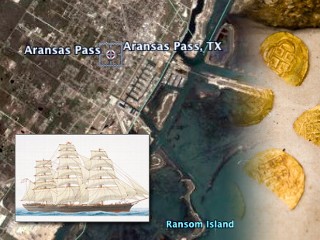
By Ryan Owens and Gina Sunseri
Nathan Smith has gold fever.
He caught it when he picked up a book on American treasures and read these words about a mythical Spanish barkentine and its gold and silver lost in south Texas: "Whoever finds either of these treasures would possess wealth beyond imagining."
The Los Angeles musician started hunting for the ship -- legend has it blowing ashore south of Refugio, Texas, during a hurricane in 1822.
His search started with Google Earth. What he saw when he zoomed into a spot north of the Aransas Pass prompted him to get into his car and drive non-stop to Texas.
He got out his metal detector and Smith said, "I got readings, which indicated gold and silver."
The problem for Smith, if a ship does exist, is that it is on private property.
The family that owns the property doesn't want anyone digging up the land for a ship no one has proved even exists.
Author and explorer Tom Townsend believes the ship, or the legend, at least, is real.
"It has been my experience, more times than not, a legend like this there is some basis of truth. Because it has been around long enough that they have named Barkentine Creek, Barkentine Creek.
That alone makes me think that there was, or is, something buried out there."
-
Dive beneath the ice
- On 08/02/2009
- In Miscellaneous
From BC Local News
The 1000 Islands in Canada’s St. Lawrence Seaway is without question the world’s best fresh water shipwreck diving site.
Below the icy surface lie entire lost villages, immaculately preserved shipwrecked schooners of all description beckoning adventurous divers.
A Canadian exploration company is now offering a world-premiere opportunity to explore this Arctic Kingdom in the world’s best and most pristine fresh water dive location.
“The wide variety of ice conditions that the St. Lawrence provides is second to none outside of the arctic” says Graham Dickson, Master Instructor and founder of Arctic Kingdom Expeditions.
Never before have these pristine fresh water wrecks been dived on in the winter months when the water visibility is at its best.“We’ve been planning this ice dive adventure in the St. Lawrence for many years and are very excited to see it become a reality,” Dickson says.
-
Sunken vessel yields 168 year-old soft drinks
- On 08/02/2009
- In Underwater Archeology
By Gamini Mahadura - The Sunday Times
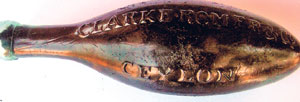
Carbonated drinks recovered from a vessel sunk off the coast of Sri Lanka have been confirmed to be 168 years old, say Ocean Archaeology officers conducting research on items found in the wreck of what has been dubbed the “Bottle Ship”.
The vessel - 23 metres long and six metres wide - was discovered two months ago.It is located 26 km off Kirinda, and lies at a depth of six metres. Iron, brass and brick props have been used to support the vessel, whose woodwork has deteriorated over the years.
Nine types of bottles of varying size, shape and colours, including several unopened bottles containing a carbonated lemon beverage, were found among the recovered items.
The trade-marked bottles indicate they were manufactured by Clarke Romer & Co. Ceylon in 1840.The company had branches in Colombo and Kandy. Advertisements appearing in the “Examiner” of 1846.10.07 and “Prodens Fone Selanika” on display at the Colombo Museum suggest that the company’s product was in demand during a cholera epidemic.
-
Navy missile cruiser runs aground near Honolulu
- On 08/02/2009
- In Maritime News

From Fox News
Navy officials say an attempt to pull free a 9,600-ton warship that ran aground off the coast of Honolulu has been unsuccessful.
The U.S. Pacific Fleet says Navy tugboats and salvage ship USS Salvor tried to tow the USS Port Royal early Saturday but the guided missile cruiser remained stuck.
The Navy says it plans to try again after extracting fuel and water from the $1 billion vessel.
The 9,600-ton ship, while carrying guests that included a rear admiral, ran aground Thursday night on a sandy, rocky bottom. The cause of the grounding, as well the extent of the damage to the ship, remains under investigation. -
127-year-old shipwreck found on beach
- On 07/02/2009
- In Parks & Protected Sites
By Michelle Draper
A missing piece of Victoria's maritime history has been uncovered, with the discovery of a 127-year-old shipwreck at a beach in the state's east.The iron steamer Pretty Jane sank off Ninety Mile Beach near Lakes Entrance in 1882 after a series of misfortunes.
The ship collided with another vessel, hit a sandbar and became caught in a wild storm en route from Lakes Entrance to Melbourne.All on board were saved, but the 34-metre-long Scottish-built vessel broke up and was never seen again until last month.
Parks Victoria rangers stumbled across the remnants of the ill-fated coastal trader on the beach at Loch Sport in East Gippsland in January.Parts of the rusting iron frames and boiler of the Pretty Jane are now visible to beachgoers.
-
Crash barriers to save shipwreck
- On 07/02/2009
- In Underwater Archeology
By Michael Hopkin
Scientists have enlisted an unlikely ally in their bid to protect one of WA’s most historically important shipwrecks.
They are aiming to adapt road crash barriers into a makeshift corral that will protect the James Matthews from the shifting tides.
WA Museum expert Vicki Richards said the plan was to place the plastic barriers in a ring around the wreck, which is lying in Cockburn Sound near Woodman Point, allowing it to be buried in sand to prevent decay. The homemade sandbox would stop sediment being stripped away and exposing the boat’s delicate hull.
Maintaining a layer of sediment on top of shipwrecks offered the best hope of preserving the historical treasures in their original resting places, Ms Richards said.
“The wood can be exposed and eaten by marine worms. We were losing this historic shipwreck,” she said.
The James Matthews, a former slave ship turned merchant vessel, sank in 1841. It was excavated in the 1970s but its hull remains on the seabed 100m from the shore. -
Sunken relics promise to unlock the secret of how Victory met her doom
- On 07/02/2009
- In Treasure Hunting / Recoveries

By Frank Pope
With its thruster motors fighting the current, the submersible pushed through a blizzard of sediment. Far above, in a darkened control room, the robot's operator squeezed his eyes shut to push away the fatigue.Making three dives a day, he had lost count of how many times he had approached suspected wrecks only to find a clump of ferrous rocks or junk from a ship. This time it would be different.
The announcement this week that Odyssey Marine Exploration, the world's biggest commercial shipwreck exploration specialist, has discovered what appear to be the remains of HMS Victory has caused a sensation.At the time of her sinking in 1744, the Victory was the most powerful warship in the world and was the immediate predecessor of Nelson's flagship now berthed at Portsmouth.
The 240ft Odyssey Alert had towed high-frequency sonar and sophisticated metal detectors across the search area, identifying anything that did not appear to be natural.Odyssey Marine had surveyed about 4,700 sq miles (12,170 sq km) of ocean floor in the Western Approaches of the English Channel alone. Then the 251ft Odyssey Explorer arrived with the robot Zeus to take a closer look with cameras.