HOT NEWS !
Stay informed on the old and most recent significant or spectacular
nautical news and shipwreck discoveries

-
Mystery as £14m treasure ship disappears
- On 23/02/2009
- In Maritime News
By Oliver Balch
Authorities have begun an investigation into the mysterious disappearance of a treasure-laden ship after it ran into difficulties in the Magellan straits off the southern coast of Argentina
The ship, registered in Chile, was carrying more than nine tonnes of gold and silver worth at least £14m when it hit a fierce storm in the channel. Waves of up to 10 metres forced the crew to evacuate.
The seven-man crew of the Polar Mist left the engines running to avoid fuel pollution after they abandoned ship. A few hours later, a coastguard helicopter spotted a second boat approaching the distressed vessel.The Beagle, which is also registered in Chile, began to tug the 23 metre Polar Mist in the direction of the Argentine port of Río Gallegos. Coastguard authorities presumed its intentions were to rescue the ship.
About 25 miles off shore, during the night, the troubled Mist Polar reportedly began listing from side to side. According to the tug's captain, it then sank beneath the waves, and the bullion is now lying on the seabed, 80 metres below the surface.
The cargo was on a scheduled journey from two mines in the Patagonian province of Santa Cruz to the Chilean port of Punta Arenas. The gold and silver was destined for a refinery in Switzerland.
The captains of the two clippers are said to be helping officials with their investigation. In the meantime, all other ships have been banned from entering the area where the Polar Mist allegedly went under. Efforts are due to get under way shortly to salvage the cargo.
"The case remains open," said Gerardo Caamaño, the judge overseeing the investigation. -
The Maple Leaf Expedition
- On 23/02/2009
- In Expeditions
By Kathleen Strelow
I’ve always had a fascination with shipwreck expeditions, and when the Titanic exhibit came to Chicago I ended up seeing it three times. Visiting the Civil War Museum last summer, I was excited to find a traveling exhibit of the Maple Leaf expedition.
Originally used in Canada as a pleasure excursion vessel, the Maple Leaf was eventually purchased by the Union Army for use in the Civil War. It was sunk by a Confederate torpedo in the St. John’s River near Jacksonville, Florida on April 1, 1864. It was one of the largest ships sunk during the war.
The torpedoes, like the one that sunk the Maple Leaf, were made out of small tar-coated wooden beer kegs that floated just under the water so they could not be seen.
Keith Holland and the St. John’s Archaeological Expedition, Inc. rediscovered and partially excavated the Maple Leaf in 1984.
It wasn’t until 1992 that the St. John’s Archaeological Expedition, Inc. entered a cooperative agreement with the East Carolina University Program in Maritime History and Nautical Archaeology to conduct a three-year investigation of the Maple Leaf site. There were 667 dives and 617 dedicated hours in the 1992 excavation alone.
There were some amazing artifacts on display from the Maple Leaf exhibit, including a bayonet, pistol cleaning rod, drum stick, a U.S. Army belt buckle, a fountain pen and brass ink well, as well as William Potter’s swords.
Due to the ship sinking so quickly, and because of the type of muddy sediment that covered the wreck, the artifacts have been kept in good condition.
This artifact collection was donated to the state of Florida, and is curated by the Florida Bureau of Archaeological Research. -
Trawlers are destroying history on the seabed
- On 22/02/2009
- In Miscellaneous
By Robin McKie
Britain's love of seafood is helping to destroy the nation's maritime heritage.That is the stark warning of marine archaeologists who say hundreds of sunken ships, from Elizabethan warships to second world war submarines, are being torn apart by trawlers - fishing for scallops and flatfish - dragging chains and cables across the seabed.
Investigations using robot submarines have revealed that serious damage has been inflicted on vast numbers of the 32,000 pre-1945 ships whose wrecks litter Britain's coastal waters.Examples include the recently discovered 18th-century warship HMS Victory, which led Britain's fleet before Nelson's flagship of the same name. In 1744, Victory sank with all hands near the Channel Islands. Cannon hauled from the wreck showed it had suffered severe damage from trawlers.
"Marine wrecks give us a very important picture of life in the past," said Dr Sean Kingsley, of Wreck Watch International. "Everything used by the crew - pipes, cards, dice, cooking utensils - is preserved by the mud into which the ship settles, even its wooden hull."
Newly discovered wrecks are usually left undisturbed where they are assumed to be safe. But surveys by controversial US company Odyssey Marine Exploration suggest such wrecks are in danger from trawling, quarrying and oil-industry work.
-
Can Egypt bring Cleopatra's palace back to life ?
- On 21/02/2009
- In Museum News
By Jack Shenker
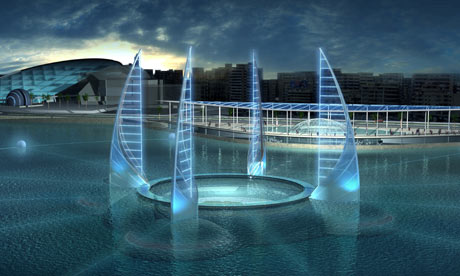
Some of the world's most exciting sunken treasures could soon be on view after Egypt confirmed plans to build a giant underwater museum in the Mediterranean.
But as preparation begins on the site of Cleopatra's Palace in Alexandria, funding and technical problems are proving as divisive and controversial as the famed queen herself.
Ancient Alexandria was one of the world's great centres of civilisation, and since excavations in the eastern harbour began in 1994, divers have unearthed thousands of historical objects.These have included 26 sphinxes, several vast granite blocks weighing up to 56 tonnes each, and even pieces of what is believed to be the Pharos of Alexandria lighthouse, one of the seven classic wonders of the world.
Remnants of Queen Cleopatra's palace complex are also submerged beneath the waves, after the island on which it stood fell victim to earthquakes in the 5th century.
Now ambitious but controversial plans are under way to open up this unique site via an immersed fibreglass tunnel which would enable close-up viewing of the underwater monuments.The designs were drawn up by the French architect Jacques Rougerie, a veteran of water-based construction projects, and have been backed by the United Nations cultural agency Unesco.
-
"Superguns" of Elizabeth I's navy
- On 21/02/2009
- In Underwater Archeology

From BBC News
The English navy at around the time of the Armada was evolving revolutionary new tactics, according to new research. Tests on cannon recovered from an Elizabethan warship suggest it carried powerful cast iron guns, of uniform size, firing standard ammunition.
"This marked the beginning of a kind of mechanisation of war," says naval historian Professor Eric Grove of Salford University.
"The ship is now a gun platform in a way that it wasn't before."Marine archaeologist Mensun Bound from Oxford University adds: "Elizabeth's navy created the first ever set of uniform cannon, capable of firing the same size shot in a deadly barrage.
"[Her] navy made a giant leap forward in the way men fought at sea, years ahead of England's enemies, and which was still being used to devastating effect by Nelson 200 years later." -
Is this Atlantis ?
- On 21/02/2009
- In Ancien Maritime History
By Virginia Wheeler and Rhodri Phillips
This is the amazing image which could show the fabled sunken city of Atlantis. It shows a perfect rectangle the size of Wales lying on the bed of the Atlantic Ocean nearly 3½ miles down.A host of criss-crossing lines, looking like a map of a vast metropolis, are enclosed by the boundary.
They seem too vast and organised to be caused naturally. And last night the possibility of an extraordinary discovery had oceanographers and geophysicists captivated.
The site lies 620 miles off the west coast of Africa near the Canary Islands — a location for Atlantis seemingly suggested by the ancient philosopher Plato.
He believed it was an island civilisation sunk by an earthquake and floods around 9,700BC — nearly 12,000 years ago.
The “grid” showed up on Google Ocean, a Google Earth extension that uses a combination of satellite images and marine surveys.
-
Mystery of Francis Walsingham and the sunken canon
- On 21/02/2009
- In Underwater Archeology
By Anne Atkins
Spies and intrigue. Vital dispatches sent through treacherous waters.The initials of one of the most powerful politicians in the land, etched on a gun lying deep under the sea. A small country, fighting with cutting-edge military technology against a terrifying power.
Hidden treasure sitting undisturbed for four centuries, which divers risk their lives to recover.
And all of it is true. On the Timewatch programme tonight on BBC Two, viewers can see for the first time the events that led to a groundbreaking discovery.
The story begins with the location of a wreck half a mile off the tip of the Channel Island of Alderney, where an Elizabethan ship, heavily armed with cannon, was reported lost in 1592.Raised from the sea bed four centuries later, the guns and shot led a marine archaeologist to propound a theory that could rewrite English naval history.
A new and tantalising mystery emerged too, prompted by a set of initials found engraved on one of the cannon.
“You do get these moments — I call them ‘mind touch’ — which transport you back over the centuries,” said Mensun Bound, the marine archaeologist and Fellow at St Peter’s College, Oxford, speaking from his 14th-century manor house in the Oxfordshire village of Horspath.“It was like that with this.”
-
WW1 French battleship Danton wreck found in deep water
- On 20/02/2009
- In Famous Wrecks


By Jonathan Amos
A French battleship sunk in 1917 by a German submarine has been discovered in remarkable condition on the floor of the Mediterranean Sea.
The Danton, with many of its gun turrets still intact, is sitting upright in over 1,000m of water. It was found by the Fugro geosciences company during a survey for a gas pipeline between Algeria and Italy. The Danton, which sank with 296 sailors still onboard, lies 35km southwest of the island of Sardinia.
Naval historians record that the Danton's Captain Delage stood on the bridge with his officers and made no attempt to leave the ship as it went down.The French government is now keen to see that the site is protected.
"Its condition is extraordinary," said Rob Hawkins, project director with Fugro GeoConsulting Limited.