HOT NEWS !
Stay informed on the old and most recent significant or spectacular
nautical news and shipwreck discoveries

POW/MIA team finds potential underwater crash sites off Vietnam's coast

Photo Ron Ward
By Erik Slavin - Stars and Stripes
A U.S. team charged with bringing home the remains of fallen servicemembers found several likely underwater crash sites off the coast of Vietnam in recent weeks, thanks in part to advances in sonar technology.
On Monday, a three-man team from the U.S. Joint POW/MIA Accounting Command, or JPAC, wrapped up a 27-day mission to find Vietnam War casualties in Vietnam’s territorial waters, team leader Ron Ward told Stars and Stripes via telephone from Hanoi on Tuesday.
The team found the potential sites with help from the U.S. Navy Oceanographic Office and the USNS Bowditch, a survey vessel from the Navy’s Military Sealift Command. The Bowditch is equipped with a multi-beam, wide-angle sonar system, which uses sound pulses to map the ocean floor at higher resolution and accuracy than past systems.
The military believes there are about 600 crash sites off the Vietnamese coast stemming from the war, Ward said.
The team, which also worked with the Vietnam's Office for Seeking Missing Persons, found potential crash sites in waters within 12 nautical miles of Quang Tri, Thua Thien-Hue, Quang Nam and Da Nang.
“It was a successful mission in terms of detecting anomalies on the seabed that we think might be associated with [service member] losses,” Ward said.
The preliminary data must now be analyzed by a JPAC forensic anthropologist.
At promising sites, JPAC teams can use remote exploration vehicles or send divers to see what the sonar array detected.
The Navy first studied the prospect of recovering remains from underwater sites during the war, but ultimately decided against it, Ward said.
Trunk that survived 1635 shipwreck at Colonial Pemaquid
From Bangor Daily News
A 376-year-old horsehide trunk that survived a shipwreck in Colonial America — caused by one of the most terrific storms to occur along the Maine coast — now is on display at Colonial Pemaquid State Historic Site in New Harbor.
John Cogswell of Buena Vista, Colo., a direct descendant of the same-named American colonist who first owned the trunk, has lent the historic artifact to the Colonial Pemaquid museum for seven years with the possibility of its becoming part of the museum’s permanent collection, according to Maine Bureau of Parks and Lands officials, under the Maine Department of Conservation.
“We have a centuries-old barrel that once lined a well near the waterfront from which colonist John Cogswell may have drunk, and now we have his personal trunk that actually went down with the shipwreck in 1635,” said Tom Desjardin, Maine Bureau of Parks and Lands historian.
“There aren’t a lot of museums where you can see things that fascinating, especially as a part of Maine’s history.”
“Our family has been the guardian of the Cogswell trunk since it floated ashore at Pemaquid Point on August 15, 1635,” the most recent John Cogswell said.
“We are now pleased to pass it along to the State of Maine, which has the perfect place where the public can enjoy this piece of history, including those descendants of families who came to America on the Angel Gabriel which met its fate during the hurricane which sunk it and brought the trunk to shore.
“The small museum at Pemaquid Point where the trunk will now rest safely and securely is a delightful place and a credit to the people of Maine,” he said.
Colonial Pemaquid is a unique Maine historic site originally a colonial fishing settlement established in the 1620s that produced and shipped cod to England.
A reproduction English fort, Fort William, an 18th-century farmhouse and a museum containing rare colonial artifacts and American Indian items going back 7,000 years define the historical significance of the site, located on a sheltered coastal peninsula, to human habitat.
Last year, more than 28,000 visitors explored Colonial Pemaquid, where special events also are offered by the Friends of Colonial Pemaquid.
In 1635, the English galleon Angel Gabriel went to the bottom of Pemaquid Harbor in the Great Colonial Hurricane of 1635, Desjardin said.
John Cogswell, a young merchant hoping to build a new life and business in the New World, had been a passenger on the Gabriel’s voyage from England and, like many of his fellow travelers, disembarked for the night while the ship anchored at the Pemaquid settlement in modern-day Bristol, Maine.
“Just before dawn the following morning, a storm that may have been the strongest ever to hit the Maine coastline blew through the region,” the park historian related.
“When it had passed, all that remained of the Angel Gabriel — a ship very much like the Mayflower, only larger and with more cannons — was debris floating in the harbor.”
The explorers who went with Scott of the Antarctic

Photo Christopher Jones
By Christopher Middleton - The Telegraph
It may have taken 100 years, but the men who accompanied Captain Scott on his final mission to the South Pole are, at long last, emerging from the great man’s shadow.
And at this month’s Scott Centenary Conference in Plymouth, they stepped out into the sunlight. Over the course of a weekend, some 200 of the world’s leading Scott experts and enthusiasts gathered together for a series of talks encompassing everything from melting ice caps to nautical navigation, from polar photography to the physiology of freezing.
Most densely attended talks, though, were those which came with human, and not just scientific interest. And during the two days, no fewer than four of Scott’s expedition members were accorded their own, hour-long sessions in the course of which their stories were told and their praises sung.
We met Captain Oates, for example, not as the grizzled, frost-encrusted explorer, but as an angelic little boy with luxuriant curls, a sickly disposition and a domineering mother who both protected and spoilt him (when his siblings got £1 as a birthday present, he got £50).
“She called him Baby Boy, and didn’t let him have his own bank account until he joined the Army,” said Michael Smith, author of the Oates biography I Am Just Going Outside.
“He was shot in the left thigh during the Boer War, as a result of which his left leg was two inches shorter than his right. This is a man who limped to the South Pole.”
And, of course, never made it back. Among the others to die with Scott was Henry Bowers, known as Birdie because of his beaky nose. “He was short, unconfident and got nicknamed Kinky Boke because of his nose,” declared Bowers’ biographer Charles Lagerbom.
“When people first met him, they tended not to give him the credit he deserved, but those who knew him had nothing but praise for his zeal and integrity. He was the backbone of the expedition, afraid of absolutely nothing except spiders. Which is why I don’t care to refer to him as Birdie. I think Henry suits him better.”
An honor of “Titanic” proportions

By Andrew Howley - NatGeo
Two outstanding explorers — filmmaker and alternative-energy proponent James Cameron and marine ecologist Enric Sala — are the National Geographic Society’s newest Explorers-in-Residence. Both were honored today at a special gathering of National Geographic’s top explorers at Society headquarters.
Explorers-in-Residence are some of the world’s preeminent explorers and scientists and represent a broad range of science and exploration; they develop programs in their respective areas of study, carrying out field work supported by the Society.
The group includes a geographer, three paleontologists, an archaeologist, a geneticist, conservationists and leaders in several other disciplines.
As a National Geographic Explorer-in-Residence, Cameron will apply his distinctive storytelling skills and innovative filmmaking technologies to National Geographic Society projects and programs.
Sala, formerly a National Geographic Fellow, will continue his leadership of Pristine Seas, an exploration, research and conservation project that aims to find, survey and help protect the last healthy and undisturbed places in the ocean.
“We are thrilled to welcome James Cameron to National Geographic’s cadre of explorers and to elevate Enric Sala’s important work on ocean conservation,” said Terry Garcia, National Geographic executive vice president for Mission Programs.
“They perfectly round out our very diverse team of explorers.”
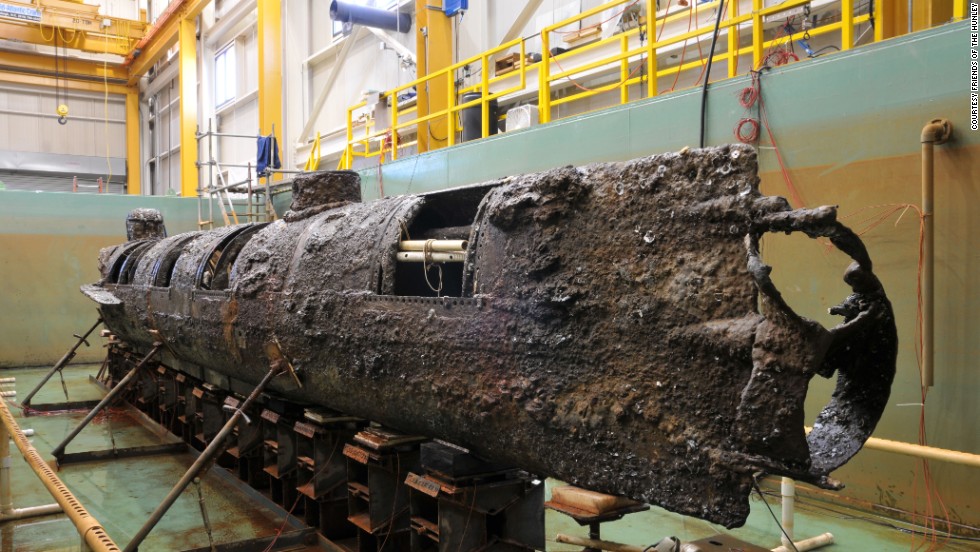
By Brian Hicks - Post and Courier
The H.L. Hunley was never a fast boat, but it probably never moved this slowly.
On Wednesday, engineers and scientists at the Warren Lasch Conservation Center began rotating the Confederate submarine into an upright position -- 3 millimeters at a time.
The pace was plodding, the progress barely visible, but then speed wasn't the objective. The idea was to right the sub without putting any stress on its iron hull.
This was accomplished by slowly adjusting the 15 straps that cradle the Hunley, and keeping a laser sight running from stern to bow that would detect any twisting of the hull.
"We're just trying to be cautious," said Paul Mardikian, senior conservator on the Hunley project. "The movement was very smooth. The laser was perfectly aligned."
Barring any complications, the rotation should be finished sometime today.
This is a major step in the Hunley project, one last engineering puzzle before conservators put the sub through the restoration process.
The move attracted the attention of myriad people who have had a hand in the project, from State Archaeologist Jonathan Leader to former Friends of the Hunley Chairman Warren Lasch.
"This is the culmination of a lot of work by a whole lot of people," Lasch said.
The Hunley has rested on its starboard side since it was recovered from the Atlantic Ocean in 2000.
Archaeologists wanted the sub lifted in the position it was found to avoid moving artifacts inside the sub.
The Hunley has remained in that position ever since.
But now the entire hull needs to be exposed so that conservators can remove the crusted sand and shell that covers the hull in preparation for the Hunley's restoration.
For more than a year, engineers and scientists worked on the plan. Basically, the straps used to lift the sub were replaced, one at a time, with new slings with load cells and handy controls that allow for minute movement.
The idea is to lower the port side, allowing the port side to drop slowly until the sub is standing upright.
Wine discovered in Bermuda shipwreck

Photo Tane Casserley
By Sirkka Huish -The Royal Gazette Online
Five bottles of unopened wine have been discovered stashed in the bow of the American Civil War blockade ship Marie Celestia – 147 years after she sank off South Shore.
The crate of bottles — which could be fortified wine — was found in the bow of the shipwreck by an international team of archaeologists working with Bermuda's Department of Conservation Services.
Public Works Minister Derrick Burgess announced at a press conference today that a diving expedition in the last week had excavated the bottles of wine from the site.
He said: “What they have found is fascinating — a secret stash of five bottles of un-opened wine, lodged inside the wreck which lay hidden since September 6, 1864.
“The Mary Celestia is a wreck with historical significance to the United Kingdom, where she was built, Bermuda, where she operated out of and where she wrecked, and the United States, where she ran as a blockade runner during the US Civil War.
“And for this project to take place so close to the anniversary of the American Civil War gives the discovery all the more resonance.”
The excavation project is also being filmed by Look Bermuda for a film about the Mary Celestia and blockade running, which will be shown to schoolchildren.
This discovery comes after Philippe Rouja found one bottle of wine in January, after a series of winter storms removed sand from the site.
Yenikapi metro dig reveals fifth-century shipwreck
Today's Zaman
Archeological digs at Yenikapı, the site of excavations for an important transfer hub in İstanbul's metro system, the Marmaray project, have revealed yet another marvel: an intact shipwreck believed to be from the fifth century, complete with its load.
Researchers, who have been working on the site since 2004, are in the process of uncovering the well-preserved remains of the ship. One archeologist said this is probably the first time in the world that a shipwreck had been found with its full load and timber frame completely in tact.
“The width of the wreck is about five meters. This is one gunwale. There is probably another one which has not yet been uncovered. Some of the amphoras on top [of the cargo] are broken but those in the lower layers appear to be intact. This is the largest cargo ship yet to be uncovered.
There is no other example in the world of a shipwreck where the timber of the ship as well as its load are in such good condition. If the wreck had been at sea, it would not have been this well preserved,” said archeologist Mehmet Ali Polat, quoted by the Radikal daily on Wednesday.
The wreck is among some 35 sunken ships at the old Byzantine harbor which had silted over, probably in the 10th century.
Sub's away ! Shipwreck mapping begins
Patrick J. Sullivan - The Leader
The wreck of the SS Governor off Point Wilson in 1921 is a story that has captivated historians, treasure seekers and now, researchers in a submarine.
During narrow tidal windows this week a submarine is being used to map what remains of the 417-foot passenger liner, which rests on its keel 240 feet beneath Admiralty Inlet's shipping lanes.
Dives are planned in the 15-foot submarine Wednesday through Sunday, June 22-26, said Joel Perry, vice president of expeditions for OceanGate.
Unlike previous expeditions in which divers were after the ship's safe – rumored to contain gold – the OceanGate goal is educational (as first reported in our May 18 issue). The sub Antipodes does not have a manipulator arm, so nothing can be retrieved – except information.
"There is only 20-30 feet of visibility so it's hard for a diver to get the scope of the whole wreck," Perry said Tuesday. "We're going to do multiple 2D and 3D scans of the wreck. Our hope is to scan about half of the wreck in 3D."
OceanGate, based in Everett, Wash., organizes expeditions primarily to benefit university-based deep ocean researchers.