HOT NEWS !
Stay informed on the old and most recent significant or spectacular
nautical news and shipwreck discoveries

-
Shipwreck yields treasures dating from 14th century
- On 18/09/2012
- In Underwater Archeology
From The Voice of Vietnam
Experts have confirmed that relics retrieved from a shipwreck in the central province of Quang Ngai date back to the 14th century, making them among the oldest underwater antiques Vietnam has ever discovered.
The objects found on the seabed in Binh Chau commune, Binh Son district, consist of numerous bowls, incense burners and ceramics. Their conditions vary, but many feature "beautiful" enamel and "abundant" decorative patterns.
After examining the objects, archaeologists concluded the ceramic wares came from 14th century China in the Yuan dynasty (1279-1368).
Nguyen Dinh Chien, deputy director of the Vietnam National Museum of History, noted that the enamel and decorative patterns showed the objects were produced late in the Yuan dynasty, making them older than several other recent finds.
According to researcher Doan Ngoc Khoi, deputy director of the Quang Ngai History Museum, the area was on a sea trade route hundreds of years ago, which many Chinese ships would pass to reach the Indian Ocean.
The latest ship was actually discovered accidentally by local fishermen, who then stole various objects from the wreck to sell.
Among the objects found, a block of 11 ceramic sinks has proved to be of particular interest. Experts believe the sinks are stuck to one another due to enamel burning at high temperatures.
The stuck sinks showed that the ship might have caught fire or exploded before being wrecked, sharing a similar fate with the five earlier wrecks discovered.
The objects were found deep under the sand of seabed and experts claim that the cracks on them are fairly new.
They believe that the whole body of the wreck remains intact under the sand and that surfacing the ship would offer a unique opportunity to study the wood material and ship-building techniques of the time.
-
Underwater stroll leads to mysterious world
- On 15/09/2012
- In Miscellaneous
By Kazuhiko Okada - The Asahi Shimbun
“Sea walks” have become increasingly popular at an undersea world here believed to have been the home of ancient sunset worshippers.
Off the city’s Hinomisaki cape, in depths up to 30 meters, various carved rocks are scattered about, resembling an altar, stairs, an approach and turtles. There is also a cave with a gravel-covered floor.
Divers can view these features up close by walking on the sea floor near Fumishima island.
It is really a mysterious world,” said Mutsuko Kobayashi, a 53-year-old care worker from Fukuyama, Hiroshima Prefecture, who visits the site once a month. “And the sea walk here makes me feel good.
Tetsuo Okamoto, a 59-year-old local diving guide who has been studying the area near the cape since 1999, discovered the rocks that year.
Since Fumishima island is known for its traditional sunset festival in August, Okamoto concluded that the underwater carved rocks were part of an ancient sunset festival site that became submerged under the sea.
After a diving magazine and other media featured the spot, an increasing number of divers and diving groups have been visiting Fumishima from the Kinki and Sanyo regions, according to Okamoto.
-
'Lost' City of Atlantis: Fact & Fable
- On 15/09/2012
- In Miscellaneous

By Benjamin Radford - Live ScienceAtlantis is a legendary "lost" island subcontinent often idealized as an advanced, utopian society holding wisdom that could bring world peace.
The idea of Atlantis has captivated dreamers, occultists, and New Agers for generations.
In the 1800s, mystic Madame Blavatsky claimed that she learned about Atlantis from Tibetan gurus; a century later, psychic Edgar Cayce claimed that Atlantis (which he described as an ancient, highly evolved civilization powered by crystals) would be discovered by 1969.
In the 1980s, New Age mystic J.Z. Knight claimed that she learned about Atlantis from Ramtha, a 35,000-year-old warrior spirit who speaks through her.
Thousands of books, magazines and websites are devoted to Atlantis, and it remains a popular topic.
Unlike many legends whose origins have been lost in the mists of time, we know exactly when and where the story of Atlantis first appeared. The story was first told in two of Plato's dialogues, the Timaeus and the Critias, written about 330 B.C.
Though today Atlantis is often conceived of as a peaceful utopia, the Atlantis that Plato described in his fable was very different.
In his book Frauds, Myths and Mysteries: Science and Pseudoscience in Archaeology, professor of archaeology Ken Feder summarizes the story: "a technologically sophisticated but morally bankrupt evil empire — Atlantis — attempts world domination by force.
The only thing standing in its way is a relatively small group of spiritually pure, morally principled, and incorruptible people — the ancient Athenians.
Overcoming overwhelming odds ... the Athenians are able to defeat their far more powerful adversary simply through the force of their spirit. Sound familiar ?
Plato's Atlantean dialogues are essentially an ancient Greek version of Star Wars."
-
Massive Luftwaffe plane wreck 'found off Sardinian coast'
- On 14/09/2012
- In Airplane Stories
By Nick Squires - The Telegraph
It is believed to be the only surviving example of the Messerschmitt 323 "Giant", a massive aircraft that was designed to carry tanks, half-tracks and artillery into battle.
The Germans initially intended to use the plane in the planned invasion of Britain, Operation Sea Lion, but it was cancelled and the aircraft instead saw action in other theatres such as North Africa and the Mediterranean.
The Me-323 was on its way from a German base in Sardinia to the city of Pistoia in Tuscany when it was shot down by a Bristol Beaufighter long-range fighter plane on July 26, 1943.
It crashed into the sea off the Maddalena islands, an idyllic archipelago of low islands and sandy beaches that is popular with sailors and holidaymakers.
A small team led by Cristina Freghieri, a diver and amateur historian, claims to have discovered the wreck at a depth of 200ft.
They spent a year trawling military archives, flight path records and local eyewitness accounts in their hunt for the unusual relic.
"It was just by chance that we found it because we were actually looking for a different plane wreck," Aldo Ferrucci, a diving instructor and photographer who took pictures of the wreck, told The Daily Telegraph.
"We had understood that the Me-323 was in a totally different location so we were lucky to stumble on it. It is in good condition – it is almost intact, with the six engines still all in line.”
The wreck, located eight nautical miles off the coast, was identified with a wire-guided camera and then explored by divers.
"It was a pure emotional charge to suddenly see the aircraft in the veiled blue of the sea. First we saw a piece of sheet metal, then another until the plane appeared in all its beauty.
My heart skipped a beat," Ms Freghieri told Ansa, an Italian news agency.
The Me-323, known in German as the "Gigant", weighed 45 tons, had six engines and boasted a wingspan of 180ft.
-
'Nuclear time bomb:' Downed K-27 submarine must be lifted out
- On 14/09/2012
- In Dangerous Places for Shipping

From RTA Soviet K-27 submarine suffered a nuclear accident before being dumped at the bottom of the Kara Sea 30 years ago.
Russia may now have to lift the sub from dangerously shallow waters – before an “uncontrolled chain reaction” causes fatal damage.“Radiation leakages will come sooner or later if we just leave the K-27 there. The sub has already been on the seafloor for 30 years, and it was rusty even before it was sunken. Leakages of radioactivity under water are nearly impossible to clean up,” Thomas Nilsen, a nuclear safety expert who has extensively mapped radioactive waste on the Arctic seabed, told RT.
Equipped with an experimental liquid-coolant nuclear engine, the K-27 was ill-fated from its launch in 1962. It made only three voyages, the last of which, in 1968, ended in tragedy.
A short way from its base in the Barents Sea, its reactor malfunctioned, and the brave but badly-trained crew made a futile attempt to fix it.
Instead of solving the problem, they were exposed to fatal doses of radiation.
Nine seamen died, most of them in hospital in agony from radiation sickness several days after the accident.
The incident was kept secret by the Soviet government for decades, and the families of the victims received no compensation.
After repeated plans to redesign the sub, Soviet authorities decided it was easier to dispose of it, and towed the vessel to a remote test site in the Kara Sea, near the Arctic Ocean, in 1981.
Although international guidelines say decommissioned vessels should be buried at least 3,000 meters under the sea, the Soviet Navy scuttled it at around 75 meters.
-
River Vistula reveals treasures
- On 14/09/2012
- In Parks & Protected Sites
Photo Tomasz GzellArchaeologists in the capital have been quick to take advantage of the situation, and a large number of relics have already been transported to a storage depot.
It is believed that the treasures ended up underwater owing to the so-called Deluge of 1655-60 (Potop), the Swedish invasion that saw Poland brought to its knees and stripped of much of its material wealth.
The invaders shipped their booty up the River Vistula to Gdansk, from where it was transported by sea to Sweden.
However, not all of the vessels were successful in getting their weighty cargo as far as Gdansk.
Archaeologists have in fact been sporadically engaged in searching the river for such treasures since a special project was launched in 2008.
However, owing to this week's record lows, state-of-the-art scanning gadgetry was unnecessary.
Tests on the water levels of the Vistula in Warsaw have been carried out since 1799. This week, the level reached just 60 cm, the lowest since checks began.
Hydrologists have nevertheless stressed that Warsaw residents have no cause for alarm as regards water that is processed for the domestic use.
-
Sunken Civil War ship shifts into view
- On 13/09/2012
- In Marine Sciences
By Michael Graczyk - The Herald TribuneThe world will soon get its first good look at the wreckage of the only U.S. Navy ship sunk in combat in the Gulf of Mexico during the Civil War, thanks to sophisticated 3-D sonar images that divers have been collecting this week in the Gulf's murky depths.
The USS Hatteras, an iron-hulled 210-foot ship that sank about 20 miles off the coast of Galveston, Texas, in January 1863, has sat mostly undisturbed and unnoticed since its wreckage was found in the early 1970s.
But recent storm-caused shifts in the seabed where the Hatteras rests 57 feet below the surface have exposed more of it to inspection, and researchers are rushing to get as complete an image of the ship as possible before the sand and silt shifts back.
"You can mark Gettysburg or Manassas, (but) how do you mark a battlefield in the sea ?" said Jim Delgado, the director of maritime heritage for the National Oceanic and Atmospheric Administration's Office of National Marine Sanctuaries, and the person overseeing the project.
On Monday, a team of archaeologists and technicians began two days of scanning the wreckage using a sonar imaging technology that hadn't been used yet at sea, Delgado said.
On Monday aboard the research vessel, Manta, researcher Christopher Horrell gleefully pored over computer images of the Hatteras' stern and paddlewheels that had just been transmitted from the sea floor.
-
Titanic explorer: Ancient shipwrecks lost to trawlers
- On 13/09/2012
- In Expeditions
By Dan Vergano - USA Today
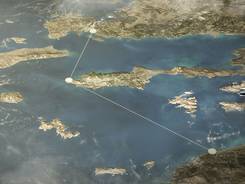
Lost in a Black Sea tempest, the ancient shipwreck waited 2,300 years to be discovered.
And it took the swipe of just one passing trawler for the secrets held in the bones of its long-drowned crew to be lost forever.
The sad tale of the shipwreck called Eregli E, found in 2011 by a team led by Titanic explorer Robert Ballard, will be told in a National Geographic Channel documentary, Wrecks of the Abyss.
Premiering on Sunday (7 p.m. ET/PT), the show is a five-part series called Alien Deep With Bob Ballard featuring the noted explorer.
"The deep ocean is the largest museum on Earth is what we are finding," says Ballard, who heads the University of Rhode Island's Institute for Archaeological Oceanography.
"But trawlers just devastate a wreck. It's like driving a bulldozer through a museum."
Best known for leading a team that in 1985 found the Atlantic Ocean resting place of Titanic, Ballard and his team have uncovered about 26 ancient shipwrecks in the Black Sea since 1999.
They date from the era of the Crusades to the heyday of ancient Egypt.
A deep layer of oxygen-free water more than 300 feet down blankets the Black Sea, preserving shipwreck timbers and, as the Eregli E (pronounced EH-ray-lee) wreck showed, human bones.