HOT NEWS !
Stay informed on the old and most recent significant or spectacular
nautical news and shipwreck discoveries

-
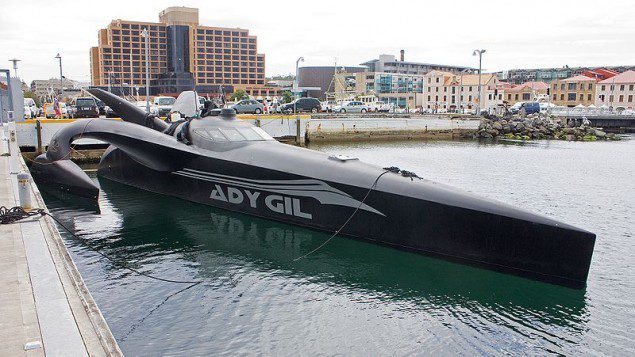
Sea Shepherd’s Paul Watson sued by the real Ady Gil
- On 09/01/2013
- In Maritime News
From gCaptain
Yesterday was a bad day for Cap’n Paul Watson.
Not only was he forced to resign as the president of Sea Shepherd in wake of legal issues facing him and his organization, but he was also sued by the real Ady Gil in connection to the 2010 sinking of the MY Ady Gil.
According to the gossip website TMZ (yup, I went there), Paul Watson, founder and now ex-president of the Sea Shepherd Conservation Society, has been sued by the Gil, who says he actually owned the high speed catamaran that famously sunk after a collision with a Japanese whaler while filming the show “Whale Wars.”
In the lawsuit, which was filed yesterday in a L.A. courtroom, Gil claims that Watson used the 2010 collision as an opportunity to promote the Sea Shepherd Conservation Society’s anti-whaling efforts by lying about the circumstances surrounding the sinking of the vessel.
Gil maintains that he had lent Watson and the Sea Shepherd the boat on the basis that they would take care of it.
Obviously that didn’t happen, and it sunk allegedly following the collision with the whaler even though footage of the boat actually going down was never released.
Gil says that the collision only resulted in damage to the Ady Gil’s bow and that the damages could have been repaired.
The suit claims that Watson, being the marketer as he is, saw the collision as an opportunity to garner support for his cause and secretly ordered members of his crew to scuttle the boat “under the cover of darkness”, then blamed the whole thing on the Japanese.
-
Divers could become real-Life Aquamen
- On 08/01/2013
- In Miscellaneous
By Robert Beckhusen - Wired
Even casual divers know that diving too deep, or surfacing too quickly, can cause a host of complications from sickness to seizures and even sudden death.
Now the Pentagon’s scientists want to build gear that can turn commandos into Aquaman, allowing them to plunge into the deeps without having to worry as much about getting ill. (Orange and green tights sold separately.)
According to a list of research proposals from the U.S. military’s blue-sky researchers at Darpa, the agency is seeking “integrated microsystems” to detect and control “warfighter physiology for military diver operations.
Essentially it comes down to hooking divers up to sensors that can read both their bio-physical signs and the presence of gases like nitric oxide, which help prevent decompression sickness, commonly known as “the bends.
If those levels dip too low, the Darpa devices will send small amounts of the gases into divers’ lungs to help keep them swimming.
The agency doesn’t specify what exactly the machine will look like, as it’s still in the research stage, but the plan is to make it portable enough for a diver to carry, of course.
Darpa also wants the gear for bomb-disposal units and “expanded special operations.” For an understandable reason.
Decompression sickness can be extremely painful, and potentially lethal to divers in both the civilian world and the military.
When underwater, a diver breathing compressed air out of a tank normally absorbs the air into fatty body tissues instead of breathing it all out, which is normally safe.
But ascending to the surface too fast after a deep dive can cause those gases to form into bubbles inside the body — imagine yourself as the equivalent of a soda bottle, shaken really fast.
That causes the body’s nervous system to go haywire and the joints to freeze up as if they were paralyzed. And that’s in addition to oxygen toxicity, nitrogen narcosis and a nasty problem called high-pressure nervous syndrome.
None of these things are very pleasant, let alone for those who make a career deactivating underwater mines.
-
Pozzino shipwreck: Ancient medicine ingredients probed
- On 08/01/2013
- In Conservation / Preservation

By Rebecca Morelle - BBC News<Six tablets were discovered in a tin box onboard an ancient Roman shipwreck, found off the coast of Italy.
Samples of the fragile material revealed that the pharmaceuticals contained animal and plant fats, pine resin and zinc compounds.
Writing in the Proceedings of the National Academy of Sciences, the researchers said the medicine might have been used to treat eye infections.
"I am surprised by the fact we have found so many ingredients and they were very well preserved considering it was under water for so much time," said Maria Perla Colombini, professor of chemistry from the University of Pisa.
The shipwreck that the tablets were found on dates to 140-130 BC, and was thought to have been a trading ship sailing from Greece across the Mediterranean.
It was first discovered in 1974 off the coast of Tuscany, and explored during the 1980s and 1990s, but it is only now that the tablets have been fully investigated.
"We used a very thin scalpel to detach a small flake of substance to be analysed," explained Professor Maria Perla.
-
Retired sea dogs to protect shipping from Somali pirates
- On 07/01/2013
- In Maritime News

Photo Mohamed Dahir
From RTThe UK's first private navy in almost 200 years has been set up by a group of pioneering businessmen, former marines and retired captains and soldiers to defend shipping off the coast of east Africa from the threat of pirates.
They are frustrated at the inability of the Royal Navy, NATO, the European Union Naval Task Force and other navies to guarantee security for shipping in an area of ocean the size of North America.
“They can’t do the job because they haven’t got the budget and deploying a billion-pound warship against six guys [pirates] with $500 of kit is not a very good use of the asset,” Anthony Sharp, chief executive of Typhon, the company behind the venture, told the Times.
Typhon is chaired by Simon Murray a millionaire business man with a colorful past including a spell in the French Foreign Legion as a teenager and walking unsupported to the South Pole aged 63.
Other Typhon directors include Admiral Henry Ulrich, former commander of US Naval Force’s Europe, General Sir Jack Deverell, former commander in chief Allied Forces Northern Europe and Lord Dannatt Britain’s former chief of the general staff.
The navy will include a 10,000 ton mother ship and high speed armored patrol boats and will be led by a former Royal Navy commodore and 240 former marines and other sailors.
The marines will be armed with close quarter weapons such as the M4 carbine and sniper rifles with a range of 2 km.
It will escort its first convoy of oil tankers, bulk carriers and the occasional yacht along the east coast of Africa in late March or early April. They will aim to deter pirates rather than engage in firefights.
-
1,000 ships locked in ice off China
- On 06/01/2013
- In Maritime News

From gCaptainTemperatures in China have plunged to their lowest in almost three decades, cold enough to freeze coastal waters and trap 1,000 ships in ice, official media said at the weekend.
Since late November the country has shivered at an average of minus 3.8 degrees Celsius, 1.3 degrees colder than the previous average, and the chilliest in 28 years, state news agency Xinhua said on Saturday, citing the China Meteorological Administration.
Bitter cold has even frozen the sea in Laizhou Bay on the coast of Shandong province in the east, stranding nearly 1,000 ships, the China Daily newspaper reported.
Zheng Dong, chief meteorologist at the Yantai Marine Environment Monitoring Center under the State Oceanic Administration, told the paper that the area under ice in Laizhou Bay was 291 square km this week.
Transport around the country has been severely disrupted.
-
Shipwreck exposed as river levels drop
- On 06/01/2013
- In Parks & Protected Sites

By Amanda Layton - Perryville NewsAs the Mississippi River continues to drop to historically low levels, artifacts long submerged have been uncovered near the shores of the massive waterway.
A couple on an afternoon stroll late last month stumbled across such a find when they located the remnants of a ship that apparently sank long ago and came to rest on the Missouri side, within walking distance of the bridge that spans from the Boise Brule Bottoms of Perry County to Chester, Ill.
“On Sunday, Dec 23, we discovered the remains of an old shipwreck on the west bank of the Mississippi River, on the Missouri side, a little more than quarter mile south of the Chester bridge, between the bridge and the old Gibbar dry dock area,” said Donna Lintner, a Perry County resident who found the partially exposed ship.
“It is a wooden hulled vessel over 100 feet long with a little more than half still in the water,” she said. “You can see old square-headed nails and spikes and a small pile of bricks that must have been part of the cargo.”
The bricks themselves found resting with the ship have a history all their own.
They are stamped “LFB WKS” and below that “NO A.” This stands for the Louisville Fire Brick Works, a Kentucky based company that has been in operation for close to 125 years.
Based on the estimated age of the bricks, it is presumed the Southern Clay Manufacturing Company, formerly known as the Tennessee Paving Brick Company, located in Robbins, Tenn., forged them in the early 1900s at the Robbins Brickyard.
The company forged bricks for many different regional plants.
-
Discovery's All-New Series SHIPWRECK MEN to Premiere 1/14
- On 06/01/2013
- In Miscellaneous
From BWW TV
There are modern day pirates patrolling the coast of southern Florida - and the bounty they're after is boats in distress. Salvage companies scan the waters day and night.When trouble strikes they race into action, whether it's saving a sinking vessel, rescuing boats from dangerous hurricane storms or putting out a massive fire.
While their intentions are good, it doesn't mean it isn't a cutthroat business. With a fortune to be made, the competition is intense. The first crew on the scene is the one that gets the job - and the lucrative profits.
The rest of the companies get nothing and mustwait for the next call in hopes of securing a job and keeping their business afloat. Meet the men behind four of south Florida's fiercest salvage companies in Discovery's all-new series, premiering Monday, January 14th at 9PM ET/PT.
Arnold's Towing
Ricky Arnold, Sr., a fifth generation Key West resident, built his business from the ground up. He started his salvage company with five-gallon buckets and a boat, removing derelict vessels filled with all kinds of dangers - from parasites to sharks. Ricky, a headstrong and unapologetic man, does things his own way, even if that means all-out fights with his sons RJ and Shane, also in business with him. Together they are taking marine salvage to the next level, all whilepreserving their family roots in Key West.
Atlantis Marine Towing & Salvage
Stu Korpela is a salvage pioneer. After serving in the Air Force and later as an aircraft mechanic for a private company, Stu headed for Florida where in 1974 he made an even trade: his house on land for a 52' sailboat that he and his family call home. He runs one of the most accomplished and feared independent salvage businesses around. Stu's son Burt has been in the salvage business with his father his whole life and is just as ruthless as Stu. Also like his father, Burt is raising his family on the water, making a boat their home - a huge advantage in a business where timing is everything. -
Famed Roman shipwreck reveals more secrets
- On 06/01/2013
- In Conservation / Preservation

By Dan Vergano -USA Today
Marine archaeologists report they have uncovered new secrets of an ancient Roman shipwreck famed for yielding an amazingly sophisticated astronomical calculator.
An international survey team says the ship is twice as long as originally thought and contains many more calcified objects amid the ship's lost cargo that hint at new discoveries.
At the Archaeological Institute of America meeting Friday in Seattle, marine archaeologist Brendan Foley of the Woods Hole (Mass.) Oceanographic Institution, will report on the first survey of Greece's famed Antikythera island shipwreck since 1976.
The ancient Roman shipwreck was lost off the Greek coast around 67 BC,filled with statues and the famed astronomical clock.
"The ship was huge for ancient times," Foley says. "Divers a century ago just couldn't conduct this kind of survey but we were surprised when we realized how big it was."
Completed in October by a small team of divers, the survey traversed the island and the wreck site, perched on a steep undersea slope some 150 to 230 feet deep in the Mediterranean Sea.
The October survey shows the ship was more than 160 feet long, twice as long as expected. Salvaged by the Greek navy and skin divers in 1901, its stern perched too deep for its original skin-diver discoverers to find.