HOT NEWS !
Stay informed on the old and most recent significant or spectacular
nautical news and shipwreck discoveries

-
The search for the Jefferson Davis
- On 16/04/2011
- In Parks & Protected Sites
From St Augustine Underground
Buried in the ocean sands off St. Augustine is a lost shipwreck, one of the last great maritime mysteries from America’s Civil War.A new DVD documentary,“Search for the Jefferson Davis: Trader, Slaver, Raider,” is the fascinating story of the underwater archaeological pursuit of one of the Civil War’s greatest Confederate privateers, the brig Jefferson Davis.
One hundred fifty years ago, America was embroiled in a terrible Civil War. Early into that conflict, the Confederate government issued letters of marque, creating privateers that preyed upon Union shipping. Confederate privateers acted in support of an almost nonexistent rebel navy.
The most successful of those marauders was the brig Jefferson Davis. Lost on the St. Augustine Bar in northeastern Florida in August of 1861, underwater archaeologists from the Lighthouse Archaeological Maritime Program (LAMP) and forensic scientists from around the country are engaged in a search for this sunken vessel.
The Jefferson Davis started life as a merchant ship built in Baltimore, Maryland and known as the Putnam.The vessel then slipped into a period as an illegal slave trader and finally ended its career as the Union Navy’s “most wanted,” a privateer that seized nine prizes on its one and only cruise.
Pepe Productions, a Glen Falls, New York multi-media company, spent two sessions in St. Augustine, Florida in June 2009 and April 2010, acquiring interviews and video footage with LAMP personnel for the documentary.The documentary team also interviewed people in Charleston, South Carolina, in Baltimore, Maryland, and at the State Museum in Albany, New York.
The documentary also tells the story of William Tillman, an African-American steward aboard the schooner S.J. Waring. The S.J. Waring was one of the vessels captured by the Jefferson Davis.A prize crew was put aboard the captured schooner to sail the Long Island-built watercraft to a southern port.
Tillman, realizing he would probably be sold into slavery, seized a hand ax and killed several privateers. He then succeeded in sailing the vessel back north and became a hero in the Union states. -
Shipwreck still fascinates local diver
- On 16/04/2011
- In Famous Wrecks
By Paul Leighton - Salem News
The USS New Hampshire was a wreck before it became a wreck.
The ship burned and sank during a training exercise on the Hudson River in 1921.The next year, its recovered hull was being towed to the Bay of Fundy to be dismantled for its copper and bronze fastenings when it again caught fire. It sank, for the final time, near Graves Island off Singing Beach in Manchester.
It might have been an inauspicious ending for the once-grand vessel, the last of the U.S. Navy's 74-gun battleships. But all these years later, the ship retains its allure for Norman "Dugie" Russell.
Russell, 72, began diving to the ship in 1961, drawn by the spikes and pins and sheeting that had been forged at Paul Revere's foundry in Canton and kept the 2,633-ton boat together.
After more than 200 dives, he put his quest on hold until 20 years ago, except for one aborted and nearly fatal attempt last year. But as he told an audience of about 40 people in a recent talk at the Beverly Public Library, he plans to go back again this summer.
"The lure of this ship, I can't let go," he said. "It became kind of an obsession for me."
Russell, a retired court officer from Beverly, has salvaged thousands of pounds of copper and brass and tons of timber from the New Hampshire over the years. He has crafted the material into hundreds of items — cribbage boards, coffee tables, lamps, clocks, mantelpieces, jewelry — and sold them to retailers and individuals.
-
The sinking of the Titanic - 99 years on
- On 14/04/2011
- In Famous Wrecks
By Emma McFarnon - The Independent
Tomorrow will mark the ninety-ninth anniversary of the sinking of the Titanic, which killed 1,517 people and remains one of the worst peacetime maritime disasters in history.
The ship, designed by some of Britain’s most experienced engineers, and boasting extensive safety features, sank in the early hours of 15 April 1912, just four days into its voyage from Southampton to New York.
The ill-fated voyage began on 10 April 1912, with Captain Edward J. Smith at the helm. Boasting a swimming pool, gymnasium, squash court and Turkish bath, the Titanic was unrivalled in luxury and elegance.
Compliant with the regulations of the time, the ship set off with lifeboats barely sufficient for half the 2,228 people on board.
Just four days later, at 11.40pm, the ship struck an iceberg 400 miles off Newfoundland, Canada. Less than three hours later the Titanic plunged to the bottom of the ocean.
The overwhelming majority of victims, who died of hypothermia, were crew members and lower-class passengers.
Before survivors even arrived in New York, investigations were underway to discover what had gone wrong. The United States Senate launched an inquiry on 19 April. -
A maritime treasure chest will dock in Tacoma
- On 14/04/2011
- In Museum News
By C.R. Roberts - Bellingham Herald
In a Tacoma-area warehouse, curator Joseph Govednik of Foss Waterway Seaport’s Working Waterfront Maritime Museum counts and catalogs the largest known private collection of artifacts related to the maritime history of the Puget Sound.
These items are spread across a floor of 6,000 square feet, and Govednik slowly brings order to the confusion.In a few months, the collection will be ready for the world to see once again.
“This is an amazing windfall for the Seaport,” Govednik said one cold day last week.
Collected over decades by winery owner and old Sound salt Bill Somers, the collection rested for decades in a barn on Stretch Island, near Grapeview in Mason County. Somers called his passion the Puget Sound Museum, and he welcomed the occasional guest or schoolchildren who happened by.
When Somers died at 93 in 1995, the fate of the collection was uncertain.
Thanks to donations by retired Tacoma businessmen Jim Milgard and George Russell, the Foss Seaport Museum was able to save the collection from being split, auctioned, dispersed and left to the whims of home decorators and theme restaurants.
“Bill was a history buff in its truest form,” said museum executive director Tom Cashman. “When people saw the collection, they said, ‘Oh my gosh, I can’t believe there’s so much stuff here.’”
Stuff. Items. Eclectic and specific, miscellaneous and fundamental – it’s a concentration of unique mementos that speak primarily to the steam-powered heart of our maritime heritage.
Cashman knows what most of it is. But not all.
There’s a pilot house wheel nine feet in diameter. Steam whistles, funnels, binnacles, anchors and charts.Hawsers as thick as a wrestler’s forearm. Finely threaded brass nuts the size of a knee. Rope fenders.
Nautical macramé of many uses, including the tethering of Japanese green glass fishing-net floats.
-
The CSS Pee Dee
- On 14/04/2011
- In Expeditions

By Matthew Robertson - Scnow
The mightiest fighting vessel to roam the waters of the Great Pee Dee River during the Civil War was the eponymous CSS Pee Dee. That it was one of the only fighting vessels in those waters does not diminish the accomplishment of those who built it.
Using limited resources, the ship was constructed over a two-year period from a design produced by Acting Naval Constructor John L. Porter, CSN, late in 1862. Lt. Edward J. Means, CSN, commanding the naval station there, oversaw construction of the twin-screw gunboat. One of its engines was ordered from the Naval Iron Works, Richmond.
Numerous sources suggest the other was brought by blockade runner from Great Britain. The Pee Dee was 150 to 170 feet long, had a top speed of something like nine knots and a crew of around 90.The ship’s battery was supposed to be four 32-pound guns broadside and two 9-inch pivots. (Note: the gunnery nomenclature generally refers to barrel diameter, such as 9-inch, or projectile weight, 32-pounder, but neither is precise.)
But difficulty in obtaining guns forced improvisation. Most accounts suggest the Pee Dee sailed with two Brooke guns of Confederate design (they would have been roughly equivalent to the specified 9-inch pivoting cannons) and one Dahlgren cannon captured from the federals.
The Pee Dee was launched in late 1864 or early 1865 and, as that dating would suggest, enjoyed a relatively short career. Lt. O. F. Johnston, CSN, is listed in most sources as the ship’s commander.
During the Civil War, the Great Pee Dee River was more navigable than it is now and had regular passenger and freight riverboat service between Cheraw and Georgetown.
The CSS Pee Dee may have been built to protect several of the Confederacy’s greatest assets — railroad bridges that allowed that vital communication link to span the biggest river in the region.The Wilmington and Manchester (Sumter), The Cheraw and Darlington and The Northeastern railroads all passed through the Pee Dee and all had key bridges which, if destoryed, would have cut vital supply lines to Confederate armies, said Carl Hill, director of the War Between the States Museum in Florence.
Other scholars suggest the Pee Dee was a “dual duty” ship that might have seen action at sea had the war continued. Orders issued late in the war — but never carried out because of low river levels — called on the ship and its crew to make for the Atlantic.
The bridge duty would have been reason enough to build a powerful fighting ship, however. At one point during the conflict, a Union gunboat sailed inland and unsuccessfully tried to destroy the Northeastern’s bridge over the Santee River, Hill said. -
Of ceramics and shipwrecks
- On 11/04/2011
- In Museum News

From Joongang Daily
Two new exhibitions offer the public a first glimpse of ceramics from the Yucheon-ri kiln and the Sinan shipwreck.Two new exhibitions at the National Museum of Korea provide fresh insight into Korean celadon, the pale green ceramics widely known for their beauty and artistry.
The exhibitions showcase ceramics from Yucheon Village in Buan County, North Jeolla, and Sinan, South Jeolla, in an attempt to broaden the public’s understanding of this delicate art.
“The Song of Nature: Goryeo Celadon of Yucheon-ri Kiln Site” is the first public showing of the results of the 1966 excavation of Yucheon Village kiln site No. 12.
“Tea, Incense, and Carrying the Soul: Longquan Ware from the Sinan Wreck” shows a collection of ceramics that were carried in the wrecked Chinese vessel in the waters near Sinan.
The refined Korean celadon known worldwide today is known in Korea as Goryeo (918-1392) celadon, which was created in the kilns of Yucheon-ri, North Jeolla, and Gangjin, South Jeolla.These artists developed Sanggam, which are inlaid designs that eventually came to distinguish Korean celadon from its Chinese and Japanese counterparts.
-
Secrets of the deep
- On 11/04/2011
- In Treasure Hunting / Recoveries
By Emily Landau - Walrus Magazine
At 40 metres long and 540 tonnes, the Chameau was a powerful frigate, designed to carry people and goods to New France and take natural resources back to Europe.She was a fast ship but a cranky one; when the weather got bad, she would toss like a toy boat in a bathtub.
On her final voyage, the Chameau was carrying approximately 100,000 livres in gold, silver, and copper — along with 316 passengers, including the newly appointed intendant of New France.
As she approached the coast of Nova Scotia in August 1725, a southeast wind rocked the waters. By nightfall, a squall had brewed, thrashing the vessel. It plunged into a reef, where it broke apart and sank into the depths. There were no survivors.
Most perished in the storm; those who didn’t were either consumed by the undertow, or died from exhaustion after washing ashore near the fort town of Louisbourg.
In 1961, twenty-three-year-old Louisbourg transplant Alex Storm was thumbing through a history of his adopted home, by then a fishing community.His interest was piqued by the story of the Chameau. A recent émigré from Indonesia, where his family had been imprisoned in Japanese-run internment camps during World War II, he had settled in Nova Scotia and volunteered for a position aboard the Marion Kent.
Taking advantage of the circumstances, he dove near Chameau Rock, the ostensible site of the wreck, and came upon a cluster of some twenty cannons, strewn alongside anchors and guns.“It was a solemn moment, because I knew that no one had seen it since the night when the ship wrecked,” he recalls from his home nearby.
But the expedition yielded more than history: glinting among the ruins was a single silver four-livre piece, embossed with the year 1724 and a portrait of King Louis XV.
The coin was a small discovery, but one that set Storm on a mission to find the rest of the Chameau’s loot. He took a job with an underwater archaeologist and, in his spare time, familiarized himself with eighteenth-century ships, and gathered weather reports and ocean current data from the night the Chameau went down.He assembled a team of divers, and in 1965 located the ship’s final resting place.
There, along the gully and the cracks in the bedrock, Storm found his treasure: over 2,000 gold louis d’or coins and more than 11,000 silver livres, which later sold for untold millions at auction. -
Nazi warplane lying off UK coast is intact
- On 09/04/2011
- In Airplane Stories
By Stefano Ambrogi - Yahoo News
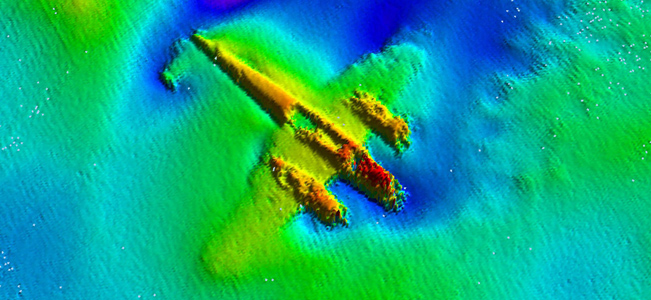
A rare World War Two German bomber, shot down over the English Channel in 1940 and hidden for years by shifting sands at the bottom of the sea, is so well preserved a British museum wants to raise it.
The Dornier 17 -- thought to be world's last known example -- was hit as it took part in the Battle of Britain.
It ditched in the sea just off the Kent coast, southeast England, in an area known as the Goodwin Sands.
The plane came to rest upside-down in 50 feet of water and has become partially visible from time to time as the sands retreated before being buried again.
Now a high-tech sonar survey undertaken by the Port of London Authority (PLA) has revealed the aircraft to be in a startling state of preservation.
Ian Thirsk, from the RAF Museum at Hendon in London, told the BBC he was "incredulous" when he first heard of its existence and potential preservation.
"This aircraft is a unique aeroplane and it's linked to an iconic event in British history, so its importance cannot be over-emphasized, nationally and internationally," he said.
"It's one of the most significant aeronautical finds of the century."
Known as "the flying pencil," the Dornier 17 was designed as a passenger plane in 1934 and was later converted for military use as a fast bomber, difficult to hit and theoretically able to outpace enemy fighter aircraft.In all, some 1,700 were produced but they struggled in the war with a limited range and bomb load capability and many were scrapped afterwards.
Striking high-resolution images appear to show that the Goodwin Sands plane suffered only minor damage, to its forward cockpit and observation windows, on impact.
"The bomb bay doors were open, suggesting the crew jettisoned their cargo," said PLA spokesman Martin Garside.