HOT NEWS !
Stay informed on the old and most recent significant or spectacular
nautical news and shipwreck discoveries

-
Whale bones, sharks, shipwrecks and volcanic rock
- On 27/08/2012
- In Expeditions
By Nathan Morley - Cyprus Mail
Oceanographer and underwater archaeologist Robert Ballard’s two-week exploration into the ocean depths off Cyprus has revealed an amazing array of life forms, shipwrecks and curiosities.
“We have found a lot of fascinating things, when you go where no one has gone before on planet earth - you are not really sure what you are going to find,” Ballard told viewers during a web-cast live from the .
“For example, on the top of the seamount, we have seen an unusual feeding pattern of whales, which are diving down 4,000 feet and feeding on something at the bottom of the ocean.
We think they are beaked whales, they are very mysterious and we know very little about them.
“They are living in total darkness and feeding in total darkness, we are trying to understand what they are eating as there is no obvious food there,” Ballard said.
Other highlights of the trip included the discovery of the remains of an Ottoman war galley at a depth of 3,000 feet, along with a flintlock pistol which was surrounded by what appeared to be black rum bottles littering the sea floor.
Surprisingly, the metal pistol appeared to be remarkably well preserved, but most of the wood from the ship has deteriorated - eaten away by marine organisms.
For those onshore, the expedition brought underwater technological progress into the fore, as cameras peering into the gloom beamed live, high definition pictures from the bottom of the Mediterranean to the internet.
Mini submarines Hercules and Argus illuminated the gin clear water, as the vessels robotic tools, including a claw, gathered sediment samples, rocks and small sea animals.
-
Fatal honeymoon is another true crime story on the Lifetime Channel
- On 25/08/2012
- In Miscellaneous

By Jackie K. Cooper - The Huffington PostThe Lifetime Channel continues its streak of making movies about real life crime stories with Fatal Honeymoon.
This is the story of the couple who went to Australia back in 2003 on their honeymoon and went scuba diving.
The husband claimed that his wife panicked underwater and knocked off his mask and breathing apparatus.
While he climbed to the surface she drowned. What really happened is anyone's guess but when you watch this movie you get a clear idea of what the writers of this movie thought.
Just like Natalee Holloway, whose story was also a Lifetime movie, Tina Thomas (Amber Clayton) was an Alabama girl.
She came from a prominent family and was the apple of her daddy's eye. Tommy Thomas (Harvey Keitel) was not happy when his daughter Tina got involved with Gabe Watson (Billy Miller).
There was just something not quite right about him, but Tina loved him so Tommy could only agree to their wedding and wish the couple well.
Still it came as no surprise to him when he received a phone call from Gabe's father with the news that Tina had drowned while the couple were scuba diving in Australia while on their honeymoon.
From that point on Tommy was convinced that Gabe had killed his daughter and he swore to see that her death was avenged by having Gabe convicted of murder.
The participation of Keitel is reason enough to watch this movie.
This actor is so talented that he can make any role believable, and that is what he does with his performance as Tommy Thomas.
He is fascinating to watch on screen as he builds the character layer by layer. To most actors Thomas would just be a grieving father but Keitel makes him that and more. He gives him nuances that show how deep the man's pain runs.
-
Search launched for the Franklin ships' watery Arctic grave
- On 25/08/2012
- In Expeditions

Photo Jonathan Hayward
By Tamara Baluja - The Globe and MailLike the explorers aboard the ships of Sir John Franklin’s doomed 1845 quest for the Northwest Passage, an elite team of professional underwater archaeologists will be racing against the clock before the winter freeze.
A new research project launched on Thursday by Prime Minister Stephen Harper in Cambridge Bay, Nunavut, is the latest expedition sent to find the watery graves of the Terror and Erebus, which have captured global imagination for almost two centuries.
“It’s been called the Holy Grail of wrecks in Canadian waters,” said Marc-André Bernier, Parks Canada’s chief underwater archaeologist, who leads the mission.
With a $275,000 cash infusion for a four to six-week expedition, by far the most significant contribution ever for the largest search since 1967, the divers are confident they may be able to find the only national historic sites not yet located.
“It’s become one of those Canadian myths and would be a tremendous cultural find,” said William Barr, a historian with the Arctic Institute of North America in Calgary and author of Arctic Hell-Ship, a book about Enterprise, one of the vessels the British sent in search of the lost Franklin ships in 1850.
The Conservatives, despite an austerity agenda that has forced cuts on government services including Parks Canada, have made establishing Canada’s claim to Arctic sovereignty a priority and are investing in historically significant national projects.
Ottawa spent only $200,000 in total on Parks Canada’s missions to seek the wrecks in 2008, 2010 and 2011. Critics call the link to Canadian Arctic sovereignty tenuous: These were British ships in what was then British waters.
Franklin embarked on his ill-fated search for the Northwest Passage in 1845. By 1848, he was dead and the ships were ice-locked near King William Island.
The survivors attempted to walk south to a fur trading post, and all died in their tracks from hunger and cold.
The ships are believed to have drifted, possibly hundreds of kilometres.
-
Archaeologists complete survey of Charleston Harbor
- On 25/08/2012
- In Underwater Archeology
From Science Daily
What remains of a five-year siege for control of Charleston Harbor during the Civil War now lay in watery graves amid the harbor's channels and under the beaches of bordering sea islands.Thanks to a team of archaeologists at the University of South Carolina, the Charleston Harbor naval battlefield has been mapped for the first time, providing historical and archaeological detail on the drawn-out struggle that spanned 1861-1865.
The survey shows where military actions took place, where underwater obstructions were created to thwart enemy forces and the spots where Union ironclads and Confederate blockade runners sunk.
The National Park Service, which funded the project through an American Battlefield Protection grant with matching funds from USC, will use the survey to preserve the battlefield.
Information gathered about the wrecks and obstructions also will be valuable to harbor managers, the U.S. Army Corps of Engineers and to USC archaeologists to ensure that underwater relics aren't damaged.
Their work will also be considered in decisions involving beach renourishment and the deepening of the harbor.
"The archives of South Carolina's maritime history are under water.
For years we have had these great resources that we should hold in as much respect as historical documents," said James Spirek, a USC underwater archaeologist.
"They are the physical representations of the state's maritime legacies."
-
Archaeologists investigate sea find of gilded bronze lion
- On 23/08/2012
- In Underwater Archeology
From Gazzetta Del Sud
Archaeologists are investigating the discovery of a gilded bronze lion found off the coast of Calabria not far from where the famed Riace Bronzes were discovered 40 years ago.Armour in bronze and copper was also found by a diver and two tourists in the area that is now closed to the public as investigators probe the details of the find.
One of the divers who made the discovery said there may be a ship and other important artifacts there as well.
"When I went into the water, I saw a statue that was stuck between the rocks and a piece of the ship," explained Bruno Bruzzaniti.
"The tides, however, cover everything and then you must be really fortunate to be able to see other items that are still at the bottom of the sea."
The discovery sounds similar to that of the iconic Riace Bronzes, 2,500-year-old statues representing ancient warriors which were discovered in 1972 by a Roman holidaymaker scuba diving off the Calabrian coast.
That find turned out to be one of Italy's most important archaeological discoveries in the last 100 years.
Those statues are of two virile men, presumably warriors or gods, who possibly held lances and shields at one time.
At around two metres, they are larger than life. The newly discovered bronze lion is said to be about 50 centimetres high and weighs 15 kilograms.
Also found in the area of the lion were remains of vases and other statues.
-
Estimated 30,000 antiques to be salvaged from sunken ship
- On 23/08/2012
- In Underwater Archeology
From English People Daily
More than 30,000 pieces of antiques are expected to be salvaged from Nan'ao-1, an ancient merchant vessel that sank about 500 years ago off the coast of Guangdong Province.Upon the conclusion of an underwater archaeological mission, about 10,000 pieces of newly salvaged antiques will be exhibited in the Nan'ao Museum in Shantou, said Huang Yingtao, director of the museum.
The salvage operation, which started in June, was suspended due to the effects of typhoon Kai-Tak, which made landfall in the coastal area of Guangdong at noon on Friday.
This round of underwater archaeological work on Nan'ao-1 will finish by the end of September, said Cui Yong, head of the team of archaeologists.
Archaeologists conducting the underwater work will measure the length of the wreck after the antiques are salvaged.
Archaeologists had previously recovered over 20,000 antiques, including porcelain and copper coins, and identified 25 cabins.
The ship sank in the Sandianjin waters off Nan'ao County, Shantou, during the mid- or late-Ming Dynasty (1368-1644).
The ship is believed to have been bound for the Philippines and Malaysia, said Cui.
Guangdong was a major center for sea trade in ancient China.
Local fishermen found the wrecked ship, estimated at 25 meters in length and seven meters in width, in May 2007. It was buried in silt 27 meters underwater and about 5.6 nautical miles from Shantou.
Experts said the antiques salvaged from the Nan'ao-1 provide evidence that the "Maritime Silk Road" once existed in the South China Sea.
-
Emperor Caligula gold coin found underwater near Cyprus
- On 22/08/2012
- In Miscellaneous

By Marianna Tsatsou - Greek ReporterA significant archaeological finding, a gold coin, has been reported discovered underwater in the area between Limassol and Larnaca by a local amateur fisherman.
According to Cypriot authorities, the coin is of great value.
Cypriot media reported that it dates back to the first century A.D. and depicts the third Roman emperor called Caligula, well-known for his fierce and brutal policy during his reign.
On this coin, Caligula is sacrificing an animal before the Temple of Augustus, which is constituted by six pillars.
Many coins of the same age have been found over the course of time, but this one is regarded among the most significant due because it’s made of gold.
Representatives of the Nicosia Archaeological Museum of Cyprus stated that such a finding enriches cultural heritage of the broader region, and may provide archaeologists with important information on ancient Cyprus’ trade.
Moreover, the area, where the golden coin was found, could reveal more clues concerning the coin’s origin and the way it ended up in Cyprus, they said.
-
£140,200 heritage grant seals Swash wreck project
- On 22/08/2012
- In Underwater Archeology
From Bournemouth EchoA project to bring an important underwater find within reach of residents has been launched at Poole Museum.
Maritime archaeologists at Bournemouth University are collaborating with Borough of Poole’s Museum Service to open up the wonders of the Swash Channel Wreck.
Made possible by a grant of £140,200 from the Heritage Lottery Fund, it aims to show how archaeologists discover, investigate and protect the underwater past.
The discovery and investigation of the Swash Channel Wreck, just outside Poole Harbour , is the inspiration behind the project.
Believed to be a high status ship dating from around 1620, it has been gradually revealing its treasures to divers from the university during a series of explorations.
It lies in seven metres of water and was designated a Historic Wreck in December 2004.
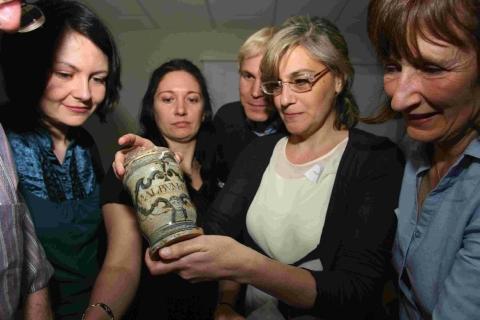
Finds include at least six iron can non, wooden barrels, rigging, copper, pewter, bones and apothecary jars, a rare wooden carving of a merman and planks from the ship have been raised.
The idea for the project came from the university’s maritime archaeology programme leader and project leader Paola Palma.