HOT NEWS !
Stay informed on the old and most recent significant or spectacular
nautical news and shipwreck discoveries

-
Titanic: The Artefact Exhibition
- On 15/05/2010
- In Museum News

By Ray Edgar - The Age
When oceanographer Robert Ballard discovered the Titanic in 1985, 4 km. below the Atlantic surface, the debris of the ship was scattered over 2.5 kilometers of ocean floor.Since then, those remains have been scattered around the world. At any one time there are eight Titanic: The Artefact Exhibitions on display. And, if they are anything like the Melbourne Museum's exhibition, all are excellent at telling the stories of the doomed ship.
With 1517 passengers killed (including the man responsible for the design), and another 706 rescued (including the White Star Line's chairman, responsible for the number of lifeboats), there is plenty of human drama.
RMS Titanic Inc obtained the rights under admiralty law, after Ballard relinquished ownership rights. Over seven dives, it retrieved some 5500 artefacts.Despite this, one of the most startling images from the exhibition is pinned to the outside of the Titanic-sized Melbourne Museum. Taken in a Belfast dry dock, the photograph depicts the ship's builders dwarfed next to the propellers.
As a siren song to the exhibition it makes the actual entrance slightly cheesy, a scaled-down version of the ship's bow. We move through galleries in chronological order, from planning and creation, to walk through 1:1 scale model hallways, bedrooms and even the grand staircase.
The exhibition gauges its audience cleverly. In the glass vitrines housing the 280 artefacts, the most prosaic objects are filled with portent (a bolt, for instance, is from the lifeboat crane).The galleries use lighting to appropriate effect, illuminating the stories of individuals whose photos hang on the walls.
-
In the Archives: Ypsi's Submarine Diver
- On 15/05/2010
- In Famous Wrecks
By Laura Bien - The Ann Harbor chronicle
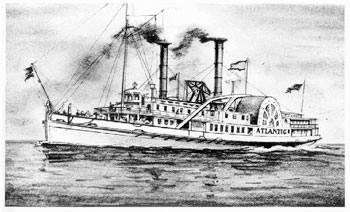
In the summer of 1852, $36,000 in cash and gold bars lay in a locked safe 165 feet deep on the floor of Lake Erie.Worth $920,000 today, the riches lay within the wreck of the steamship Atlantic. So did more grisly testimony of the shipwreck’s victims, estimated as ranging from 130 to over 250. The deaths represented about a third of the 576 travelers packed onto a steamship meant to accommodate far fewer.
The era’s stream of immigrants pouring west made a profitable trade for passenger steamers traveling the Great Lakes.
The Atlantic was the fastest one of all, speeding to Detroit from Buffalo in just 16-and-a-half hours. A towering steam engine churned huge paddle wheels on either side of the vessel.Despite her power and 267-foot-long brawn, the Atlantic succumbed when she was struck on the night of Aug. 20, 1852, by the Ogdensburg, a ship from a rival ferry line.
In the chaos and panic that ensued as the Atlantic began sinking, several of the lifeboats swamped when they hit the water.Some passengers grabbed cushions or anything buoyant and jumped in the water. The Ogdensburg circled back and picked up about 250 survivors from the water.
Immigrants among the rescued traveled on into the new world with no possessions, and some, according to survivor Amund Eidsmoe, one of the 132 Norwegians on board, went in a half-naked state to Milwaukee.In that city, a collection was taken up for their benefit. Eisdsmoe received $30 and a suit of clothes.
Read more... -
UAE diving team to search for sunken wartime submarine
- On 15/05/2010
- In World War Wrecks
By Kevin Scott - Gulf News
A Dubai-based shipwreck hunter is embarking on a new expedition in search of a sunken Italian wartime submarine.
William Leeman, a member of the Desert Sports Diving Club in Al Quoz, and his team of divers will begin their five-day search for the Galvani in international waters off the coast of Iran on May 28.
The Galvani was sunk by British sloop HMS Falmouth near the Straits of Hormuz on June 26, 1940. Leeman, who was the first person to find the Nazi submarine U-533 off the coast of Fujairah several years ago, is heading the first expedition to search for the Galvani.
Very little information is available about the whereabouts of the lost Italian sub, which makes her physical discovery even more precious to historians.
"We have coordinates for the Galvani from the Hydrographic Office in London that show ‘position precise'. We have already been on a scouting trip prior to the exhibition because it is vital we locate the Galvani's exact position; every meter counts when you are underwater," Leeman said.
"The Galvani is a historic vessel and it will be quite a challenge to find it. If we succeed, it would equal any of my diving achievements including the discovery of the U-533. The big problem we face on this expedition is the sub's location just off the coast of Iran," he said.
"We will be diving in a shipping channel between Iran and Oman. I would not say it is inevitable that we will be arrested by the Iranian authorities but it is a possibility," Leeman added.
"I have my passport and ID on a laminated sheet in case we encounter any difficulties. We have never had a boat driver brave enough to take us before."
However, the Galvani's location is not the only obstacle facing the expedition. The deep-sea mission is dangerous in its own right and every team member has been trained to be totally independent underwater.
Technical diving is generally considered diving which is deeper than 40 metres. Leeman and his team will be plummeting to depths of a 100 metres over a period of approximately two hours.
"We always dive in pairs, nobody goes solo. However, circumstances can change underwater and people can become separated from each other," Leeman said.
"You cannot go looking for people at such depths if you lose them; there is no way back at that point and you just have to hope you meet up with everybody back at the top," he added.
"The other big risk with 100-metre dives is oxygen toxicity on decompression, which could lead to convulsions underwater. The team have been trained to mix different gases on their way back to the surface." -
Indonesia criticized for murky rules on sunken treasures
- On 14/05/2010
- In Auction News

By Putri Prameshwari - The Jakarta Post
Given the country’s thousands of sprawling islands, key shipping lanes and bounty of shipwrecks, the government should immediately draft legislation on the recovery and management of sunken treasures, stakeholders said.
Last week’s lack of bidders at an auction of 10th-century ceramics and jewelry recovered from the depths was clear proof that the government had a long way to go toward managing such items, said speakers at a discussion organized by the Indonesian Heritage Trust (BPPI) in Jakarta on Tuesday.
Ratu Raja Arimbi Nurtina, a spokeswoman for the Cirebon royal family at the Kanoman Palace, said the recovered items had been taken from the waters off Cirebon, West Java, without the involvement of local residents.
“I regret the decision to take these treasures and put them under the hammer,” she said. “Even though they were, strictly speaking, not ours, it would have been better to consult with us on the matter.”
The treasures, Arimbi said, could have been used to build a picture of the region’s vibrant trading history.
“The palace opposes any attempt by the government to auction off the treasure before it is exhibited to the people of Cirebon,” she said, adding that Kanoman Palace needed a say in any decision made by the government or private contractors salvaging sunken treasure in the area.
Mustaqim Asteja, from the Cirebon-based Kendi Pertula Heritage Society, said a thorough study of the treasure could shed light on the city’s past. “History is a work in progress,” he said. “You can’t categorically rule out these items being related to Cirebon or its development.”
The Cirebon shipwreck was located 130 kilometers off the north coast of West Java. Under the regional autonomy law, a district’s jurisdiction stretches up to six kilometers offshore, while a province’s jurisdiction extends from six to 20 km. The central government is responsible for anything beyond that.
Nunus Supardi, the former director for archeology and ancient history at the Kendi Pertula Heritage Society, said government regulations on recovered treasures remained unclear. “No one understands how it works,” he said. -
'Ghostly' pictures of Great Wall of China taken from underwater
- On 14/05/2010
- In Miscellaneous

Photo: Mathieu Meur/National
By Andrew Hough - Telegraph.co.uk
The section of wall lies under the surface of Panjiakou reservoir about three hours drive northeast of Beijing.
A team of professional divers braved the murky conditions to get some ghostly shots of the wall which ran from 13 metres below the surface to the bottom at 35 metres.Though urban legend has it being the only man-made object visible from space this one part is lying up to 100 feet below a valley flooded when a dam was built.
Mr Meur, the expedition photographer, said just getting the 500kg of equipment down hundreds of steps to the water's edge was a challenge in itself.
"The lake itself is rather barren, with only a couple of species of freshwater fish and shrimps," he said.
"The real stars here really are the ruins. The wall is in amazingly good condition considering that it is several hundred years old, and is underwater.
"The top of it was at around 13m depth, and we located a guard tower, with openings on all sides, which created underwater tunnels."
He added: "Throughout the dives, the weight of history was very present on our minds. It was incredible to navigate the wall and guard posts, thinking that centuries ago soldiers were walking the same location, keeping China safe from intruders."
"We did two dives on the Wall and wanted to do more but were plagued by technical problems.
"The diving was challenging as it was 25 centigrade on the surface but dropped to just six degrees when you got 35 metres down on the bottom.
"Visibility was limited to about 1-5 metres maximum, as the bottom is very silty. If you stir the bottom, you end up diving in soup." -
Sunken treasure in Morton & Eden London sale
- On 13/05/2010
- In Auction News
From News Antique
Salvaged gold coins and ingots recovered from a Spanish treasure ship which sank in 1752 are among items to be sold by specialist London auctioneers Morton & Eden in London on May 20, 2010. The Wallace Katz Collection is expected to raise a total of around £200,000.
The late Mr Katz, a New York collector was inspired by the romanticism of gold coins and ingots that had been recovered from the seabed.In 1993, for example, he was a major purchaser at the Sotheby's New York sale of The Uruguayan Treasure of the River Plate recovered from the wreck of the Nuestra Señora de la Luz.
On July 2 1752, the Luz was anchored off Montevideo, preparing to sail to Cadiz and waiting for the last of her cargo, passengers, crew and captain.She was swept away by a westerly storm of extreme suddenness and violence (known locally as a pampero), and her wreckage was smashed against the northern coast and strewn over a large area. All hands were lost.
A salvage operation commenced immediately and over 90 per cent of the registered cargo and large quantities of privately owned goods were successfully recovered within the following year. Further modest finds were made during the next 20 years, although the compartment of the Luz's hull in which the ammunition and powder store would have been located, was not found.
The wreck was discovered in 1992, although the divers at first assumed it was that of El Preciado sunk in 1792. However, during the salvage operations, it became apparent that, due to the large quantities of 8 and 4 escudos dated between 1749 and 1751, most of which were in perfect or near perfect condition, the wreck had to be a ship sunk soon after the date of the latest coins found.
This pointed to the Luz and almost certainly to the contraband stored in the ship's hull. In addition to escudos coins of various denominations and a quantity of silver coins, the divers also salvaged 40 gold ingots. -
The mystery of the Ming dynasty galleon
- On 11/05/2010
- In Eastern World Treasures
By Malcolm Moore - The Telegraph
Three years ago, a group of local fishermen were diving off the side of their boat near Nan’ao island chain, a cluster of small islands which lie close to the south China coast, roughly two-thirds of the way between Hong Kong and Xiamen.
On the sea-floor, one of the fishermen found ten porcelain plates, which he promptly scooped up, stashing a few of them away and taking the others to the market to sell.
An informant promptly ratted on him and some officials from the Guangdong Cultural Relic Research Institute came to have a word about where the porcelain came from.
When the fisherman took the researchers to the site, they discovered the wreck of a 65-foot-long ship, probably a merchant vessel, which may have been carrying tens of thousands of pieces of blue-and-white porcelain to foreign markets.
More importantly, the researchers dated the ship to the late Ming dynasty, probably during the reign of the Wanli Emperor (1573 to 1620).
The wreck is, in fact, the first late Ming dynasty ship ever found. “We have found lots of wrecks from the Song and Yuan dynasties, but this is the first ship we have found from the late Ming era. There’s just nothing to compare it with,” said Cui Yong, the head archaeologist on the salvage operation.
“We have been trying to raise it last year and again early this year, but the weather has been terrible,” he added.
The ship was found too close to the Chinese shore to draw any conclusions about its final destination, but Mr Cui reckons it may have been heading in a south westerly direction “possibly to the Philippines”.He said: “There’s a high chance it hit a rock or a hidden reef, since there are quite a few in the area”.
-
Can a nation afford its own treasure ?
- On 11/05/2010
- In Auction News
By Dina Indrasafitri - The Jakarta Post
Middle Eastern traders carrying swords with golden hilts sailed a ship filled with goods such as intricately carved ceramics and glimmering green glass wares from the Eastern Mediterranean. Alas, the ship, along with the hundreds of thousands of trade wares, sank in the waters of the archipelago when making its way to the Kalingga kingdom in Central Java.
So went one scenario suggested by Adi Agung Tirtamarta, the CEO of one of the private companies involved in the excavation of over 270,000 artifacts from a sunken ship about 90 miles North West from the city of Cirebon, West Java.
Another scenario suggested that Middle Eastern traders had stopped by in India and China to pick up goods before crossing the Molucca strait and met their final fate in the sea, he said. Romantic as the tale seemed, the story of its finding, up to the recent auction, which attracted no bidders in Jakarta, had been less so, for it revealed that Indonesia’s sunken treasures might be too costly to handle alone.
Local fishermen were the first to discover the Cirebon wreck, which came to rest more than 50 meters below sea level. They then sold the position to PT Paradigma Putra Sejahtera-Adi Agung’s company.
What is telling is that they did not report the find to the local authorities.
“Perhaps they thought reporting to companies wouldn’t get them any compensation, so they asked the government what companies work in the excavation of sunken cargo from ship wrecks,” Adi Agung said.
The company proposed to the government its survey and excavation plan, which was issued in February 2004. The recovery process, completed in October 2005, took 18 months.
According to the artifacts’ catalogue, the majority of the ceramics found at the wreck were produced during the Five Dynasties in China’s Zhejiang Province, where an early form of porcelain called the Yue ware were produced.
History enthusiasts protested the government’s plan to auction some of the discovered artifacts.