HOT NEWS !
Stay informed on the old and most recent significant or spectacular
nautical news and shipwreck discoveries

-
Titanic search was cover for secret Cold War subs mission
- On 27/05/2008
- In High Tech. Research/Salvage
By Lewis Smith
The man who located the wreck of the Titanic has revealed that the discovery was a cover story to camouflage the real mission of inspecting the wrecks of two Cold War nuclear submarines.
When Bob Ballard led a team that pinpointed the wreckage of the liner in 1985 he had already completed his main task of finding out what happened to USS Thresher and USS Scorpion.
Both of the United States Navy vessels sank during the 1960s, killing more than 200 men and giving rise to fears that at least one of them, Scorpion, had been sunk by the USSR.
Dr Ballard, an oceanographer, has admitted that he located and inspected the wrecks for the US Navy in top secret missions before he was allowed to search for the Titanic.
Only once he had used his new underwater robot craft to map the submarine wreck sites was he able to use it to crisscross the North Atlantic seabed to pinpoint the last resting place of the luxury liner. It meant he had only 12 days to find the Titanic. -
Military robot subs seek out sunken treasure
- On 24/05/2008
- In High Tech. Research/Salvage

By Jeff Hecht
Robot submarines designed to hunt for underwater mines showed potential as underwater archaeological treasure hunters last week, turning up several new artefacts off the coast of Rhode Island, US.
Several military AUVs (autonomous underwater vehicles) took part in the archaeological treasure hunt as part of a US Navy event called AUVfest. The contest suggests that robotic submersibles could find many non-military applications as they become cheaper.
The US National Oceanic and Atmospheric Administration (NOAA) sought to test the ability of navy subs to investigate shipwrecks and inspect undersea cables and pipelines.
During the event, the subs discovered eight previously unknown objects associated with the wreck of 18th century frigate, HMS Cerberus, which was scuttled by its British captain in August 1778 during the American Revolution.
< -
In Memoriam - Roxanna Maude Brown
- On 21/05/2008
- In People or Company of Interest

From UCLA Institute and other sources
It is with deepest sadness that we mourn the untimely death on May 14, 2008 of UCLA Art History alumna Dr. Roxanna M. Brown, 62, world-renowned expert on SEA ceramics, curator of the Southeast Asian Ceramics Museum at Bangkok University and editor of their excellent newsletter.
She died in Seattle reportedly of an infection brought on by a perforated ulcer while in federal custody on a very dubious indictment.
She had gone to Seattle to present a paper on SEA ceramics at a conference co-sponsored by UCLA and the University of Washington.
An Asian-antiquities dealer arrested in Seattle on wire-fraud charges died in federal custody from infection and inflammation caused by a perforated gastric ulcer, according to the King County Medical Examiner's Office.
Brown had been arrested a week ago by federal agents on an grand-jury indictment in Los Angeles. She was charged with wire fraud and was a key figure — and the first arrest — in a long-running investigation into alleged Asian-antiquities smuggling and fraud, according to court papers. -
Spanish galleon discovered in Southern Chile
- On 20/05/2008
- In Shipwrecks of the "New World"
By Julia Thompson
Remains of a 238-year-old shipwrecked Spanish galleon named “Our Lady of the Good Council and San Leopoldo” have been discovered on the coast near the Chilean town of Curepto, located in Chile's Region VII. Oriflama S.A., the private archaeological excavation firm that discovered the galleon, is now grappling with Chilean authorities for permission to continue their excavation efforts and receive part of the estimated US$30 million in booty.The Chilean National Monuments Council insists the ship and its treasures are state property under terms spelled out in Chile’s national monuments law N. 17.2888. Even so, the Council has agreed to grant the company 25 percent of the loot.
“Because the ship was embedded in the sand rather than deep under the ocean 'Our Lady of the Good Council and San Leopoldo' is property of the private business that found it,” the Republic's Comptroller's Office told the Santiago Times.
Most archaeologists expected to find the remains of the ship deep on the ocean floor. But fragments of the 41-meter x 11-meter ship have been discovered embedded in the sand under fairly shallow waters near where the Huenchullami River flows into the ocean.
The once ornate vessel was built by the French in the mid 1700s and, loaded with 56 canons, was used by their military until the ship fell into Spanish hands. The Spaniards revamped the ship into a merchant vessel and set it sailing to New Spain.
-
Divers accused of taking treasures face trial in Spain - The Friesland
- On 16/05/2008
- In Illegal Recoveries
From This Is Cornwall
Falmouth diver Peter Devlin and a friend from Truro have been given less than a fortnight to face trial in Spain, accused of plundering treasure from a sunken wreck.
The friend, father-of-four Malcolm Cubin, was suddenly told to prepare a defense to face trial in 10 days after the matter had hung over himself and Mr Devlin for more than six years.The case was delayed, but the two men now face a nervous wait to find out if they will spend up to six years in a Spanish prison.
Self-employed commercial diver Mr Cubin, 37, of Truro, said: "The first I heard about it was from the TV news so I was stunned and shocked.
"Then the panic set in and I called our investors who confirmed it. I contacted our lawyers in Spain who got a stay of execution.It's hard to know what to do with it always in the back of your mind. You wonder what's going to happen to your family if you get carted off to jail. We did nothing wrong and no-one has convinced us otherwise."
A team including Mr Cubin was licensed by the Spanish government to recover 220 tonnes of tin from Dutch cargo vessel the Friesland, which sank off the port of Corrubedo, Galicia, in 1877, and hand over 23% of the expected £650,000 value. -
Divers find Caesar bust that may date to 46 B.C.
- On 15/05/2008
- In Underwater Archeology

From Yahoo! News
Divers trained in archeology discovered a marble bust of an aging Caesar in the Rhone River that France's Culture Ministry said Tuesday could be the oldest known.
The life-sized bust showing the Roman ruler with wrinkles and hollows in his face is tentatively dated to 46 B.C. Divers uncovered the Caesar bust and a collection of other finds in the Rhone near the town of Arles — founded by Caesar.
Among other items in the treasure trove of ancient objects is a 5.9 foot marble statue of Neptune, dated to the first decade of the third century after Christ.
Two smaller statues, both in bronze and measuring 27.5 inches each also were found, one of them, a satyr with his hands tied behind his back, "doubtless" originated in Hellenic Greece, the ministry said. -
1846 shipwreck yields southern gold and capped bust halves
- On 15/05/2008
- In Treasure Hunting / Recoveries
From Coin Link
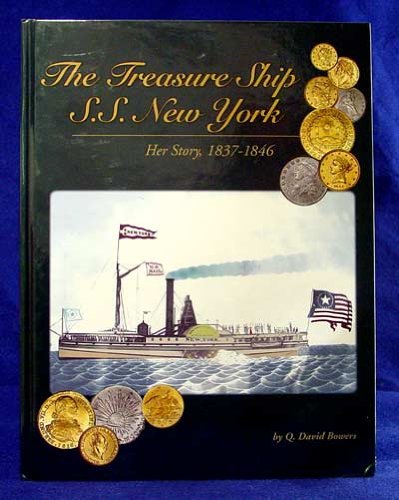
A recent close examination of coins recovered a year ago from the 1846 Gulf of Mexico shipwreck of the SS New York has revealed some of the finest known Southern branch mint gold coins and a nearly complete set of Bust half dollars.
The New York was a side-wheel steamer that foundered during a hurricane about 60 miles off the coast of Cameron, Louisiana in 1846.Four New Iberia, Louisiana area residents found the 365-ton wooden hull ship in about 60 feet of water two years ago. The four, who call their recovery operation, “Gentlemen of Fortune,” are Gary and Renée Hebert, Avery Munson and Craig DeRouen.
“We brought up the ship’s bell in the summer of 2006, staked a claim and obtained a federal court judgment granting us title to the site, then brought up several hundred coins from the underwater mud last year.We recently sent them to Numismatic Conservation Services and Numismatic Guaranty Corporation for certification,” said DeRouen.
-
Monitor sanctuary in good health overall
- On 15/05/2008
- In Parks & Protected Sites
From NOAA
The natural resources of the Monitor National Marine Sanctuary off the North Carolina coast are in good condition overall, but the wreck of the Civil War ironclad encompassed by the site is at risk from human activity and natural deterioration, according to a new NOAA report.
The first-of-its-kind assessment of the sanctuary’s archaeological and living marine resources indicates that corrosion, strong currents, hurricanes, high water temperatures and highly salty water threaten the long-term stability of the Monitor wreck.Discarded fishing gear, which can become entangled on the wreck, and other forms of marine debris also pose a danger to the historic site.
Although not a major problem currently, looting of the wreck, vessel anchoring, bottom trawling and other activities prohibited in sanctuary waters are of concern due to significant diving, boating and fishing activity in the area.