HOT NEWS !
Stay informed on the old and most recent significant or spectacular
nautical news and shipwreck discoveries

-
Button is clue to sunken ship's history
- On 25/07/2012
- In Parks & Protected Sites

By Marcia Lane - St AugustineA ship’s bell from a wreck found off St. Augustine has yielded another clue to the possible identify of the ship that may date from the American Revolution.
The clue: a button found in the concretion still attached to the bronze bell that was discovered in 2010 by archaeologists with the Lighthouse Archaeological Maritime Program.
“It’s in rough shape,” Sam Turner, director of archaeology at the St. Augustine Lighthouse and Museum, said of the button.
Even so, the top part of a crown can be seen on the button and similar crowns are found on Royal Provincial buttons plus the initials RP.
Those were on the uniforms of men in the Loyalist regiments, the colonists who remained loyal to the Crown during the American Revolution.
“When our button is cleaned you hope to find RP or part of one (of the letters),” Turner said.
That would be a big step forward in identifying the wreck discovered a few miles off the St. Augustine Inlet in the summer of 2009.
One of the hypotheses archaeologists have been working under is that the ship could be part of a fleet carrying Loyalists to St. Augustine after the fall of Charleston to the Americans.
Over a two-day period 16 ships were reported wrecked off the sandbar in December of 1782.
-
How you get dry supplies to an underwater base—without a submarine
- On 23/07/2012
- In Miscellaneous
By Brian Lam - GizmodoYou think carrying your grocery and laundry into your 5th-floor walkup is a pain in the ass ?
Try bringing that stuff into an undersea base without it getting soaked. How do you do it ?
The answer is surprisingly low-tech: pressure pots.
Pressure pots are paint cans that have been modified with a release valve that lets them gradually normalize to their surroundings' pressure.
When they go down to the habitat, the valves let air flow in slowly, adjusting to an environment that is at 2.5x regular atmospheric pressure; when they come, they let the pressure slowly bleed off.
Clamps or bolts hold the lids on, and divers swim them 50 feet down to the entrance of Aquarius Reef Base.
Without the bleed off valve, a pot would be dangerously compressed when brought to the surface—the lid could literally fly off when you undid the clamps.
When brought down to the bottom, a canister's vacuum would make it impossible to open.
-
F-16 fighter jet splash down in Pacific near Kurils
- On 23/07/2012
- In Airplane Stories

From RTAn American F-16 fighter jet went down in a Russian exclusive economic zone near the Kuril Islands on Sunday.
The pilot successfully ejected before the jet plummeted into the waters below.
“The Kamchatsky territorial naval rescue center reported at 8:30 am local time (8:30 pm GMT) that an aircraft was in distress over the Pacific Ocean near the northern Kurils,” Andrey Orlov, a spokesman for the Russian Border Guard Service in the Far East said.Later on it turned out to be an American F-16.
The Russian Antias border patrol vessel and an An-72 patrol aircraft were dispatched to the crash zone, though the pilot was ultimately picked up by the Japanese the Hokko Maru fishery research vessel about five hours after the crash.
Orlov says the fighter jet sank almost immediately after the crash.The Antias patrol vessel that arrived at the scene has not found even a petrol spot on the surface of the ocean, so the crash site poses no threat to ecology, the Russian border guard reported.
-
50 tons of garbage pulled from Pacific Ocean
- On 23/07/2012
- In Miscellaneous

By Stephanie Pappas - MNN
About half of the marine junk was broken fishing gear and plastic from Midway Atoll.Scientists loaded their ship to the max this month off the coast of Hawaii, but their bounty wasn't fish or coral or any other scientific specimen. It was garbage.
The crew of the National Oceanic and Atmospheric Administration (NOAA) ship Oscar Elton Sette pulled 50 metric tons of marine debris out of the Papahanaumokuakea Marine National Monument off the northwestern Hawaiian Islands last month, part of an ongoing mission since 1996 to clean up the shallow coral reef environment.
"What surprises us is that after many years of marine debris removal in Papahanaumokuakea and more than 700 metric tons of debris later, we are still collecting a significant amount of derelict fishing gear from the shallow coral reefs and shorelines," Kyle Koyanagi, the chief scientist for the mission, said in a NOAA statement."The ship was at maximum capacity and we did not have any space for more debris."
NOAA has been sending out garbage-removing ships every year since 1996.On the mission that ended on July 14, 17 scientists cleaned up the coastal waters and shorelines of the Kure Atoll, Midway Atoll, Pearl Atoll, Hermes Atoll, Lisianski Island and Laysan Island, all in the northern section of the Hawaiian Islands.
-
Symbiosis in the deep sea
- On 23/07/2012
- In Marine Sciences
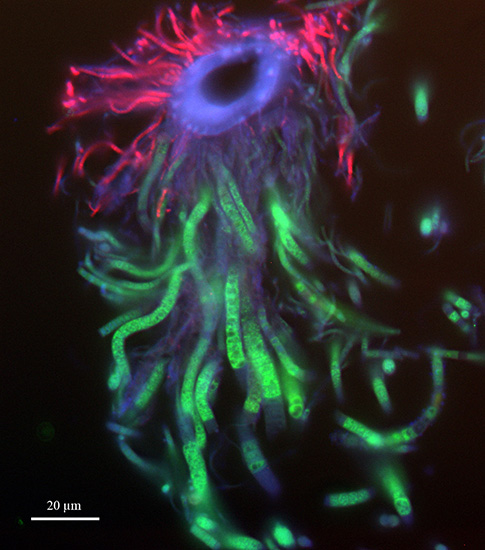
From Oceanus
Scientists discover how bacteria living with shrimp make a living.Mobs of pale shrimp clamber over each other, jockeying for position in the swirling flow of black-smoker vents on the seafloor where ultra-hot fluids from Earth’s interior meet cold seawater.
The shrimp, Rimicaris exoculata, are not the only animals that live near these vents on the Mid-Atlantic Ridge, the volcanic seafloor mountain range that bisects the ocean basin.
But they are by far the most abundant, with population densities reaching 3,000 individuals per square meter.
Though numerous and known to science since 1986, how they make their living is still a mystery.
At first, scientists thought they grazed on bacteria that grow on the chimney-like walls of the vents, which spew dark, chemical-rich fluids into the ocean.
Then, in the 1990s, a novel kind of bacterium was found living in the shrimps’ gill chambers.
That finding raised the possibility that Rimicaris relies on symbiotic relationships with bacteria, which, in turn, need chemicals in the vent fluids to live.
But figuring out how two organisms interact requires more detailed knowledge than just seeing them together. What kinds of bacteria are present with the shrimp ?
What, if anything, do the bacteria and the shrimp provide to each other ? How do they do it ?
-
Funding cut imperils undersea lab
- On 21/07/2012
- In Maritime News

Photo Mark Ostrick
By Jennifer Kay - St AugustineOcean explorer Sylvia Earle sported one Rolex dive watch on each wrist as she slipped beneath the balmy waters of the Florida Keys for a weeklong stay at an undersea research lab where marine biologists have kept constant watch on a coral reef.
In 1970, Rolex gave Earle a small gold watch when she led the first team of women “aquanauts” to a lab off the U.S. Virgin Islands. Back then, prolonged underwater exploration was still something of a novelty.
She got a larger black dive watch not long before arriving in Key Largo last week for what could be the last mission for her and other scientists to the Aquarius Reef Base.
It seems that time has almost run out for the lab in the Florida Keys National Marine Sanctuary.
The mission ending Saturday could be the last at the last publically funded lab of its kind, because the Obama administration has cut Aquarius’ $3 million annual funding.
The National Oceanic and Atmospheric Administration owns the lab that has rested for two decades some 60 feet below the water’s surface.
The federal budget cuts threaten to close the lab unless it can secure private funding.
-
Deep water treasure hunters recover 48 tons of silver
- On 19/07/2012
- In Treasure Hunting / Recoveries
From gCaptain
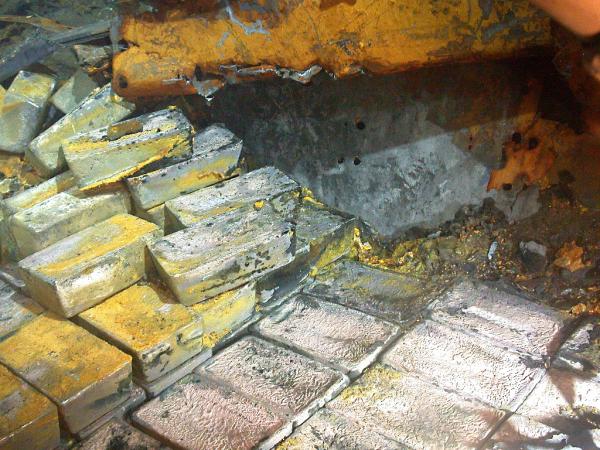
Odyssey Marine Exploration Inc., a deep-ocean exploration company, said it recovered about 48 tons of silver from a World War II shipwreck three miles (4.8 kilometers) beneath the Atlantic Ocean.
The company retrieved 1,203 silver bars, or about 1.4 million ounces of the metal, from the SS Gairsoppa, a 412-foot (126-meter) British cargo ship that sank after being torpedoed by German U-boat in February 1941, Tampa, Florida-based Odyssey said today in a statement.
The metal, worth $38 million at today’s prices, is being held at a secure facility in the U.K.
Odyssey said the recovered silver represents about 20 percent of the bullion that may be on board the Gairsoppa, which lies about 300 miles off the coast of Ireland.
The operation, the largest and deepest recovery of precious metals from a shipwreck, should be completed in the third quarter.
“With the shipwreck lying approximately three miles below the surface of the North Atlantic, this was a complex operation,” Greg Stemm, Odyssey chief executive officer, said in the statement.
“Our success on the Gairsoppa marks the beginning of a new paradigm for Odyssey in which we expect modern shipwreck projects will complement our archaeological shipwreck excavations.”
-
Chinese warship runs aground on Philippine reef
- On 18/07/2012
- In Maritime News
As China's leadership continues to press its claim on territory that the Philippines also claims for itself, a Chinese warship has run aground on a reef off Palawan while patrolling contested waters in the South China Sea/West Philippine Sea, an Australian newspaper reported on Friday.
The report came as the Philippine government started verifying reports that China had installed a powerful radar on Subi Reef, an islet 22 kilometers from the Philippine-occupied Kalayaan group of islands in the Spratly archipelago.
Reporter John Gaurnaut of The Sydney Morning Herald, citing unnamed Western diplomatic sources, said the People’s Liberation Army’s naval ship No. 560 became “thoroughly stuck” on a reef at Half Moon Shoal during the previous night.
The warship is a Jianghu-class frigate “that has in the past been involved in aggressively discouraging Filipino fishing boats from the area,” the Morning Herald said.
The Philippines refers to Half Moon Shoal as Hasa-Hasa Shoal, which military sources said is only about 111 km (60 nautical miles) from the municipality of Rizal on the main island of Palawan province, well within the country’s 370-km (200-nautical-mile) exclusive economic zone.
Mayor Eugenio Bito-onon of Kalayaan in Palawan confirmed the incident and said it has been 10 days since it happened according to field reports.