HOT NEWS !
Stay informed on the old and most recent significant or spectacular
nautical news and shipwreck discoveries

-
Tampa’s Odyssey Marine
- On 12/08/2016
- In People or Company of Interest

By Robert Trigaux - TBO
For more than two decades, Tampa’s Odyssey Marine Exploration has reveled with a reputation as a swashbuckling, deep-ocean treasure hunting enterprise.Odyssey has hauled tons of gold and silver from centuries-old U.S., Spanish and British ships sunk far beneath the Atlantic Ocean and adjacent waters. The company has enjoyed the limelight of more front page stories over the years in the New York Times than most major U.S. corporations and far more than any other business in the Tampa Bay area.
It has been the focus of long sagas in magazines like The New Yorker and was profiled by a National Geographic staffer in the 2005 book Lost Gold of the Republic about what was then the richest monetary and archaeological marine salvage in American history.
In 2009 the Discovery Channel launched a reality called Treasure Quest with 12 episodes devoted to Odyssey Marine’s shipwreck adventures. “Shipwreck stuff was cool,” Odyssey Marine CEO Mark Gordon said in a sit-down interview this summer.
“The acid test is when your teenage daughter asks you to come to school day and tell them what you do.” Lately, the coolest Dad around now looks more like the Maytag repairman sitting by a phone that does not ring. Odyssey Marine’s forlorn Tampa headquarters sits back in a too-quiet office building on West Laurel Street, its second floor space eerily lean on employees.
Tight times in the past year forced cuts in office staff to 22 from more than 40. Nine years ago, when the company was in the thick of high-profile underseas treasure finds, Nasdaq-traded Odyssey basked in a stock price topping $80.
This year, its sub-$4 shares briefly spiked at $9 in April after Odyssey took a draconian move of converting every 12 shares to one in order to raise its stock value. But shares have since sunk again, now trading between $2 and $4. Nasdaq has warned Odyssey its market value (shares times its stock price) is still below the $35 million minimum value required to remain as a viable Nasdaq-traded company.
One of Odyssey’s last shipwreck finds in 2007, code named Black Swan, promised up to 500,000 gold and silver coins, a possible underwater mother lode. Except for one thing: Spain.
The country, claiming rights to the ship and its Spanish wealth, took legal action against Odyssey, eventually landing two C-130 airplanes at Tampa’s MacDill Air Force to load nearly 17 tons of salvaged coins and return the enormous bounty to Spain. That long legal fight diminished Odyssey’s stock price and resources, forcing company leaders to concede its days of treasure hunting as an independent company were at an end.
It all sounds bleak. And it is. Odyssey is at a crossroads. Will it slowly wither as a faded treasure hunting business, or reinvent itself as a business that can find even greater sources of wealth than shipwrecks on the ocean floor ?
Since its start, Odyssey’s future was built on its specialized skills as a deep ocean shipwreck finder. Few treasure hunters can pursue shipwrecks deeper than 1,000 feet and Odyssey used its ROV or “remotely operated vehicle” known as “Zeus” on wrecks as deep as 15,000 feet — nearly 3 miles underwater.
That’s what set it apart from so many shallow water treasure hunters. Gordon still ponders Odyssey’s choices.
-
Colombia trabajará en la recuperación del Galeón San José
- On 08/08/2016
- In Shipwrecks of the "New World"
El Pais
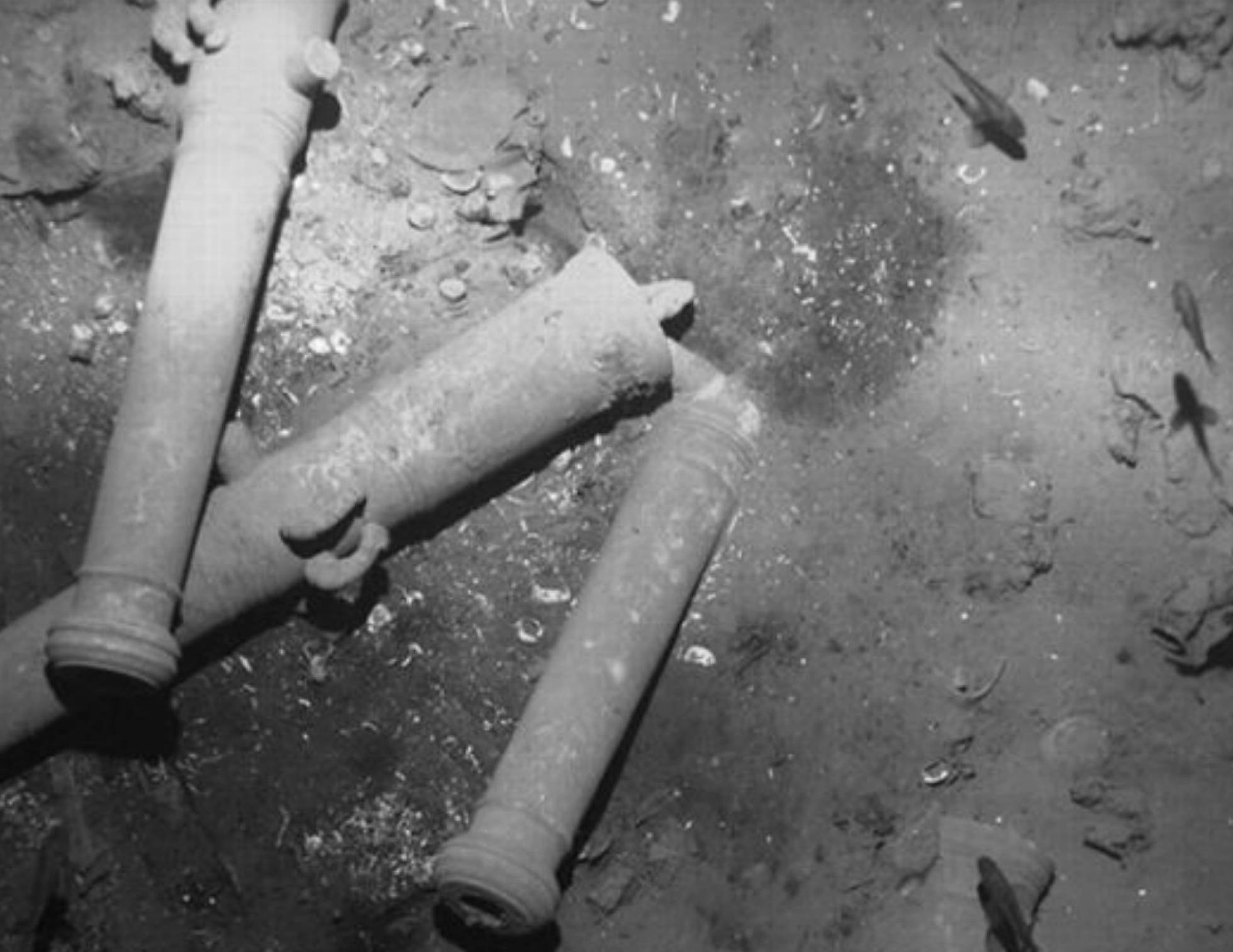
"El Galeón San José lo vamos a recuperar siguiendo todos los cánones”, aseguró este sábado el presidente de Colombia, Juan Manuel Santos, durante la inauguración de la nueva sede del Instituto de Investigaciones Marinas y Costeras ‘José Benito Vives de Andréis’, en la ciudad de Santa Marta.El mandatario de los colombianos señaló que la tarea de recuperación del galeón no será realizada por cazatesoros y que el propósito es permitir que la humanidad pueda gozar del patrimonio que se logre encontrar.
"Hay un aspecto que tiene que ver con esta institución y es muy importante: toda la riqueza marina que hay alrededor del San José para recuperar, para poder investigar”, advirtió e insistió en que la idea de rescatar la embarcación obedece a motivos científicos y arqueológicos, más que comerciales.
El pasado mes de mayo el Gobierno colombiano reveló que aceptó la colaboración de España para la fase de investigación del galeón, sin embargo, en la jornada de este sábado Santos no se refirió a la forma cómo participaría este país en el proceso de recuperación de la nave, hundida por la Armada británica en aguas del Caribe en 1708.
Desde diciembre del año anterior, cuando el presidente Santos informó a los colombianos sobre el hallazgo de la embarcación 307 años después de su hundimiento, se han profundizado las dudas sobre cuál debería ser el destino del galeón.
Mientras el Ejecutivo considera que es " asunto de Estado", España, a través de su secretario de Estado de Cultura, José María Lassalle, ha advertido que la "embarcación debe quedarse donde está" y que al ser un patrimonio de la Humanidad, como lo señala la Unesco, "plantea una serie de protocolos de funcionamiento en relación con la protección del patrimonio subacuático".
A esa voz, se han unido la de otros científicos que desaconsejan rescatar el barco, argumentando que podría perder valor para su estudio.&
-
Sassanid-era pottery off Bushehr Peninsula
- On 08/08/2016
- In Underwater Archeology
By Ramin Adibi - Past Horizons
A pottery assemblage consisting of fragments of food storage vessels and amphora belonging to the Sassanid era (224 to 651 CE) has been discovered in the first underwater archaeological investigations near the coastal city of Bushehr, south-western Iran.Hossein Tofighian, exploration team supervisor explained that the underwater archaeological surveys under license from the Research Institute for Cultural Heritage and Tourism, are being carried out off the coastline of Bushehr as part of a field research program in partnership with the University of Medical Sciences.
Early on in the diving operations, the team discovered fragments of large food storage jars and torpedo-shaped amphora, leading them to conclude that there is a very high likelihood of an archaeological site within the shallow waters of the Bushehr Peninsula.
-
The London: Shipwreck collection to 'rival best in country'
- On 07/08/2016
- In Underwater Archeology
From BBC News
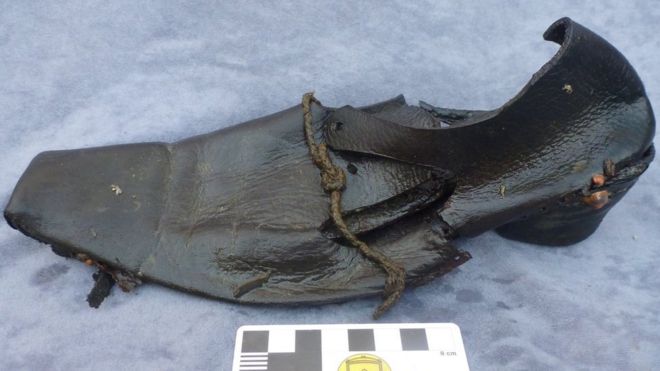
The London sank off Southend-on-Sea in 1665 and was only rediscovered in 2005.Artefacts salvaged from the wreck since 2010 have included shoes, pieces of instruments and a compass.
Steven Ellis, a licensed diver from Leigh-on-Sea, said the finds were remarkably well-preserved. Mr Ellis, who works as a fishmonger, said The London was the last surviving "large ship" built between 1642 and 1660 for the Anglo/Dutch War from "such an important period of time".
An estimated 300 people drowned when the ship mysteriously exploded on a journey along the coast to Gravesend and sank on 8 March 1665.
Mr Ellis said: "I've been diving it since 2010 and we've brought loads of bits up.
"We've found two gun carriages, all kinds of personal items like shoes, a compass - loads of stuff. "You can see by the shoe how well-preserved things are."
"When they eventually go on display, there is going to have to be a whole wing of the museum for them," he said.
-
UW duels: How Soviet submarines held their own in WWII
- On 03/08/2016
- In General Maritime History

From Alexander Vershinin - Russia Beyond the Headlines
On the eve of WWII the Soviet submarine fleet was the largest in the world. In terms of the number of subs it was twice as big as the fleet in the U.S. and almost four times as big as the Kriegsmarine, the German navy.Nevertheless, the challenges placed before it were rather narrow. Due to its geographical position the USSR could not fight for supremacy in the oceans. It had only two entrances to the open ocean, but both the North Pole and the Far East did not present the necessary possibilities to set up full naval infrastructures.
What remained were only closed seas: the Black Sea and the Baltic Sea. It was believed that after the beginning of the war the Soviet navy would be able to strike the enemy communications located in these regions.
But the Soviet submarines could not compete with those from Germany, while the position of the UK (which had the biggest fleet in the world) in the event of a war was unclear.
Therefore the decision to develop the submarine fleet was very logical: Relatively low production costs helped create a powerful force, capable of playing an important role in the war's naval battles.
-
Excavation of famed Chinese warship underway
- On 03/08/2016
- In Underwater Archeology

From Victor Ning - CRI
The shipwreck that was code-named "Dandong No.1" has been tentatively identified as the Cruiser Zhiyuan of the Beiyang Fleet.
But Song Jianzhong with the National Center of Underwater Cultural Heritage says it is still too early to make a final conclusion on the ship and its history."The relics and information currently in hand indicates it's the wreck of the warship Zhiyuan, but more work needs to be done before the publishing of the final conclusion."
The shipwreck was first discovered in 2013.
In the past month, over a hundred relics have been salvaged from the depths of the Yellow Sea, including canons, shells, and other artillery. The most crucial piece of evidence for the ship's identity is a shattered porcelain plate that features the words 'Zhiyuan' written in the middle of its back.
Song Jianzhong says all of the recovered items will studied further.
"Archaeology mainly focuses on the investigation, excavation, study and protection of cultural relics. Items to be found during the current underwater probe will be sent to labs where they will undergo procedures of de-watering, desalination and de-sulfated before being renovated and pieced together."
Also among the findings is a boiler cap found 30 meters away from the wreck at the bottom of the sea.
Sa Su, a Chinese scholar of Japanese studies, says the artifact could reveal details of the final moments of the brave sailors who operated the ship during combat.
"It's said that the sailors sealed the boilers at last in the hope of enabling them to generate more power and make the ship run faster than usual. Only with that, could it catch up with Japanese warships that were more advanced. But as seawater poured in after Zhiyuan's hull was penetrated by shells, the boiler exploded with the cap blown out."
The 2,300-tons warship, with 246 officers and soldiers aboard, was lost in the Battle of the Yellow Sea on September the 17th, 1894, during the first Sino-Japanese war.
-
US WWII tank from Barents Sea bottom
- On 25/07/2016
- In Salvage

From TASS
Russia’s Northern Fleet divers have raised a US Sherman WWII tank from the bottom of the Barents Sea during drills, acting Head of the Fleet’s press office Andrei Luzik said on Tuesday.The Sherman tank is the second combat vehicle recovered from the US Arctic convoy ship Thomas Donaldson sunk by a German submarine during World War Two.
"In addition to the tank, a 102mm gun, an antiaircraft machine gun and a pair of locomotive wheels, as well as a number of small items like artillery shell casings and projectiles were brought to the surface," the officer said.
The Northern Fleet personnel are using two diving boats with operational pressure chambers and a team of medical specialists for descents to the sea bottom, the officer said.
Also, remotely operated vehicles are being used to survey objects under the water, he added.
-
Recovered gold from SS Islander up for sale for $4 million
- On 25/07/2016
- In Treasure Hunting / Recoveries

By Paul Gilkes - Coinworld
Twelve-hundred troy ounces of Alaskan Gold Rush gold recovered in 2012 from the 1901 shipwreck of the SS Islander is being offered for $4 million exclusively through private treaty by Fred N. Holabird from Holabird Western Americana Collections LLC.The gold is unrefined placer gold contained in five original leather pokes, all sealed, and the contents of a sixth leather poke that broke open during the recovery process, according to Holabird.
Holabird is acting as the exclusive agent for the salvors. Placer gold is often found in alluvial deposits of sand and gravel in modern or ancient stream beds.
The Islander, a 240-foot-long steamship owned by the Canadian-Pacific Navigation Co., was bound from Skagway, Alaska, to Victoria, British Columbia, Canada, in the early morning hours of Aug. 15, 1901, when the vessel struck a submerged iceberg in Stephens Passage, next to Douglas Island, shearing the port bow.
The ship sank in 20 minutes, claiming the lives of 40 among the 107 passengers and 61 crewmembers reported aboard. Records suggest that gold valued then at $275,000 was aboard the Islander, a total that subsequently was quickly reported in news accounts as high as $2 million to $3 million.
The gold was in the form of placer gold that was secured in either locking leather mail sacks or gold pokes — elongated leather sacks containing the unrefined gold from Alaska’s Klondike.